Strong together









The unfolding of the AfCFTA is expected to increase governments' expenditure on infrastructure. According to the United Nations Economic Commission for Africa, the continent's overall commitment to infrastructure development averaged $75 billion annually between 2012 and 2016.
"However, more needs to be done, as the infrastructure deficit remains high, leading to many lost opportunities," says Vera Songwe, executive secretary of UNECA. "Energy, for example, continues to be a major hindrance in Africa's ability to establish competitive industries."
In addition, by creating a large consumer market, the AfCFTA is expected to give needed impetus to the China-Africa industrial partnering and industrial capacity cooperation - proposed during the Forum on China-Africa Cooperation Summit in Johannesburg, South Africa, in 2015 by President Xi Jinping - to speed up the relocation of jobs from China. The World Bank says Africa is well positioned to attract jobs outsourced by China as the latter's domestic labor costs increase.
"A scaled-up market is attractive to Chinese manufacturers. First, it reduces the need to negotiate tariff structures with 54 different countries and customize products for each market, too. A common market is better for planning," says Robert Kagiri, a strategy and policy consultant and adjunct lecturer at the Institute of Diplomacy and International Studies at the University of Nairobi.
Kagiri says this will augur well with the implementation of the China-proposed Belt and Road Initiative, whose aim is to connect Asia, Europe and Africa.
Kagiri says Kenya should pursue strategies similar to those that resulted in China's meteoric economic rise. Among these are creating a conducive investment environment through incentives and by building infrastructure.
"The move will push up foreign direct investments that will be accompanied by technology transfer," he says.
The AfCFTA will give impetus to Chinese investors to set up in the region and take advantage of the low wages as well as trade agreements with developed economies, such as the African Growth and Opportunity Act signed with the United States, Kagiri says.
"The African Continental Free Trade Area also offers immense opportunities to Chinese manufactures producing locally. It will give them a leg up as the continent shapes up to strengthen intra-African trade," he says.
According to Anzetse Were, a development economist based in Kenya, the realization of a continental trade bloc needs a coherent infrastructure plan by African countries to ensure a seamless network of linkages. "Once this is in place, it will be easy to align with the (Belt and Road Initiative) and source financing," she says.
While conceding that this will increase Africa's appetite for loans, she says most African countries are yet to establish innovative and effective public-private partnership policies that would open doors to alternative financing from the private sector.
The private sector in most countries lacks the capacity to implement mega projects, which prevents them from undertaking government bids, says Were. "The interest rates are so high compared to capital costs accessed by foreign firms. Therefore, a lot needs to be done by governments toward accessibility to cheap financing as the (AfCFTA) comes into action," Were says.
A lack of skills and technical capacity is another challenge facing Africa, she says.
"We will depend on partnerships with foreign companies to enhance our manufacturing sectors to meet demand. Otherwise, our import bill will still soar as population increases," says Were.
She says joint partnerships with Chinese manufacturers will build the country's technical and technological capacity. However, Kenya needs to make deliberate plans in building ecosystems that encourages manufacturing, she adds.
"We also need to undertake a comprehensive cost-benefit analysis and understand the needs of the Chinese market, then invest in these value chains to improve our products and access the Asian market," says Were.
Policy inconsistencies are also suppressing local manufacturing, says Yu, the managing director of Yocean Group. "In Kenya, computer parts and spares are levied a 25 percent import duty, while an already assembled computer is duty-free."
"We also need direct access to relevant government departments to ensure challenges are addressed fast," he says.
In addition, says Yu, African governments need to make deliberate efforts to facilitate intra-Africa trade.
The realization of a free trade zone is already facing head winds. Ten countries, including Nigeria, did not sign the AfCFTA agreement, asking for time to consult with local stakeholders. According to media reports, Nigerian President Muhammadu Buhari is concerned that imports would undermine local manufacturers and entrepreneurs.
Under the AfCFTA, the phasing out of tariffs will be applied gradually over five years for developing countries and 10 years for the least-developed ones. For sensitive products, there is an even longer phase-out period of 10 years for developing countries and 13 for the least-developed.
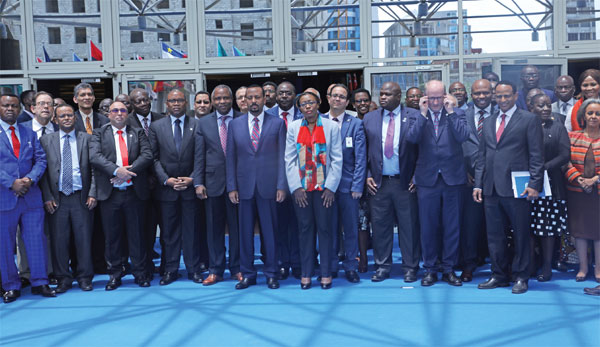
David Luke, the coordinator of the African Trade Policy Center at UNECA, says an autonomous secretariat has been created to oversee the realization of the trade agreement. There also is a consensus that it will be financed by the African Union, he says. The second phase of negotiations, on such issues as investment, competition and intellectual property rights, is expected to begin later this year and be completed by January 2020.
"E-commerce is also considered as a possible additional topic," says Karingi, of UNECA.
lucymorangi@chinadaily.com.cn