Emerging bloc has challenges and missions ahead









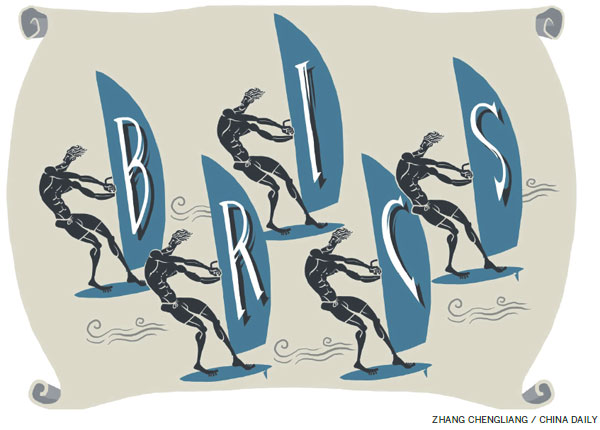
As a multilateral cooperation platform for Brazil, Russia, India, China and South Africa, BRICS has become an active player in global governance. The 10th BRICS summit in Johannesburg, South Africa, from July 25 to 27 is significant, because it brings together the leading emerging economies which are committed to safeguarding and promoting globalization and free trade amid growing unilateralism and trade protectionism in many parts of the world.
As important members of the G20, the BRICS states are helping reform the global governance mechanism to make it fairer and more representative of the changing world marked by the emergence of developing countries as vital drivers of global growth.
Within a decade, the BRICS group's proportion in the global economic aggregate has increased from 12 percent to 23 percent, contributing to about half of global growth. As such, the deepening of cooperation among its members will make BRICS an even bigger driver for global trade and investment.
And to make global trade fairer, the BRICS members must actively promote inclusive cooperation. Intra-BRICS' cooperation in credit rating and cybersecurity has already helped increase developing countries' say in economic matters, raising hopes that the world order could be reformed.
But for that, apart from expanding South-South cooperation, BRICS also has to adopt an effective approach to global cooperation. Intra-BRICS investment accounts for only 5.7 percent of their total foreign investment of $197 billion. Which means BRICS has to use innovative ways to expand cooperation at multiple levels to facilitate the reform of the global value chains and boost the global economy.
Besides, as it has done over the past more than 10 years, BRICS has to continue promoting peace in the coming decade so as to deepen multilateral cooperation for inclusive development and shared benefits.
The BRICS principle of equal partnership, mutual respect and win-win cooperation goes beyond ideology, abhors the zero-sum game and doesn't promote alliances. Instead, it is aimed at making more contributions to economic globalization and global governance, in order to build a community with a shared future for mankind. For example, the BRICS New Development Bank supports public and private projects through loans, equity participation and other financial instruments to advance development in various countries, and thus supplements the work of institutions such as the World Bank, International Monetary Fund and the Asian Development Bank.
Still, BRICS has to address the challenges that lie ahead.
BRICS members know the Western world better than each other's countries. So they have to expand communication and people-to-people exchanges to improve mutual understanding of and derive optimum benefits from each other.
Since the lack of enough communication among the BRICS members is the result of the very low volume of intra-BRICS trade, they would do good to use the China-proposed Belt and Road Initiative to promote cooperation in production capacity with the aim of expanding both exchanges and trade.
Different from each other in economic size, history, culture and conditions, the BRICS members don't have a unified and effective cooperation mechanism. Therefore they have to build such a mechanism to derive optimum benefits from each other. Plus, without an advanced cooperation mechanism to increase its influence in the global community, BRICS cannot include more members and expand its area of functioning, a factor which needs the special attention of the bloc.
The five-member bloc could also learn from the European Union how to increase public participation but, while doing so, it should be careful not to raise populist sentiments.
And despite setting an example for international cooperation, BRICS members still need self-improvement and more negotiations to better address the internal and external challenges so the bloc can become strong and sustainable enough to help reform the world order for the benefit of all countries in the long run.
The author is director of the Institute of International Affairs and senior researcher at Chongyang Institute of Financial Studies, Renmin University of China.