Deepening reform to counter trade threat









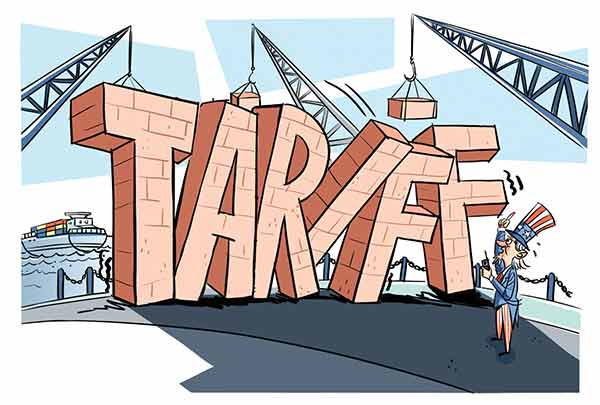
The United States continues to ratchet up its trade threats against China, the latest being the threat to impose 25 percent tariffs on $200 billion of Chinese exports, up from the 10 percent mooted previously.
Last month US President Donald Trump said, "I'm ready to go to 500"; in other words, impose tariffs on almost all Chinese exports to the US, which last year totaled $505 billion.
With the US' trade policy tending to follow Trump's trade rhetoric, it's worth thinking through just how much pain Washington could potentially inflict. Could it derail China's economic rise?
The good news is that the numbers point to China being well placed to weather the storm. The World Trade Organization says that only 65 percent of the value of China's exports to the US is actually added in China. This means the value-at-risk is not $500 billion but rather about $325 billion.
Which is still significant. But considering that the Chinese economy is now worth about $12 trillion, it would be less than 3 percent of GDP.
Besides, US tariffs on Chinese exports might as well be tariffs on Australian exports, Japanese exports, and so on, as these countries supply the raw materials and components that China uses to make final goods. This explains why on trade, Trump's battle cry of "America first" is, in fact, "America alone" with even US security allies wanting nothing to do with its lurch toward protectionism.
Even a 25 percent tariff won't totally wipe out US demand for Chinese goods. US importers will absorb some of the cost increase. And the bilateral exchange rate can undergo adjustment, offsetting an increase in the price of Chinese goods in US dollar terms. Putting all that together, the short-and medium-term impacts of US tariffs on China are likely to be negative but manageable.
In the long run, economics textbooks are clear about what will determine whether China will achieve the status of a high-income country, and it's not US trade policy. In 1994, Nobel Prizewinning economist, Paul Krugman wrote: "Productivity isn't everything, but in the long run, it is almost everything."
Currently, the value of output per worker in China is only about 26 percent of US levels. This fact shows China's enormous potential for "catch up". Of course, "catching up" is not destiny, as many countries in the past have got stuck in the so-called middle-income trap.
But there are plenty of reasons to be optimistic.
Five years ago it was commonplace to wonder whether China could really innovate. Now, most economists have little doubt about China's ability to innovate.
Besides, in 2012 only Beijing, Shanghai and Tianjin had per capita income levels that met the threshold the World Bank uses to classify countries with high income. Collectively, they accounted for 62 million people. By 2017, they had been joined by Jiangsu and Zhejiang provinces, adding a further 136 million people. Next year, Fujian and Guangdong provinces are on track to graduate, taking the aggregate to 285 million people.
How China responds to the US' trade provocations will inevitably consume headline writers in the coming months. But the real story will be whether China deepens domestic reform needed to propel living standards in provinces such as Yunnan and Gansu to the levels enjoyed by the coastal provinces today.
China is doing a lot right, with the upgrading of transportation and energy infrastructure nationwide being a highlight. But some other recent trends are less encouraging.
In 2000, China's trade-weighted average tariff was 14.7 percent. By 2005, after having implemented its WTO entry commitments, it fell dramatically to 4.7 percent. Since then, no further progress has been made, although in 2016 the figure was higher at 5.2 percent.
Last month, a report by the International Monetary Fund revealed the outstanding efficiency of Chinese private enterprises: their rate of return on assets was five times higher than that of State-owned enterprises. Yet for much of the past three years, the growth of fixed asset investment by these "less-efficient" SOEs has outstripped their private sector counterparts.
The IMF report also said that while China's restrictions around investment by foreign companies have fallen over time, they remain far higher than not only in the Organization for Economic Cooperation and Development countries, but also most emerging markets.
It is understandable that China's leaders do not wish to appear as buckling under US pressure. And claims such as those made in May by Dennis Shea, US ambassador to the WTO, that China is the "world's most protectionist, mercantilist economy" are absurd. After all, Germany runs a current account surplus equal to 8 percent of GDP. China's is a paltry 1.3 percent.
Still, the best way to draw attention to this absurdity, as well as bolster China's economic prospects in the face of US trade threats and in the longer term, would be to heed the advice of Beijing's own champions of reform, and confidently accelerate the economy's opening up.
The author is deputy director, Australia-China Relations Institute, University of Technology Sydney.