The poetry of preservation: Songxi's lyrical culture









Much of the poetry written in Songxi now circulates online, creating a lyrical network through which outsiders can learn of the village. Most of the poems are deeply pictorial and concern quotidian scenes, as in an anonymous poem posted online last year:
All the willow trees are bowing down; the people’s houses appear green.
A few elders are talking of the present and past, the kids are playing next to the dogs and the chickens…
Meanwhile, the cotton is falling from the trees as if in a dance…(Translation: Nora Du and Jacob Pagano)
Written in classical Chinese, the poem describes a day in Songxi that might have occurred in the Qing dynasty, or just last week. The effect is to create a common mythos, an underlying story that helps define the very sense of civilization.
I am currently living in Songxi, Pujiang county as part of the Jinhua Homestay Project. The Municipal government of Pujiang hopes that outsiders, many of whom come from nations like France and India (where preservation is a formative part of life), can contribute to Songxi’s future.
That poetry constitutes a means for Songxi (and villages throughout China) to retain a historical heritage might seem idealistic, but from living here the opposite has emerged.
That’s in part because the poetic spirit refers to a culture where literary chatter form a constitutive part of life. Walking back to my host family, a villager named Shao Jicun told me about his career as a poet. Handing me his card, he explained the poem on the back of it by gesturing to the narrow alleys and the ancient stonewalls. A few other villagers stopped to watch as Shao enacted his poem, such that his lyrics engendered a unique public forum. Like the oral culture of the Greeks, poetry considered inaccessible in other forums becomes woven into life and motivates encounters.
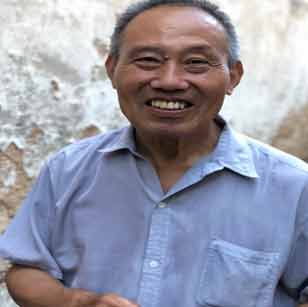
Shao Jicun, a poet and historian in Songxi. [Jacob Pagano]
Shao Jicun, like Zhao Lufu and many of the other poets we met here, saw poetry as a mode of being both observant and questioning, in turn creating a more aware community.
And for Zhao, poetry can also revitalize the other arts, from opera to painting. As our meeting came to a close, he offered to read from the first poem he ever wrote, entitled “Songxi Kunqu,” a reference to the form of opera which originated in the region. The poem reads:
Kunqu has lasted hundreds of years, and among the operas it is a special form;
Regardless of where you walk, you’ll be able to hear the villagers singing,
So that it seems to be everywhere at once, as if the sound is emerging from the sky.
(Translation: Chen Yi and Jacob Pagano)
The metaphor Zhao uses—that the opera, hailing from so many of the villagers’ voices, seems to come from the sky—is an apt one for thinking about poetry’s role in the village.
Indeed, while architects preserve buildings and environmentalists air quality, the words of poets here create an atmosphere of mystery and possibility. They form a fabric of living history that might just carry Songxi’s past into its future, and give an infinite array of new forms as Songxi opens its doors to new languages and the perspectives of those from worlds away.
Jacob Pagano is a writer and reporter. He has worked as an assistant producer for the In Contrast podcast at New England Public Radio, lived and reported in China, and written for publications including The Oxford Culture Review, The Oxford Review of Books, and The Mainichi Daily newspaper.