Qi remains a beacon of ancient prosperity









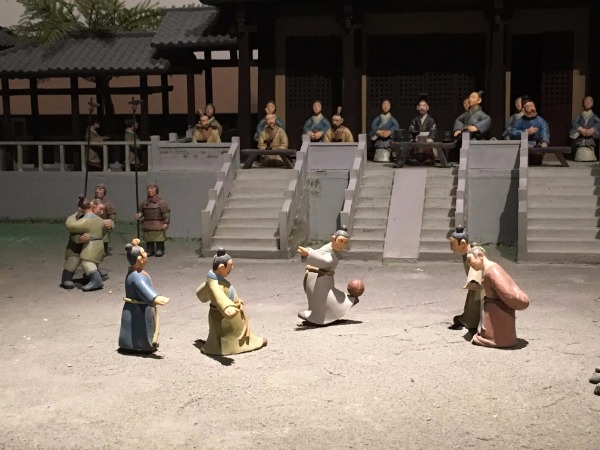
From millennia-old remains and ancient ruins to the birth of the 'beautiful game', a visit to Linzi is a journey into China's rich cultural history
I walk through an underground tunnel and stare at the 2,600-year-old funerary horses and chariots. There is a seeming confluence of millennia as I hear the hustle and bustle from the highway above my head.
Adding to this sense of timelessness, the buried chariots face the same direction of the traffic above.
Linzi - a district of Zibo city in Shandong province today - is not an unfamiliar name for anyone with a basic knowledge of ancient Chinese history: It is one of the oldest Chinese cities which is still inhabited today.
Despite that, it is the highly developed chemical and mining industries for which Linzi is probably most famous, though. Even many of the locals tell me that their hometown is hardly ever associated with tourism.
However, during construction of the aforementioned highway in 1990, the discovery of the funerary pits unveiled the city's past glory and made people realize that their history is the most precious resource they have.
Because this area is also a hotbed for Houli Neolithic Cultural Heritage - which dates back about 8,000 years - prior to the thoroughfare's construction, archaeologists conducted field research to ensure that no important relics got missed or damaged during the work.
Accidentally, they unearthed two intact funerary pits from the Spring and Autumn Period (771-476 BC). As well as many exquisite ornaments, the find included 10 chariots and 32 horse skeletons in the larger 32 meter by 8 meter (No 1) pit, and three chariots and six horse skeletons in the smaller 8 by 3 meter (No 2) pit.
Although the canopies of the chariots have rotted and disappeared over the centuries, it is still easy to imagine the high status of the tomb's occupant through the remnants.
Upon its discovery in 1990, the site was named among the entries in the first edition of China's top 10 new archaeological findings, an annual list which is often dubbed "the Oscars of Chinese archaeology".
It is, perhaps, a shame that no grave has yet been found to identify the aristocrat to whom all of this finery once belonged, but it is enough to reveal the prosperity of the Qi state, of which Linzi was the capital.
Qi first rose as a vassal state of Western Zhou Dynasty (11th century to 771 BC) and gradually grew into a superpower in its own right, before surrendering to the first emperor of China, Qinshihuang, as part of his unification of the country.
On the basis of the chariots discovered in the two pits, the China Ancient Car Museum was established to offer a comprehensive view of how the chariots, and other types of ancient Chinese vehicles, have developed over time. To date, it remains the only museum in China to focus on the subject.
The exhibits range from models of early chariots from the Shang Dynasty (16th to 11th century BC), to those reflecting various kinds of siege equipment from different historical periods, which are all based on archaeological discoveries made nationwide. Other carts and transportation are also on display, showing facets of people's daily life.
Standing in the exhibition hall, it's easy to envisage busy caravans trundling along the ancient Silk Road.