

男女羞羞视频在线观看,国产精品黄色免费,麻豆91在线视频,美女被羞羞免费软件下载,国产的一级片,亚洲熟色妇,天天操夜夜摸,一区二区三区在线电影
Martin Jacques
Author of When China Rules the World
BORN:

1945 in Coventry, England

EDUCATION:

1957-64: King Henry VIII School, Coventry

1968: Manchester University, BA in economics (first class honors)

1976: King's College, Cambridge, PhD

CAREER:

1965-90: Executive committee member, Communist Party of Great Britain

1969-71: Tutor in economic history, King's College, Cambridge

1971-77: Editor of Marxism Today

1993: Editor and founder of London-based think tank Demos

1994-96: Deputy editor of The Independent

2003-08: Visiting fellow, London School of Economics Asian Research Center

2009: Author of When China Rules the World

2010-11: Bosch public policy fellow at the Transatlantic Academy, Washington

2013-present: Senior fellow at the Department of Politics and International Studies, Cambridge University

2016-present: Visiting professor, Tsinghua University, Beijing

Sinologist sees China changing the world
Esteemed author says nation's development model can be a blueprint for emerging economies
Cecily Liu in London
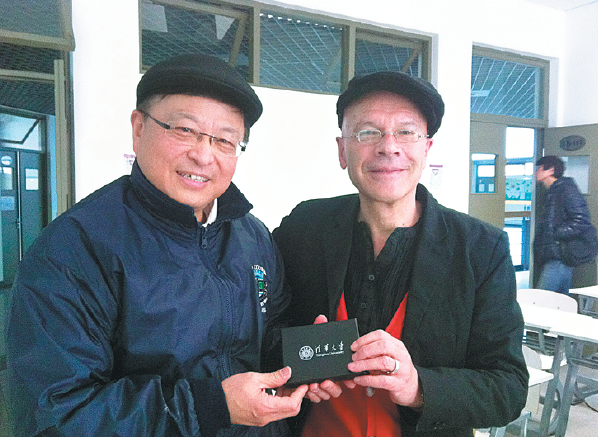
Jacques poses with professor Yan Xuetong, dean of the Institute of International Relations, Tsinghua University, in 2011. [Photo provided to China Daily]

China's recent history details a success story. In 1978, the size of China's economy was just one-40th of that of the US, but during the past 40 years, China's GDP has grown by an average of about 9.5 percent a year. By 2017, the size of China's economy had grown to more than three-fifths that of the US, according to International Monetary Fund estimates.

During the past four decades, China has also succeeded in lifting more than 740 million people out of poverty.

Jacques said he feels confident that China will continue to develop. He said its GDP growth rate may drop to a more sustainable level over the long term, but its development will increasingly focus on innovation and quality growth.

He recalled that when he first published When China Rules the World, one question he was often asked at author talks was how China could break free from the need to imitate advanced economies' technology, and what would happen if the country reached the point where it was inventing its own technology.

"I never hear that question anymore, because the answer is clear with the transformation of the technology companies in China," Jacques said.

For instance, in the second quarter of this year, China's Huawei overtook Apple to become the world's second-largest smartphone seller.

In the pioneering sector of mobile payments, China has emerged as the biggest market, worth 40.36 trillion yuan ($5.90 trillion) in the first quarter of this year. Its two biggest payment companies, WeChat Pay and Alipay, now have 900 million and 500 million active users respectively. These numbers eclipse Apple Pay's 127 million active users.

Accompanying these technology innovations is China's rapidly strengthening intellectual property system and its soaring number of patent registrations. Chinese companies' filings with the European Patent Office in 2017 were up 16.6 percent year-on-year, compared with the global average of 3.9 percent. This year, for the first time, Huawei topped the EPO's league table by number of patents filed by a single company, ahead of Siemens and LG.

While China's development path shows a rosy picture full of excitement, Jacques also warns that one challenge China will encounter in the future is the antagonism it will attract from Western countries fearful of being challenged.

Equally, the novelty of China-proposed initiatives such as the BRI could lead to questions and doubts. US President Donald Trump's moves to instigate a large-scale trade confrontation with China this year is evidence of the sort of external pressure China must learn to face, he said.

The trade dispute, which started this year, has seen the US slap tariffs on billions of dollars of Chinese imports, and China doing the same in retaliation. Many companies have already been negatively impacted, including US companies that rely on the supply chain in China.

Jacques said he feels that the attitude in the US under Trump is based on a recognition that China has been successful, and that the antagonism US administration has expressed toward China has, in a sense, spoken of the success of China.

"As China has risen, its relationship with the US has become more difficult," Jacques said. "For the US, it's one thing to look relatively benignly on China when it's well behind, but when China is not well behind, but is a competitor who has an alternative view of the world, then that's a different game."

He said that as China experiences rapid transformation and gains global influence, it must find its own new position in the world and ensure that other countries are comfortable with it.

"China has got to find a way of dealing with it," he said. "By and large, I think it's succeeding in doing it, but it's not a simple matter."


|<< Previous 1 2 3 4   
Martin Jacques
Author of When China Rules the World
BORN:

1945 in Coventry, England

EDUCATION:

1957-64: King Henry VIII School, Coventry

1968: Manchester University, BA in economics (first class honors)

1976: King's College, Cambridge, PhD

CAREER:

1965-90: Executive committee member, Communist Party of Great Britain

1969-71: Tutor in economic history, King's College, Cambridge

1971-77: Editor of Marxism Today

1993: Editor and founder of London-based think tank Demos

1994-96: Deputy editor of The Independent

2003-08: Visiting fellow, London School of Economics Asian Research Center

2009: Author of When China Rules the World

2010-11: Bosch public policy fellow at the Transatlantic Academy, Washington

2013-present: Senior fellow at the Department of Politics and International Studies, Cambridge University

2016-present: Visiting professor, Tsinghua University, Beijing

Sinologist sees China changing the world

Esteemed author says nation's development model can be a blueprint for emerging economies
Cecily Liu in London
Jacques poses with professor Yan Xuetong, dean of the Institute of International Relations, Tsinghua University, in 2011. [Photo provided to China Daily]

China's recent history details a success story. In 1978, the size of China's economy was just one-40th of that of the US, but during the past 40 years, China's GDP has grown by an average of about 9.5 percent a year. By 2017, the size of China's economy had grown to more than three-fifths that of the US, according to International Monetary Fund estimates.

During the past four decades, China has also succeeded in lifting more than 740 million people out of poverty.

Jacques said he feels confident that China will continue to develop. He said its GDP growth rate may drop to a more sustainable level over the long term, but its development will increasingly focus on innovation and quality growth.

He recalled that when he first published When China Rules the World, one question he was often asked at author talks was how China could break free from the need to imitate advanced economies' technology, and what would happen if the country reached the point where it was inventing its own technology.

"I never hear that question anymore, because the answer is clear with the transformation of the technology companies in China," Jacques said.

For instance, in the second quarter of this year, China's Huawei overtook Apple to become the world's second-largest smartphone seller.

In the pioneering sector of mobile payments, China has emerged as the biggest market, worth 40.36 trillion yuan ($5.90 trillion) in the first quarter of this year. Its two biggest payment companies, WeChat Pay and Alipay, now have 900 million and 500 million active users respectively. These numbers eclipse Apple Pay's 127 million active users.

Accompanying these technology innovations is China's rapidly strengthening intellectual property system and its soaring number of patent registrations. Chinese companies' filings with the European Patent Office in 2017 were up 16.6 percent year-on-year, compared with the global average of 3.9 percent. This year, for the first time, Huawei topped the EPO's league table by number of patents filed by a single company, ahead of Siemens and LG.

While China's development path shows a rosy picture full of excitement, Jacques also warns that one challenge China will encounter in the future is the antagonism it will attract from Western countries fearful of being challenged.

Equally, the novelty of China-proposed initiatives such as the BRI could lead to questions and doubts. US President Donald Trump's moves to instigate a large-scale trade confrontation with China this year is evidence of the sort of external pressure China must learn to face, he said.

The trade dispute, which started this year, has seen the US slap tariffs on billions of dollars of Chinese imports, and China doing the same in retaliation. Many companies have already been negatively impacted, including US companies that rely on the supply chain in China.

Jacques said he feels that the attitude in the US under Trump is based on a recognition that China has been successful, and that the antagonism US administration has expressed toward China has, in a sense, spoken of the success of China.

"As China has risen, its relationship with the US has become more difficult," Jacques said. "For the US, it's one thing to look relatively benignly on China when it's well behind, but when China is not well behind, but is a competitor who has an alternative view of the world, then that's a different game."

He said that as China experiences rapid transformation and gains global influence, it must find its own new position in the world and ensure that other countries are comfortable with it.

"China has got to find a way of dealing with it," he said. "By and large, I think it's succeeding in doing it, but it's not a simple matter."

主站蜘蛛池模板: 宜君县| 格尔木市| 海淀区| 安多县| 仁怀市| 巍山| 南岸区| 太谷县| 七台河市| 中方县| 右玉县| 昌黎县| 黎平县| 南昌市| 腾冲县| 灵寿县| 日喀则市| 棋牌| 莱州市| 丹阳市| 饶阳县| 康平县| 龙门县| 余庆县| 钟祥市| 莆田市| 平武县| 长兴县| 凭祥市| 嘉兴市| 蒲江县| 达州市| 华蓥市| 连江县| 溧水县| 霸州市| 类乌齐县| 丹棱县| 乌恰县| 泽州县| 潢川县| 夏河县| 福建省| 富顺县| 南漳县| 措勤县| 射洪县| 扬州市| 日土县| 勐海县| 民县| 鹤峰县| 常山县| 玉屏| 宜州市| 上饶县| 女性| 克什克腾旗| 通榆县| 德惠市| 汉川市| 大新县| 城口县| 富裕县| 招远市| 英德市| 通州区| 锡林郭勒盟| 崇文区| 吉首市| 安义县| 尼勒克县| 房山区| 黄浦区| 泰和县| 凤冈县| 九龙城区| 涟水县| 韶关市| 永州市| 二连浩特市| 资源县|