Printing sector jumps on smart 3-D bandwagon









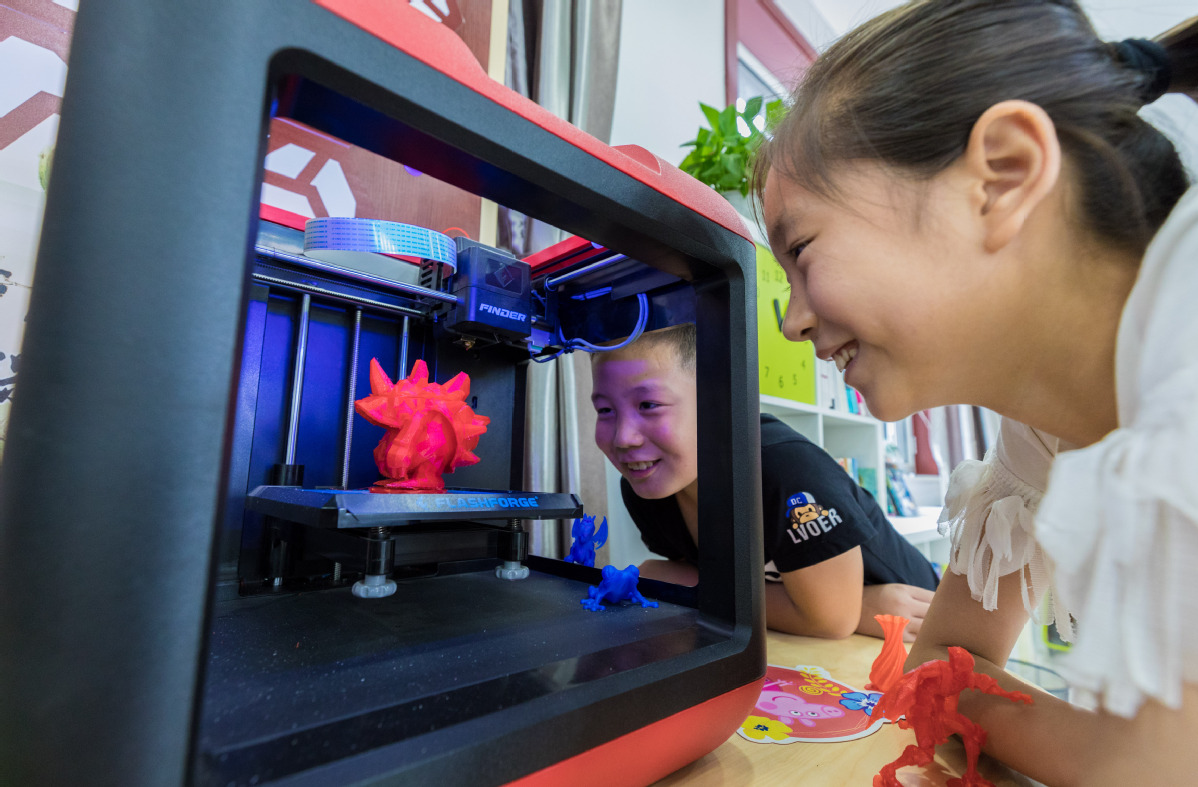
One of the four great inventions of ancient China, printing is on the cusp of a new era, thanks to the industry's embrace of cutting-edge technologies, insiders said.
The advent of 3-D printing and "smart" technologies like artificial intelligence are accelerating the Chinese printing industry's evolution to keep up with the times, they said.
"The Chinese printing industry has a long history and more innovations are being made to carry forward this traditional segment," said Liu Xiaokai, a senior official of the National Press and Publication Administration.
He made the remarks at the first-ever printing innovation conference in Beijing in September.
At the event, printing industry players agreed to form an alliance for smart manufacturing.
The proposed alliance will likely play an important role in setting standards for modern printing and developing relevant key technologies.
A cloud-sharing platform will be also set up to help the industry to transform itself for the smart era.
Led by the China Academy of Printing Technology, the planned alliance will likely include research institutes, universities, and large printers.
Industry experts said the proposed alliance is necessary in the 3-D printing era that has not only dawned but growing rapidly in China.
Several sectors like medical, automotive, machinery, consumer electronics and toys are already making use of 3-D printing technologies in China, they said.
"3-D printing is entering a golden period in China," said Wang Peng, secretary-general of the Additive Manufacturing Alliance of China. "After years of development, it has turned from an innovative concept to something quite helpful in upgrading manufacturing plants."
Wang said the 3-D printing sector is booming and helping the traditional printing industry to transform itself into a "smart" area of enterprise.
"We have cultivated a relatively good industrial system with manufacturing techniques close to, or on a par with, leading foreign countries. The sector is leaping from laboratory research into industrial applications," he said.
One latest example is the automobile sector. Pix, an automobile startup in Guizhou province, is building autonomous-driving cars using 3-D printing. Success in making such cars safe and viable would make Pix a pioneer not only in China but the world.
Automation has enhanced manufacturing efficiency in the automobile industry, but most machinery and processes used have not kept pace with the evolution of technologies like 3-D printing, artificial intelligence, big data, which are driving the shift toward unmanned vehicles, said Cao Yuteng, chief operating officer of Pix.
"3-D printing will become a turning point in the automobile sector and will be a promising innovation in the future," Cao said.
By using 3-D printing technologies, companies will be able to produce lighter rather than heavier parts that could help improve mileage, simplify maintenance, and lower vehicle cost.
In the past few years, intelligent printing has seen growth momentum globally, with 3-D printing growing rapidly in the industrial and enterprise-level areas.
In China, the segment notched up sales revenue of nearly 1.75 billion yuan ($252 million) last year, up almost 48 percent year-on-year, an industry report showed.
Zuo Shiquan, a manufacturing expert at the Beijing-based China Center for Information Industry Development, a research institute affiliated with the Ministry of Industry and Information Technology, said technology's transformation is necessary in that there is a growing demand for efficiency in different manufacturing areas.
"Improvement of technology is an inevitable trend during the process of intelligent manufacturing as it will help improve large-scale production and personalized manufacturing at the same time," Zuo said.
Agreed an expert who sought anonymity and from a Hangzhou, Zhejiang province-based printing company. "However, China still faces a lot of challenges. Compared with other raw materials, 3-D printing materials have higher requirement of density distribution, oxygen concentration and liquidity.
"In China, a lot of these materials are imported, which makes 3-D printing costlier, almost exorbitant. It restricts the Chinese printing industry's transformation to some extent."
Smart printing also requires higher standards and exacting technical specifications to support the development of additive manufacturing, he said.
"The current standards still need to be detailed in order to meet the increasingly rapid development in China."