US soybean farmers deal with pests









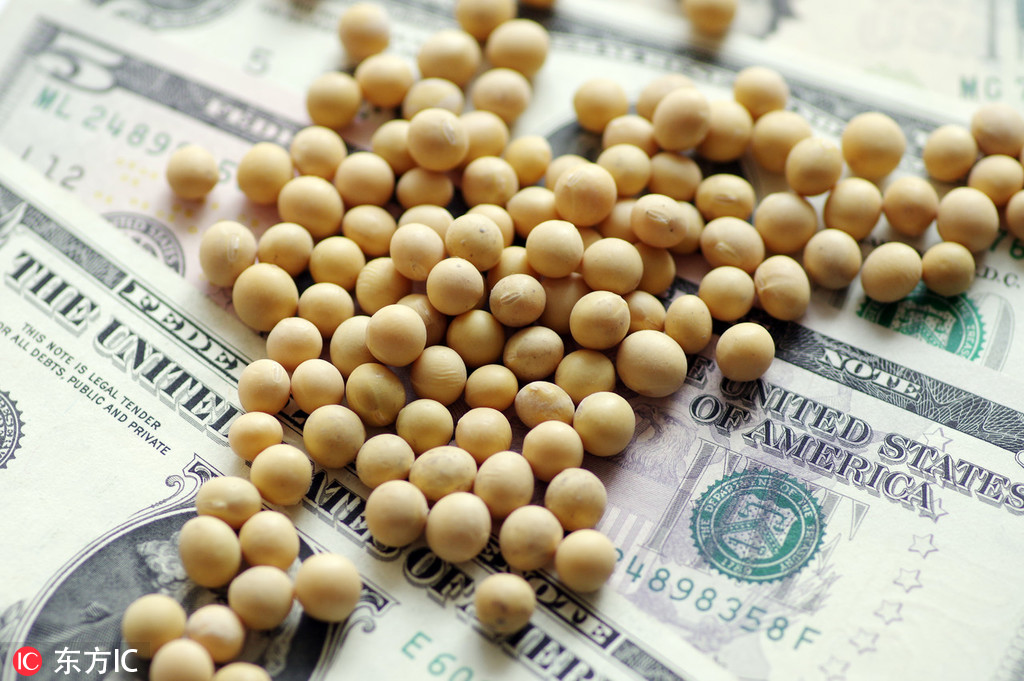
The root-attacking soybean cyst nematode is blamed for $1.3 billion in lost production annually
US soybean farmers await the possible end of the trade dispute between the US and China that would reopen China to their crop as they get ready for spring planting season. But some may have to deal with another problem: the Heterodera glycines, or soybean cyst nematode (SCN).
SCN is a pest that attacks the roots of soybeans and causes an estimated loss of $1.3 billion in US soybean production annually, according to researchers at the University of Missouri's Agricultural Extension Service, who say SCN can be suppressed but not eliminated.
"It is often difficult to identify fields with soybean cyst nematode infestations because low numbers (of the pest) will cause little damage to roots, so above ground plant growth appearance may appear normal," Allen Wrather and Melissa Mitchum write in a research paper published by the university. "Stunting of plant growth, visible changes in leaf color and wilting, and yield loss will increase as the infection of roots … increases."
"A soil analysis is the only way to determine whether (soybean cyst nematode) is present at detectable levels in a field. It is estimated that even when 2 million eggs are present per ace of soil, there is only a 63 percent chance of detecting one egg if one pint of soil is examined. Distribution of (the pest) in the field is neither random nor uniform," the researchers said.
"The nematode is the most devastating pathogen on soybeans," Mitchum, an associate professor in the plant sciences division at the University of Missouri, told China Daily. "The nematode was first found in North Carolina. It spread to the Midwest and north into the Dakotas and Canada. It's found in South America, Asia and has the potential to rob soybean yields worldwide."
In the US, SCN is present in 30 states, including Hawaii and the US territory of Puerto Rico.
Seed companies are developing new strains of soybeans more resistant to the the nematode, but immediate efforts to combat the pest focus on crop rotation, reducing weeds and avoiding undue stress on the soybean crop from nutrient deficiencies, insects and other diseases that weaken the plants.
John Heisdorffer, chairman of the American Soybean Association who farms 500 acres of soybeans in Keota, Iowa, told China Daily that he hasn't had a problem with the pest, but some other farmers in the state have.
The nematode can be spread by dirt left on farm equipment from routine operations or simply by a farmer walking from an infected field to an uninfected field — and a farmer may not know a field is infected until production declines.
Pesticides are expensive and pose threats to the environment and those applying the chemicals to the fields. Crop rotation can slow the spread of the pest, but not eliminate it because the nematode goes dormant until soybeans are again planted in the field. Genetically modified seeds produce soybeans resistant to most current types of nematodes but have the effect of selecting a variant of the pest that can survive, Mitchum said.
Farmers in eastern China domesticated the soybean about 3,000 years ago. The crop didn't reach North America until about 1765. At first, it was a curiosity for gardeners and not a cash crop.
However, demand for soybean oil increased in the 1920s, and it became profitable to grow. In the 1930s, US production increased to about 2 million tons from 400,000 tons a decade earlier.
Last year, the US exported 31 million tons of soybeans to China, about 60 percent of its soybean exports. In China, about 10 percent of soybeans are consumed directly as tofu and soy sauce while the balance is used as animal feed or cooking oil.
In July, China imposed a 25 percent tariff on imported American soybeans in response to US tariffs on Chinese goods.