Belt and Road harnessing mutual benefits









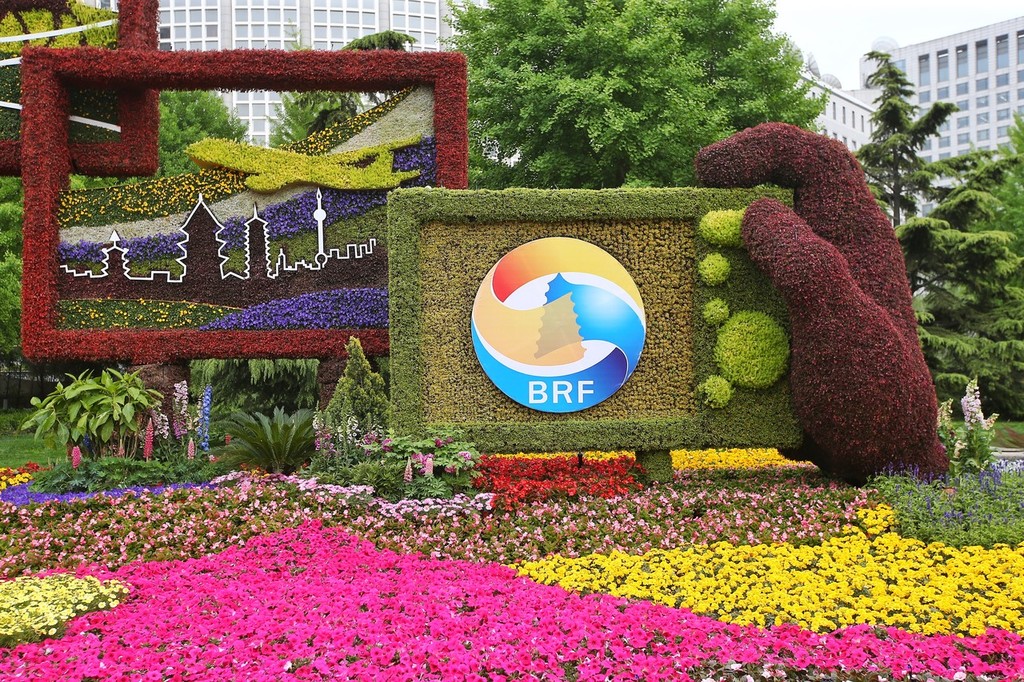
With Beijing set to host the second Belt and Road Forum for International Cooperation from Thursday to Saturday, it's time to assess the achievements China has made in promoting the Belt and Road Initiative since it hosted the inaugural forum in 2017. To be sure, China has greatly advanced the initiative to improve infrastructure connectivity between Asia, especially China, and Europe and Africa by, among other things, creating more public goods. That the BRI has expanded beyond Eurasia shows China's efforts are yielding fruitful results across more regions.
At the upcoming Belt and Road forum, the participants will discuss how to strengthen the BRI. China has proposed to strengthen the BRI through consultation, co-construction and sharing. And China's efforts to share its economic development ideas and expertise to bring the countries closer through better infrastructure connectivity have drawn the support of almost half of the countries in the world.
While the idea of promoting infrastructure connectivity is welcome, it requires huge amounts of resources to do so. To build a modern airport or a high-speed railway, we need large amounts of funds, which could be sourced from the World Bank or the Asian Development Bank. But since China has helped establish the Asian Infrastructure Investment Bank specifically for this purpose, it is easier to seek the required funds from it to build such infrastructure facilities.
It is equally important that those countries where such facilities are to be built contribute their share of the required resources, especially in large-scale projects. The East Coast Rail Link in Malaysia is one such project. According to their extensive consultations and negotiations, Beijing and Kuala Lumpur agreed in 2016 to build a 688-kilometer high-speed railway along the east coast of Malaysia.
The Malaysian government approved the project, initially estimated to cost some 55 billion Malaysian ringgits ($13.29 billion). After work was stopped on the project in July last year, Kuala Lumpur and Beijing have been re-negotiating in order to revisit the project to make it more affordable for Malaysia in the short term.
Based on the principle of consultation, co-construction and sharing, China and Malaysia have held cordial talks to review the project, including some detouring and shortening of length, and cutting some of the cost. Though China may bear more of the cost reduction, so as to help lessen the burden for Malaysia, its attitude has been appreciated by the Malaysian government and people. Over time, the world will realize the importance of the ECRL in improving connectivity along the 21st Century Maritime Silk Road as part of the Belt and Road Initiative, as it would link most ASEAN states with the rest of the continent.
China has proposed the same principle to work in partnership with European countries. During Premier Li Keqiang's latest visit to Europe, China issued a joint statement with the European Union, and initiated investment agreements between the two sides. This is a significant progress in seeking cooperation under the BRI framework through broadly defined partnerships. But despite China's initial success in collaborating with Central and Eastern European countries in infrastructure construction, some Western European countries have preferred to wait and watch rather than working with China to improve infrastructure connectivity.
During President Xi Jinping's recent visits to Italy, Monaco and France, Italy became the first G7 country to sign a memorandum of understanding on infrastructure construction with China under the BRI framework. Although Rome expects Beijing to be more transparent with its financing sustainability aspects, it has made it clear that such concerns will not prevent it from cooperating with Beijing.
Premier Li has further promoted China's cooperation with EU countries based on mutual investment in order to usher in an era when the two huge markets would be more open to each other. Once that happens, both economies will benefit hugely, sending a strong message to the world that cooperation is the only way to increase mutual benefit.
The author is a professor at and former executive dean of the Institute of International Studies, Fudan University. The views don't necessarily represent those of China Daily.