Enhance BRI to boost world economic growth









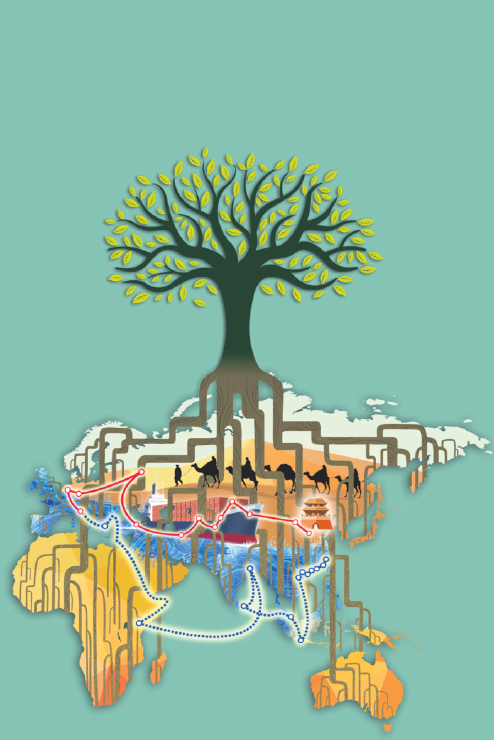
Since being proposed by President Xi Jinping in 2013, the Belt and Road Initiative has been promoting economic development along the Belt and Road routes, and thereby facilitating global development. And given the uncertainties facing the world today, the Belt and Road Initiative has become a new engine for global growth.
The ongoing Second Belt and Road Forum for International Cooperation will help to build further international consensus on the initiative. At such a key point, emphasizing the role of the initiative as a multilateral economic development platform and its principle of achieving shared growth through dialogue and collaboration are critical for its success.
Recently, the 5th China and Globalization Forum, an annual platform organized by the Center for China and Globalization in Beijing, saw diplomats from the United States, Germany, Italy, Ireland, Cuba, Ghana and other countries hold a roundtable discussion on the internationalization and multilateral transformation of the Belt and Road Initiative.
Severe challenges to global growth
A wide range of participants shared their views on, in-depth analyses of and expectations for the initiative and its relationship with the world economy. They reached a consensus that the initiative should be promoted as a platform that can help the global economy fully recover from the blows of the 2008 global financial crisis and develop smoothly. Although the world economy has recovered to a certain extent, the rising threat of unilateralism and trade protectionism pose severe challenges to global growth. For instance, global growth is projected to decline from 3 percent in 2018 to 2.9 percent this year.
The Belt and Road Initiative helps to invigorate the economies of the countries participating in it. And as a new platform promoting globalization and fair global governance, it is built upon multilateral rules.
With the world economic growth showing a declining trend, global investment too is slowing down. According to the Global Investment Trends Monitor issued by the United Nations Conference on Trade and Development, global foreign direct investment (FDI) fell from $1.47 trillion in 2017 to $1.2 trillion last year. The continuing decline over the past three years has seen FDI fall to the lowest point since the global financial crisis.
Rise in Chinese FDI beats global trend
Contrary to the overall global trend, however, FDI in the countries along the Belt and Road has increased. According to Ministry of Commerce data, from 2013 to 2018 Chinese enterprises invested more than $90 billion in countries along the Belt and Road at an average annual growth rate of 5.2 percent. The investments in Belt and Road projects have not only boosted global investment, but also created more growth opportunities for the participants.
Developed countries are in a relatively less favorable situation due to declining overseas investment growth and a lack of adequate infrastructure facilities. By contrast, the Belt and Road Initiative has created huge opportunities for developing countries, especially those in Asia and Africa, and thus helped these countries to solve their problems, to a certain extent, in areas such as infrastructure construction and resource extraction, and helped train skilled workers and cultivate talents.
The Ministry of Commerce statistics also show that Chinese enterprises have helped establish a number of trading cooperation zones in countries along the Belt and Road with a cumulative investment of more than $30 billion. These zones in turn have helped raise local economic growth and created nearly 300,000 job opportunities.
Transport projects can be game changers
According to a World Bank research report, the transportation projects under the initiative's framework, once completed, will reduce the shipment time and trade costs for Belt and Road economies between 1.7 percent and 3.2 percent, and 1.5 and 2.8 percent, respectively. The initiative will also help increase actual income growth in local areas by 1.2 to 3.4 percent and global income growth by 0.7 to 2.9 percent, thereby promoting shared prosperity.
As China enters a new phase of reform and opening-up, it should make greater efforts to optimize the positive impact of the Belt and Road Initiative on the world economy and further promote it as a platform for multilateral economic development.
First, China should work to establish a "Belt and Road International Cooperation Committee" to make the initiative multilateral, rather than bilateral, in nature. In fact, China should use the second Belt and Road forum to invite officials and experts from key international organizations to join the proposed committee, in order to enhance the initiative's multilateral characteristics, as well as attract more participants from different countries and organizations, and thus reduce doubts over the initiative's goals. Also, Beijing should set institutional standards for the initiative that measure up to international standards and are transparent.
Initiative's importance cannot be overstated
Second, the importance of the initiative in the post-2008 global financial crisis era can be gauged from the fact that China has signed 173 documents on cooperation with 125 countries and 29 international organizations under the Belt and Road framework. But since the initiative is aimed at boosting global growth, it should have a more inclusive definition. Perhaps it should be called the "Belt and Road International Development Plan" to emphasize its overarching economic goal and remove doubts that China is using it as a tool to expand its influence across the world.
And third, there is a need to strengthen cooperation between China and international organizations under the Belt and Road framework, in order to enhance overall multilateral cooperation. For instance, the Asian Infrastructure Investment Bank model could be used to better collaborate with the World Bank, Asian Development Bank, African Development Bank, Inter-American Development Bank, European Bank for Reconstruction and Development and other regional and international banks to provide loans for Belt and Road projects. There is also a need to open a global project website to issue tenders and invite international bids for Belt and Road projects.
The initiative has already made many significant achievements, and seems set to serve as a great Chinese contribution to the world economy and global governance. And by making full use of the Belt and Road Initiative, the international society can realize the 2030 Sustainable Development Goals and build a community with a shared future for mankind.
The author is the founder of the Center for China and Globalization, a Beijing-based non-governmental think tank.