Nepal president's visit to China opens up new vistas









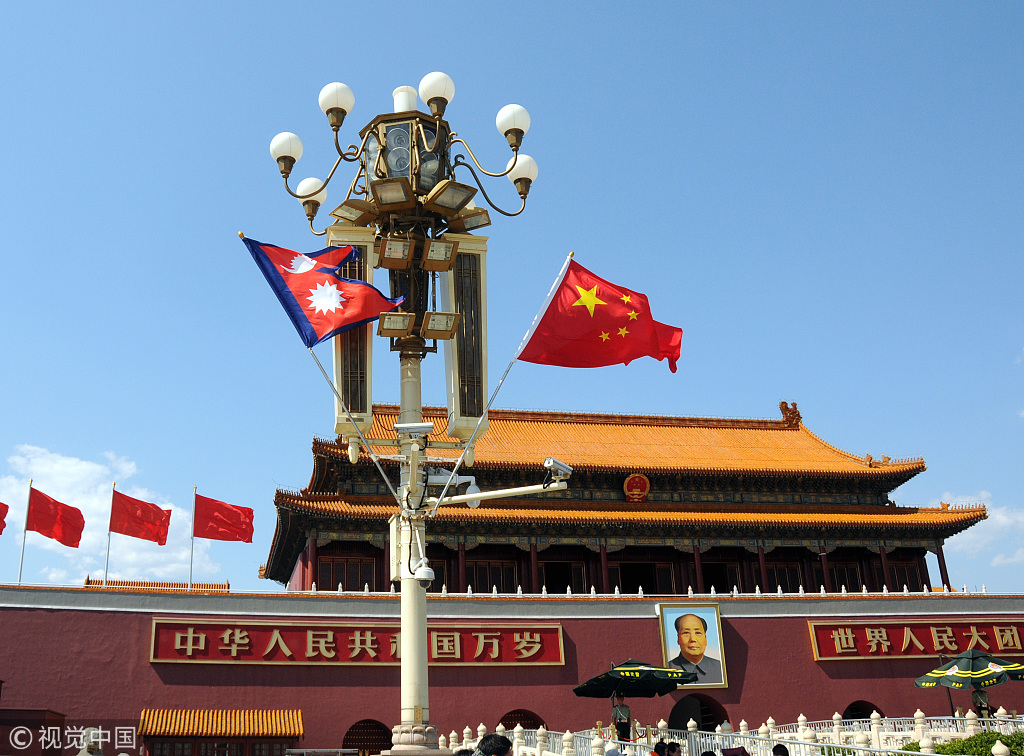
The recent state visit of Nepalese President Bidhya Devi Bhandari to China, which coincided with the Second Belt and Road Forum for International Cooperation held in Beijing, offered the two countries the opportunity to discuss mutual interests and exchange views at the highest political level.
While President Xi Jinping said China will support Nepal in its fight against climate change and poverty, and help it clear the development bottlenecks, Bhandari reiterated Nepal's firm support to the one-China policy and the Belt and Road Initiative.
The first state visit of Nepal's head of state to China since the Himalayan country abolished 250 years of monarchy in 2008 helped to deepen mutual trust and achieve tangible progress in many areas including Belt and Road projects. Officials at different levels from both sides are supposed to get down to the nitty-gritty of the proposed projects and pave the way for their implementation in an expeditious manner.
The signing of the protocol to implement the agreement on transit and transport is a landmark achievement for Kathmandu, as China has officially promised to give landlocked Nepal access to its seaports and dry ports-the seaports of Tianjin in North China, Lianyungang in East China's Jiangsu province, and Shenzhen and Zhanjiang in South China's Guangdong province, and the dry ports of Lanzhou in Northwest China's Gansu province, and Lhasa and Shigatse in Southwest China's Tibet autonomous region-to trade with the third countries.
Yet Nepal realizes that conducting trade through the Chinese routes is a herculean task given the long distance involved and the poor road connectivity across the Nepal-China border.
Nepal has been using the Indian ports of Kolkata (including Haldia) and Vishakhapatnam for trade with third countries. So the protocol should be seen as a move to diversify and promote Nepal's trade with countries to the north, including Central Asian states, which will also help it to tap the opportunities available in the emerging economies of Asia.
More important, goods could be transported to and from Chinese ports to Nepal in about 20 days-less than half the time taken to do so from Indian ports, because the customs clearance systems are too lengthy in India.
Nepal and China have also agreed to form a secretary-level intergovernmental committee and a joint-secretary level consultative panel for resolving bilateral trade and transit issues. Some media reports have quoted an official as saying the Nepalese government has formed two technical committees to conduct a field-based study on the operation of transit facilities by next month so importers and exporters could use the Chinese transit routes as soon as possible.
Besides, the incorporation of Nepal-China Trans-Himalayan Multi-Dimensional Connectivity Network and Nepal-China cross-border railway projects in the joint communiqué issued by the second Belt and Road forum reflects the deepening of relations between Kathmandu and Beijing.
The Nepal-China cross-border railway is a much talked about project but with little progress made after Nepal joined the Belt and Road Initiative in 2017 during the prime ministership of Pushpa Kamal Dahal "Prachanda". The railway, when completed, could be a real game changer since it will clear Nepal's development bottleneck, as well as benefit people not only in Nepal but also in India's most populous provinces of Uttar Pradesh and Bihar.
The infrastructure connectivity projects mentioned in the communiqué, the proposed Nepal-China railway, the series of meetings between the two presidents, and Xi's proposal to further enhance exchanges between their legislatures, political parties, youths, think thanks, local authorities and the media show Nepal-China relations are truly multi-dimensional.
Nepal is eager to improve its transportation network and establish better connectivity with China and the rest of the world under the Belt and Road framework. Most of the people in Nepal believe the two countries will soon finalize the financing modality of the proposed Nepal-China railway and work on the project would begin accordingly.
The author is a Nepalese journalist.
The views don't necessarily represent those of China Daily.