China's National Defense in the New Era









V. Reasonable and Appropriate Defense Expenditure
China attends to both development and security. It is making an integrated effort to build a prosperous country and a strong military, and striving for the coordinated development of national defense and the economy. Following the principle of building the armed forces through diligence and thrift, China takes into consideration the development of the economy and the demands of national defense, decides on the appropriate scale and composition of defense expenditure, and manages and applies these funds in accordance with law.
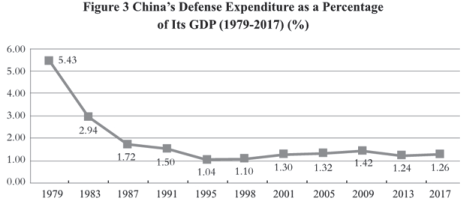
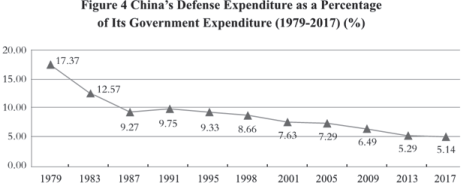
Since reform and opening-up, China has increased its defense expenditure from a level of sustainability to moderate growth. On the whole, defense expenditure has grown in tandem with the growth of the national economy and government expenditure. Defense expenditure as a percentage of GDP has fallen from a peak of 5.43% in 1979 to 1.26% in 2017. It has remained below 2% for the past three decades. Defense expenditure as a percentage of government expenditure was 17.37% in 1979 and 5.14% in 2017, a drop of more than 12 percentage points. The figures are on a clear downward trend.
China's Defense Expenditure Since 2012
In the new era, to keep pace with the country's modernization, China is focusing on building a fortified national defense and a strong military commensurate with the country's international standing, and its national security and development interests. China is striving to narrow the gap between its military and the world's leading militaries, and make up the deficiencies in the military's capabilities in modern warfare. Defense expenditure is growing steadily and the breakdown of spending is being continuously optimized.
In terms of usage, China's defense expenditure is assigned to three sectors-personnel, training and sustainment, and equipment. Personnel expenses mainly cover the salaries, allowances, food, bedding, clothing, insurance, subsidies and pensions for officers, non-ranking officers, soldiers and contracted civilians, as well as retirees supported from the defense budget. Training and sustainment expenses mainly cover training of the troops, institutional education, construction and maintenance of installations and facilities, and other expenditure on routine consumables. Equipment expenses mainly cover R&D, testing, procurement, repairs, maintenance, transport and the storage of weaponry and equipment. In terms of scope, defense expenditure covers all active forces, reserve forces and militia.
Since 2012, the increase in defense expenditure has been primarily spent for the following purposes:
1. Adapting to national economic and social development, improving the wellbeing of service personnel, ensuring regular increases in military salaries, and bettering the working, training and living conditions of the troops;
2. Increasing input in weaponry and equipment development, phasing out the outdated, upgrading the old, and developing and procuring the new, such as aircraft carriers, fighters, missiles and main battle tanks, to steadily modernize weaponry and equipment;
3. Deepening national defense and military reform, supporting major reforms in military leadership and command systems, force structure and composition, and policies and institutions;
4. Supporting training in real combat conditions, enhancing strategic-level training, joint training at TCs' level and training of services and arms, and improving the conditions for simulated, networked and force-on-force training; and
5. Supporting diverse military tasks including the UNPKOs, vessel protection operations, humanitarian assistance operations and disaster relief efforts.
From 2012 to 2017, China's defense expenditure increased from RMB669.192 billion to RMB1,043.237 billion. China's GDP and government expenditure grew at average rates of 9.04% and 10.43% respectively, calculated on the price of the indicated years, while its defense expenditure increased by an average of 9.42%. Defense expenditure accounted for 1.28% of GDP and 5.26% of government expenditure on average. The percentage of China's defense expenditure in GDP remained stable and grew in coordination with the increase of government expenditure.
China applies strict mechanisms of fiscal allocation and budget management on its defense expenditure. It pursues a level of defense spending that is demand-oriented, planning-led and consistent with its capacity. It endeavors to strengthen unified management, coordinate existing and incremental expenditure, gradually practice cost-effectiveness management, and steadily press ahead with reform that is centered on efficacy and efficiency. To improve and strengthen budget management, China's armed forces are extending reform of the centralized collection and payment of military funds, accelerating standardization in relation to defense expenditure, and improving the management of assets and funds.
Comparison of Defense Expenditure in the International Context
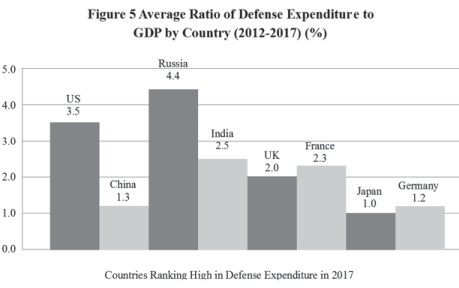
Among countries ranking high in defense expenditure in 2017, China's share of defense expenditure in GDP and government expenditure, as well as per capita and per-serviceperson defense spending, are all at a relatively low level.
China has become the world's second largest economy. The fact that China's defense expenditure ranks second in the world is determined by the demands of its national defense, the size of its economy, and the defensive nature of its national defense policy. In terms of total spending, China's defense expenditure in 2017 was less than a quarter of that of the US.
As a percentage of GDP, from 2012 to 2017, China's average defense expenditure was about 1.3%. Comparative figures were: the US about 3.5%, Russia 4.4%, India 2.5%, the UK 2.0%, France 2.3%, Japan 1.0%, and Germany 1.2%. China ranks 6th among these countries in terms of defense expenditure as a percentage of GDP on average and is the lowest among the permanent members of the UN Security Council (UNSC).
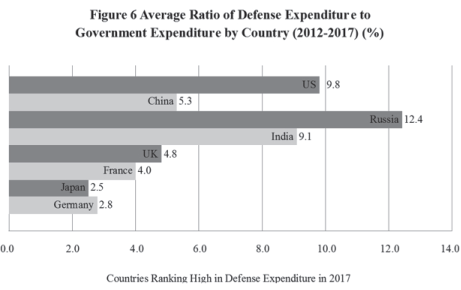
As a ratio of spending to government expenditure, from 2012 to 2017, China's average defense expenditure was 5.3%. Comparative figures were: the US about 9.8%, Russia 12.4%, India 9.1%, the UK 4.8%, France 4.0%, Japan 2.5%, and Germany 2.8%. China ranks 4th among these countries in terms of defense expenditure as a percentage of government expenditure on average.
China's per capita defense expenditure in 2017 was RMB750-5% of the US, 25% of Russia, 231% of India, 13% of the UK, 16% of France, 29% of Japan, and 20% of Germany. China's per-serviceperson defense expenditure was RMB521,600-15% of the US, 119% of Russia, 166% of India, 27% of the UK, 38% of France, 35% of Japan, and 30% of Germany. China's defense expenditure ranks 7th and 6th in per capita and per-serviceperson terms respectively among these countries.
China reports and releases its defense expenditure through various mechanisms. Since 1978, the Chinese government has submitted annual budget reports to the National People's Congress and released the total amount of defense budget. In 1995, the Chinese government issued a white paper, China: Arms Control and Disarmament, releasing data concerning its defense expenditure to the world. Since 2007, China has joined the UN Standardized Instrument for Reporting Military Expenditures and has submitted annually to the UN the basic data on its defense expenditure for the latest fiscal year, reporting total spending as well as personnel expenses, training and sustainment expenses, and equipment expenses for the active force, reserve force and the militia respectively, along with an explanation of the application of China's defense expenditure and its ratio to GDP.
All in all, China's defense expenditure is open and transparent, and its spending is reasonable and appropriate. Compared to other major countries, the ratios of China's defense expenditure to GDP and to government expenditure, as well as the per capita defense expenditure of the country, remain at a relatively low level.
As the only major country yet to be completely reunified, and one of the countries with the most complex peripheral security environment, China faces serious challenges in safeguarding national sovereignty, territorial integrity, and maritime rights and interests. China is moving closer to the center of the world stage, and the international community expects more international public security goods from the Chinese military. In addition, China's armed forces are moving towards informationization and shouldering arduous tasks in following the trends of worldwide RMA and speeding up RMA with Chinese characteristics. There is still a wide gap between China's defense expenditure and the requirements for safeguarding national sovereignty, security and development interests, for fulfilling China's international responsibilities and obligations as a major country, and for China's development. In step with national economic development, defense expenditure of China will maintain a moderate and steady growth.