Italy yet to grapple with long economic stagnation









Expert: Frequent change of govts could alarm investors and European partners
The collapse of Italy's coalition government may hit the economy, but its long-run economic stagnation is an even bigger problem.
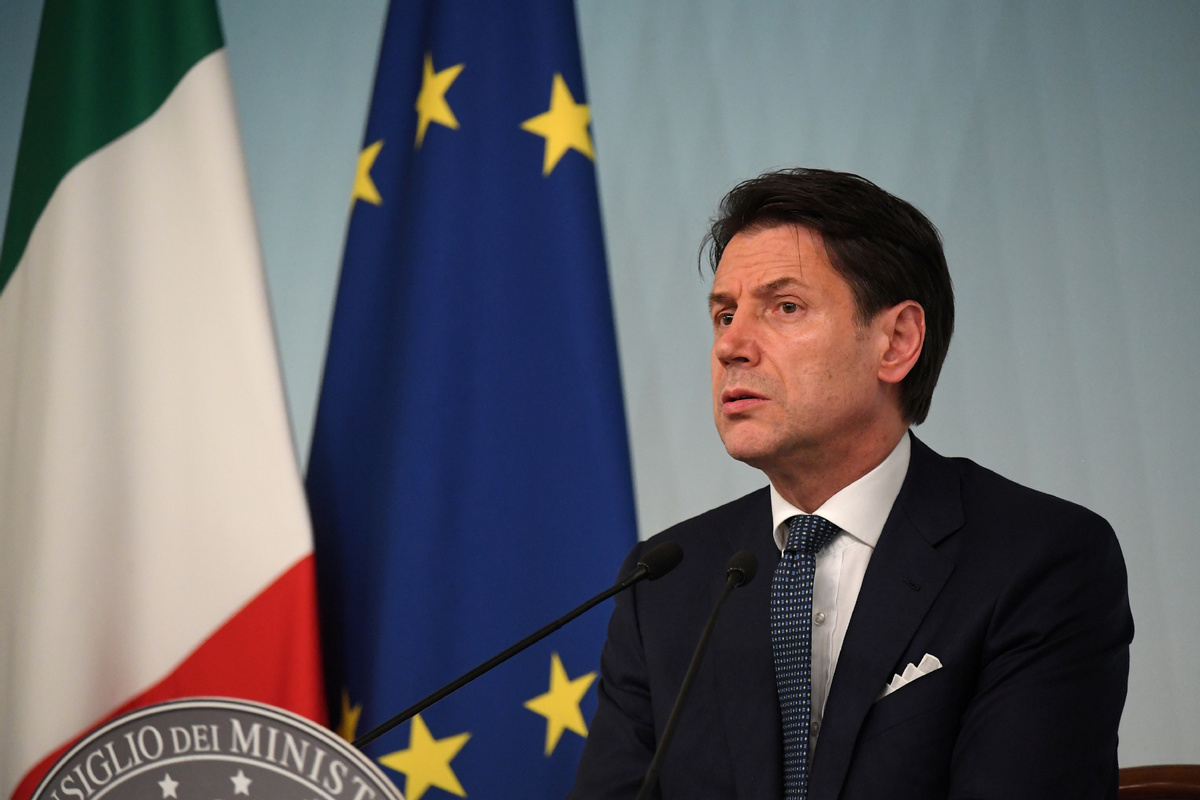
Italian Prime Minister Giuseppe Conte resigned on Tuesday after blasting Interior Minister Matteo Salvini, accusing him of ending the 14-month-old coalition government and damaging the economy for personal and political interests.
Salvini, leader of the far-right League party, pulled the plug on its alliance with the anti-establishment 5-Star Movement earlier this month and called for elections. Conte, a jurist, has acted as a mediator between the two partners.
The League party scored a record high in the recent opinion polls with 38 percent favorable, compared to 17 percent in the March 2018 general election. Meanwhile, support for the 5-Star has slipped from 33 percent to 16 percent. Thus, there is a high possibility of Salvini's party winning if snap elections are held now.
Tian Dewen, deputy director of the Institute of European Studies at the Chinese Academy of Social Sciences, said the Italian coalition's collapse could be anticipated, as the two parties have persistent divisions over many issues, including a high-speed rail link with France.
"Italy's frequent change of governments could alarm international investors and European partners and hurt its own economy," he said. "However, the difference in political ideas is not the most important factor. The real problem for the country is whether the next government will be able to improve Italy's economic situation."
Italy has suffered from very slow economic growth rates in the past three decades. The eurozone's third-largest economy is among the most sluggish performers in the European Union's 19-nation currency bloc.
Italy's economic growth was stagnant in the second quarter of this year. GDP growth in the quarter remained unchanged on both a quarter-on-quarter and a year-on-year basis, according to Italy's national statistics bureau ISTAT.
Despite slow growth, the country has high public debt and has long clashed with the EU bureaucracy over the country's budget plans.
Last year, it had a debt-to-GDP ratio of 132 percent, second only to Greece in the eurozone, and is pushing up against EU limits on its budget deficits.
The League's economics spokesman, Claudio Borghi, said on Monday that the party would seek tax cuts in the 2020 budget by raising the country's deficit a little.
Tian said that Salvini's idea of a tax cut is just a means of winning votes; whether these policies are workable may not be his concern. But such a move would have a negative effect on Italy's political and economic situations, as the world market and global investors will lower their expectations and evaluation of the country if they think the Italian government is likely to be unpredictable.
Sergei Guriev, chief economist at the European Bank for Reconstruction and Development, said that investors in Italian assets are certainly concerned about Italy's political stability and would like to see a credible and realistic plan of reforms that would restore Italy's competitiveness and macroeconomic and financial balance.
"So far, the markets do not believe that Salvini's socio-economic policy can result in solid economic performance and improved the fiscal situation," he said.
Fiscal discipline
He added that Italy needs both to maintain the fiscal discipline and to accelerate economic growth to reduce the debt/GDP ratio.
"Currently, Italy can service the debt as the interest rates in the euro area are exceptionally low. However, it will be much harder if and when the interest rates increase," he said.
Qu Qiang, assistant director of the International Monetary Institute of Renmin University of China, said the main root of Italy's economic problem is its aging population.
As nations grow older, the country will have fewer workers who can create wealth, make innovations and increase the efficiency of industries, thus the country's economic growth has become slower and slower.
Meanwhile, Italy has expensive pension systems and welfare systems, which require high public spending.
"If the economy stops growing, while the public spending is increasing, it is obvious that the economic situation won't be sustainable or healthy, " he said. "But Italy doesn't have an effective economic policy to stimulate its economy."
If Italy exits the eurozone, it could use its own currency to devaluate all its debts, However, it would hugely damage the country's credit, and making it more difficult for the country to borrow money, Qu said.
He said that rationally, Italy may still need to reduce its public debt, tighten its financial and fiscal discipline.
Chen Fengying, a senior researcher of the world economy at the China Institutes of Contemporary International Relations, said Italy is accustomed to being a debt economy, that is, to borrow new money to repay old debts.
"A debt economy would not be a problem while the world economy is in a good state, but is not easy to handle amid a crisis, because it is difficult either to borrow money or to pay the debt," she said. "I think the real challenge for Italy's economy is that they want to change the situation but they cannot find the momentum yet."
Chen said that, generally speaking, Italy is a beneficiary of European integration, and whoever leads the next government will still have to work with the EU institutions and other eurozone countries to alleviate its economic dilemma.