Artificial intelligence boom continues despite mistrust









Editor's note: David Lee is a consultant and author based in Beijing who focuses on energy, health, international politics and international development. The article reflects the author's opinions, and not necessarily the views of CGTN.
Artificial intelligence (AI) is the talk of day and has occupied center stage at the second China International Import Expo (CIIE). While it's a visual thrill to enjoy the fantastic lights show by the Huangpu River in Shanghai, it's a true eye opener for anyone interested in the future of AI and humanity as a whole to learn from and exchange with industry thought leadership in CIIE seminal discussions.
In many seminal discussions about AI and its disruptive force held during this year's CIIE, big concerns have been raised amid many controversies. Thus my gut feelings are the AI boom is to continue despite mistrust in the near future.
Apart from being a generally optimistic person about technology and its impact, I believe that such controversial concerns about AI will be mitigated thanks to evolving and adapting new solutions.
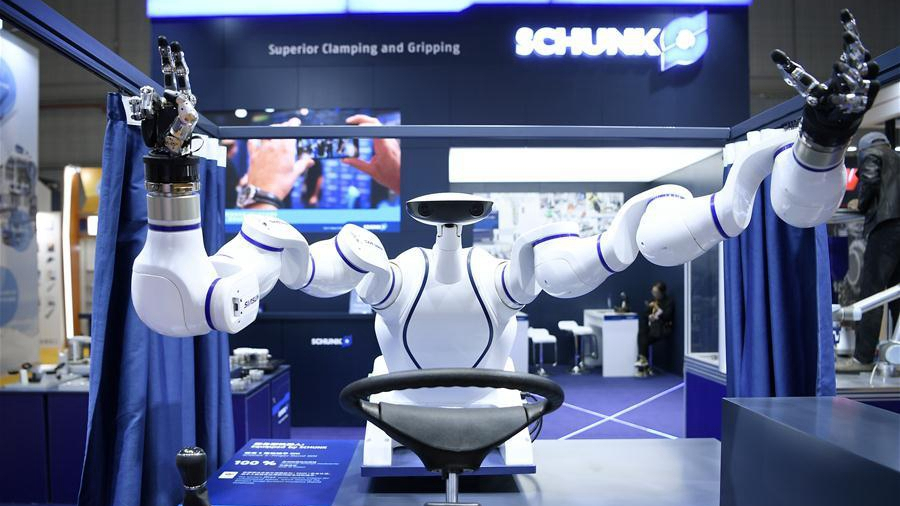
First of all, is AI taking away jobs? Yes, robotics backed by AI is starting to replace human labor in the manufacturing sector. However, there are many restrictions of such AI replacement process.
AI replacement takes a process because technologies do have its due course to run before they are mature, reliable, and effective. I don't see any reason why, during the process, smart people who designed and implemented AI cannot take mitigation measures.
If AI is replacing simple labor, why can't innovative societies just create more jobs that AI cannot replace? Such jobs involve human attention and care, empathy, or real human creativity that AI today or in the foreseeable future still lacks. Instead of blaming AI for "stealing" our jobs, why not blame ourselves for failing to innovate fast enough?
Secondly, is AI interfering in people's privacy? Well, this question cannot be answered with a categorical "yes" or "no." AI is a powerful tool that does affect and threaten privacy, but the key in here is a robust, effective, and evolving regulatory framework that governs the use of AI.
Therefore, to reframe the question of AI interfering privacy, the real question is how regulatory measures are to catch up with fast-moving technologies. To answer a big question like this, we need to look at the effectiveness of decision and policy making processes in each and every country.
Subsequent questions to be answered include: How does the country's policy making process engage with the high-tech community? How flexible, proactive, and responsive can the country's industry policies be? How does the civil society participate in the process in a way to ensure the people have their voice too?
Thirdly, if we take a longer look into the future, is AI trustworthy enough? Will AI be too powerful to be controlled by people? What if the Matrix goes to rise and people have to find refuge in Zion?
These questions merit philosophical proactive thinking, but they are also very long-term indeed. The Matrix is not going to rise over night, and humankind seems to have enough patience and resources to deal with the scope of AI making decisions through the course of time.
Of course, there are trends where in certain areas people trust AI more than their managers or colleagues, particularly when it comes to credit rating and HR decisions. However, such trends cannot be categorically labelled as AI ruling over people. In such cases, AI decisions are based on the calculations of a range of clearly defined parameters. People set the parameters, and AI simply accelerates the process of decision- making.
In all, AI is the central hub that links up the building blocks of the future – powerful algorithms to do meaningful computing, sensitive information such as surveillance footage and personal biometrics, the 5G backbone of connectivity, among others.
AI poses big challenges but also offers unlimited possibilities. At least up till now and well into the foreseeable future, AI has remained and will continue to be only as a tool in the hands of people, who must decide on what to do with the tool and how the tool will evolve and work.