Shanghai officials: early detection, contact-tracing slowed COVID-19









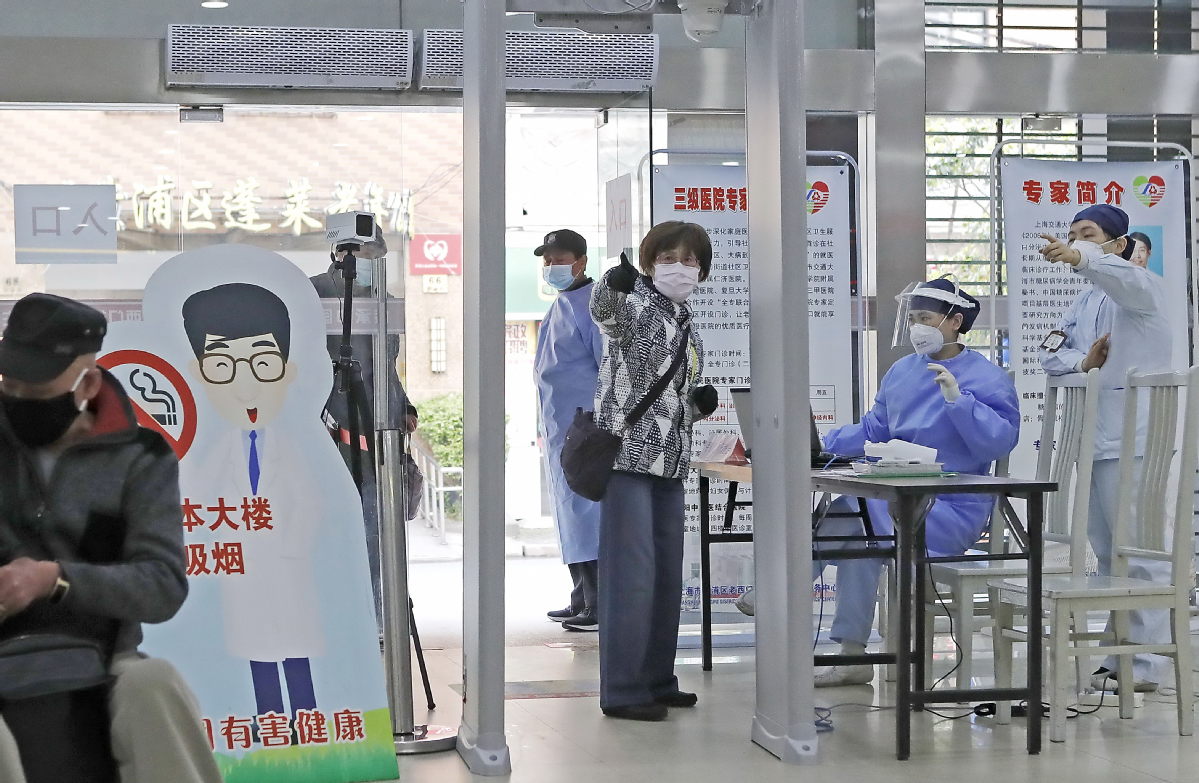
Shanghai, a city with more than 24 million people, was able to slow the spread of the coronavirus with early detection and contract tracing, officials said at a symposium.
A US-China symposium on COVID-19 — Texas-Shanghai Experience —was organized by Fudan University, Harris County Public Health and the Houston Public Health Authority. The symposium on Tuesday was conducted via Zoom teleconferencing, and 100 people participated, the limit allowed for the conference.
So far, Shanghai has 339 domestic and 283 imported cases of coronavirus infections and four-related deaths.
Wu Fan, leader of the Shanghai COVID-19 Task Force and vice-dean of the Fudan Medical School, told how Shanghai prevented the virus from spreading.
She stressed that Shanghai's success in stopping further spread of the virus came from detecting cases at the early stage, providing free and widely available tests, and conducting contact-tracing of infected people.
Another important step was disseminating correct information through multiple media platforms to educate the public about the disease and implement self-protection measures, such as social distancing and wearing face masks, Wu said.
Dr Zhang Wenhong, another leader of the Shanghai COVID-19 Task Force and head of infectious disease at Huashan Hospital, shared his experiences.
"We do everything we can for each patient," he said. "Tracing every cross contact is very important."
Umair Shah, executive director of Harris County Public Healthcare, said he was impressed by Shanghai's ability to detect infections early and conducting effective contact-tracing.
Wu, who was director-general for Shanghai's Center for Disease Control and Prevention (CDC) for 10 years, said three factors contributed to Shanghai's contact-tracing effort.
"We set up the CDC system – we not only have CDC at the municipal level but also at the county level — and public health network. Most importantly, we have a primary healthcare center to help our public healthcare workers. That's a lot of human resources,'' she said.
Second, Shanghai has in place a model to do epidemic investigations and help well-run organizations.
The third is technology.
"We use the big data with mobile phones. We have also set up a public health information network for many years. Everyone in Shanghai, no matter a resident or someone coming into Shanghai, if you go to a hospital, we have an archive for each one," Wu said.
Mobile phones were used to track a person's movement.
"The new technology is very helpful to timely find the person and increase the quality of field-epidemiology investigation," she said.
Dr Edward Septimus, a professor at Harvard Medical School and a member of the MCA Health System COVID-19 Treatment Team, said he was impressed with contact-tracing in China.
"If we have a second wave, we don't have the diagnostic tests to test people, including a potential antibody test. We don't have the ability to do contact-tracing to identify individuals to quarantine and isolate. I think that's the US challenge right now," Septimus said.
According to data from covidtracking.com, as of April 15, about 3.1 million Americans have been tested, less than 1 percent of the total population.
In Harris County, which encompasses Houston and has a population of about 4.7 million, the capacity to test COVID-19 first started at 500 tests a day and gradually increased to the current 2,000 a day.
David Persse, head of the Houston Public Health Authority, echoed Septimus' comments.
"We have been hearing from our colleagues in Shanghai, and it sounds like identification followed by contact-tracing to strict isolation and quarantine are the key. "We are way behind in our ability to test; mostly, the antigen tests have long turnaround times, some of them days. We need to amp up our testing, strategy of having strict quarantine, and isolation practice that the society will work with, quite honestly," he said.
Different cultural attitudes about wearing a face mask also were discussed. Zhang emphasized that social distance of 6 feet could still be dangerous sometimes, and a mask is just another form of social distancing. "Social distancing is the core strategy, and masks strengthen that strategy," he said.