Joint efforts can mitigate impacts of pandemic









Major international events in recent years, such as the trade war and Brexit, heralded the return of isolationism and protectionism in the world. While globalization has previously suffered setbacks, the COVID-19 pandemic may deal a real blow to the globalization process.
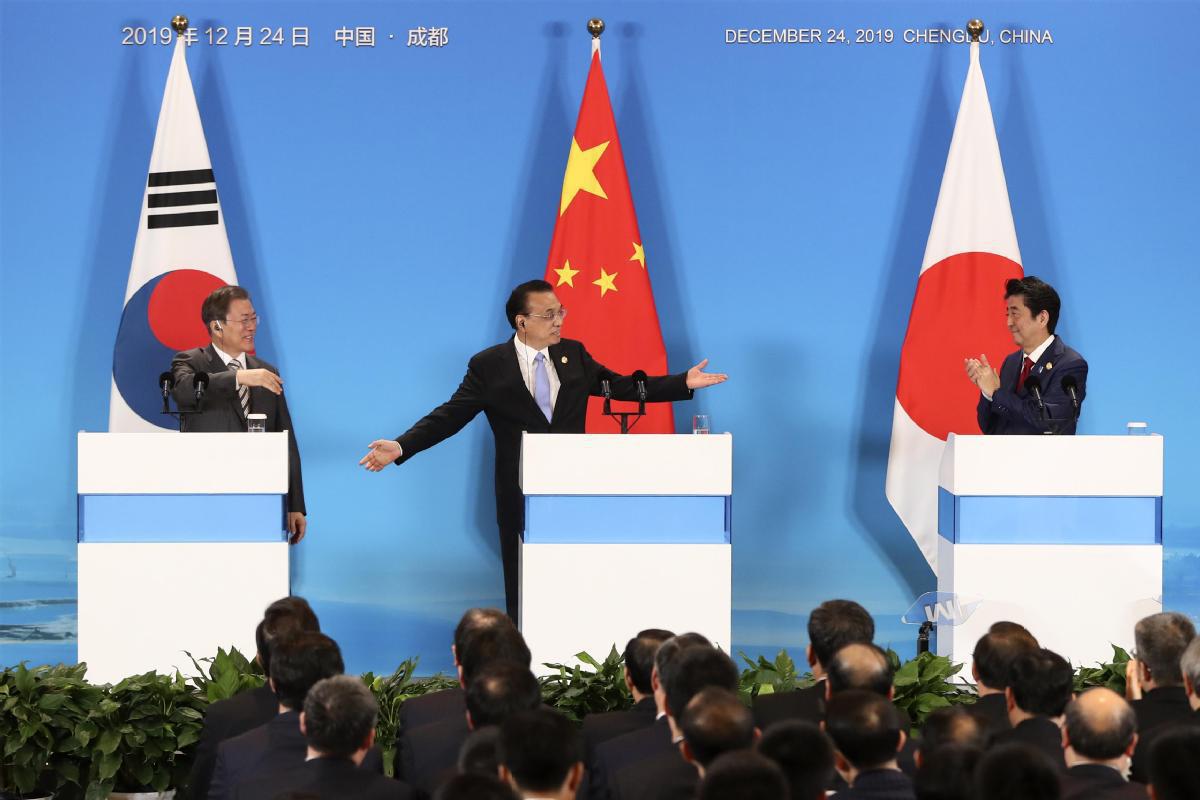
China, Japan and South Korea need to join hands in regional cooperation, build an East Asian community of shared future and mitigate the negative effects of COVID-19.
The three countries need to further strengthen regional economic cooperation. In the past 20 years, trade between these countries rose from $130 billion to $720 billion, which can be attributed to their inclusive trade policies, complementary industrial chains and closely knit network of suppliers.
However, COVID-19 has had a negative impact on trade. According to the General Administration of Customs, the trade between China and Japan totaled 274.95 billion yuan ($38.8 billion) in January and February, down 15.3 percent year-on-year.
Meanwhile, two-way investment between China and South Korea had risen from $6.08 billion in 2016 to $8.4 billion in 2018, an increase of 38.2 percent. Since the outbreak, however, they have introduced strict border controls, which has affected production and operations, as well as mutual investments.
While COVID-19 has disrupted trade and economic cooperation, it has become imperative for them to remove trade barriers, reduce the threshold for market access, cut corporate operating costs, expand trade and investment, and maintain economic growth and domestic stability in order to mitigate, or eliminate, the negative effects of the virus.
As the virus has dealt a blow to trade and economic cooperation with Europe and North America, countries there may shift from their traditional markets to East Asia if trilateral cooperation is promoted.
China, Japan and South Korea should move faster with negotiations on a trilateral free trade agreement and the second phase of the China-South Korea free trade agreement, and push for timely entry into force of the Regional Comprehensive Economic Partnership, a free trade agreement for the Asia-Pacific region.
The three countries have made major progress in fighting COVID-19. In this context, they need to make the best use of mechanisms such as the trilateral summit, the trilateral economic and trade ministers' meeting and the trilateral senior economic officials' meeting in promoting policy coordination and planning.
They can focus on firming up their strengths in existing industrial chains and supply chains.
In addition, a trilateral cooperation mechanism on public health should be jointly established.
They should hold videoconferences among public health officials, experts and academics at different levels. They can share experiences and learn from one another.
They can also explore effective epidemic control models. The solutions they provide can be used as a reference by other countries.
The three countries can also expand cooperation in areas such as tourism and education.
Their concerted efforts in combating COVID-19 have not only provided new impetus to trilateral cooperation on public health, but also have offered an opportunity to step up maritime cooperation and governance.
COVID-19 has become a litmus test for social governance in affected countries. The impressive performance of the three countries indicates their comparative strengths in social governance.
They should leverage their willingness for cooperation in epidemic control efforts and their respective strengths in governance. For example, they can work more closely in global maritime governance, particularly on joint marine scientific research and technological development, sustainable use of marine resources, protection of the marine environment, and maritime crisis management.
In these trying times, we see humanity shining against the background of our shared cultural traditions, which have become a special bond connecting the three countries.
The author is president of the National Institute for South China Sea Studies. The views do not necessarily reflect those of China Daily.