US won't allow foreign students to stay if classes are moved fully online









International students in US educational institutions will have to leave or will be prohibited from entering the country if their schools move to online-only teaching in response to the novel coronavirus pandemic.
US Immigration and Customs Enforcement announced a new rule on Monday that students on F-1 (academic student) and M-1(vocational or technical student) visas may not remain in the United States if they take a full online-only course load for the fall semester.
The US Department of State will not issue visas to students enrolled in schools that operate under an online-only course model, and US Customs and Border Protection will not permit such students to enter the country, according to an ICE statement.
ICE said students affected by the new policy can transfer to a school with in-person instruction to retain their legal status; otherwise, they will be deemed to be in the US illegally and subject to deportation.
Due to continuing concerns over the pandemic, many colleges and universities, such as Ohio State, will be offering hybrid solutions combining in-person instruction and online teaching for its fall semester.
Oleg Wang, a Chinese student majoring in civil engineering at Ohio State, said: "There's a lot of uncertainty. There's no deadline for departing the country, and it's not clear how they are going to implement the new rule."
After the pandemic broke out and the situation worsened in the US, many Chinese students left for home. Wang decided to remain in the US to avoid the potential difficulty of reentering the country.
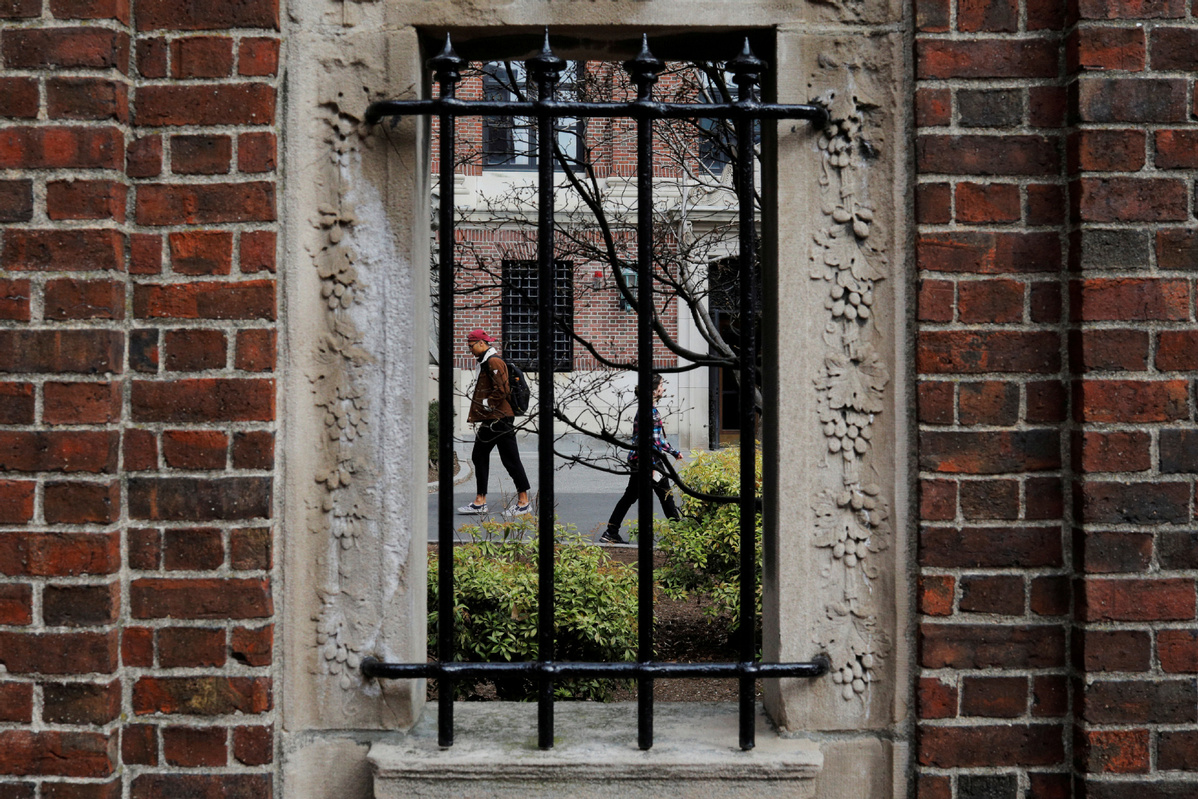
Two of his roommates returned to China in March. One of them has decided to take a gap year due to the pandemic, and the other is considering his options.
"If they take a gap year, they'll have to reapply for a student visa, and they may face difficulties obtaining a visa then," said Wang.
Liu Jinyi, president of the Chinese Students and Scholars Association at James Madison University in Virginia, said his group is waiting for the university's response.
"Many students around me are anxious about the current situation," said Liu. "Some Chinese students who choose to stay in the US now hope to enroll in the fall semester rather than having a one-year gap."
According to data from The Chronicle of Higher Education, which is tracking nearly 1,100 colleges and universities' reopening plans, 60 percent of schools are planning to offer in-person instruction, 23 percent are planning to operate under a hybrid model, and about 8 percent are planning to be online-only.
At Stanford University, for instance, only freshmen, sophomores and new transfer students are invited to come to campus for the fall classes. While in-person classes will be offered on campus, online classes will be "the default teaching option for the 2020-21 school year", Forbes quoted the university's president, Marc Tessier-Lavigne, as saying.
Harvard announced on Monday that it would offer only online classes for 2020-21, becoming the latest institution to announce a virtual-only operating model for the fall semester.
More than 1.1 million foreign students currently have active student visas, according to the US Department of Homeland Security. China was the largest source of international students in the US in the 2018-19 year, with 369,548 students enrolled in various programs, according to the Institute of International Education in New York.
"This new rule poses a major problem for my Chinese students," said Stanley Kwong, an adjunct professor at the University of San Francisco whose classes will all be delivered online for the fall semester.
"My students from China all wanted to come to San Francisco. They want a real college experience," said Kwong.
Aaron Reichlin-Melnick, policy counsel at the American Immigration Council, said the new rule "is almost certainly going to be challenged in court".
Dong Leshuo in Washington contributed to this story.