As restaurant dining moves outside, safety risks emerge









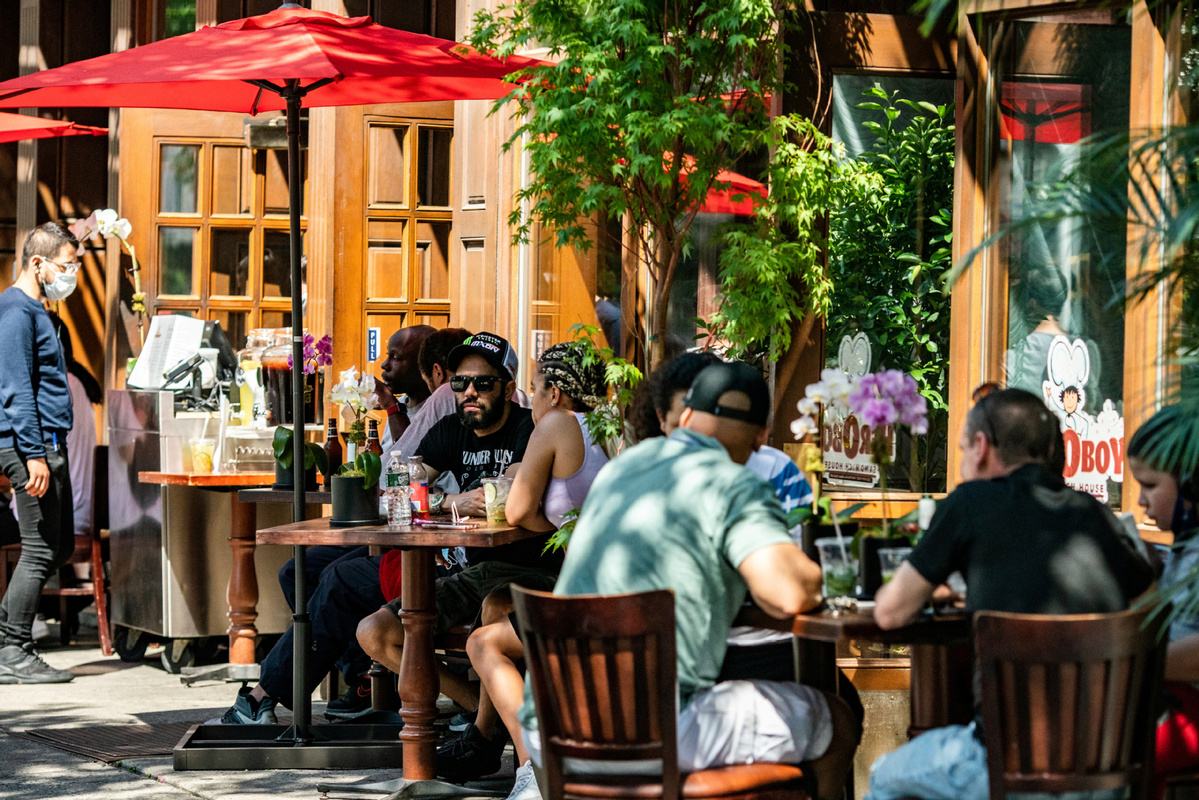
With a pandemic preventing restaurants nationwide from offering indoor dining, many have turned to improvised seating outside.
But expanding into the great outdoors can bring risks, especially for bars and restaurants in crowded cities that didn't previously spill out onto sidewalks, streets and parking spots.
In New York City, an Open Restaurants program that debuted on June 22 allowed more than 9,500 restaurants in all five boroughs to temporarily expand their seating areas onto sidewalks, parking spaces (so-called parklets) and closed roadways.
Of that total, more than 6,000 restaurants have been approved to actually set up tables and chairs on square footage — roadway and parking spots — that was recently the domain of motor vehicles, according to a report in The Wall Street Journal.
New York's rules stipulate that roadway cafes — or "streateries", as the website Curbed calls them — must have barriers at least 18 inches wide separating patrons from passing traffic and must be marked with reflective tape. Tables must be at least 15 feet from a fire hydrant and 8 feet from a crosswalk.
Of the restaurants offering open-air dining under the program, about half are in Manhattan, about 2,800 have sidewalk seating only, 760 have roadway seating and 4,300 have both, the Journal reported.
Even if one can ignore the risk of sudden bad weather, unmasked pedestrians and the occasional rat, there's still the issue of noise and fumes from cars and buses to cope with. But some establishments have the good fortune to be located on streets included in New York's Open Streets program, which closes 62 streets each weekend to traffic to accommodate roadway dining and other socially distanced activities.
Pell Street in Manhattan's Chinatown was one of the first to participate, under the sponsorship of the Chinatown Business Improvement District and the Chinese Consolidated Benevolent Association.
One downside of the trend is that so far there have been four collisions resulting in eight minor injuries in New York City alone, the Journal reported.
Last month, an out-of-control vehicle hit the 12-table outdoor dining area of L'Wren, a cocktail bar in Sunset Park, Brooklyn, injuring three.
Despite the incident, the bar's co-owner, Jessica Klaus, told the Journal that the ability to offer outdoor table services has been critical. "If we didn't have the outdoor and roadway seating, I think even more people would be filing for bankruptcy right now."
In a similar incident July 10, a driver passed out and plowed into the outdoor dining area behind Nellie's Place, a family restaurant in Waldwick, New Jersey. The lunchtime incident destroyed half of the 12 picnic tables set up behind the restaurant, but due to an impending storm, no one was seated outside. The driver was not seriously injured, and Nellie's reopened the next day.
New York Mayor Bill de Blasio declared Open Restaurants a success Monday, saying it would be renewed next summer. The city said that 80,000 laid-off hospitality workers had returned to work through the program, which will conclude on Oct 31 this year.
"We have seen that this experiment worked," de Blasio told Politico. "I want the folks who own the restaurants to know that they're going to have that additional revenue going forward."
It is probably worth it for restaurants and bars to spend the several thousand dollars for furniture, plywood floors, umbrellas, planters and street barriers it can cost to turn parking spaces into dining areas.
The challenges can be considerable.
At Pescatore, an Italian restaurant near the United Nations, staffers have to set up and then take down large traffic barriers each night at 7 pm, as the tables are set up in a rush-hour-only express-bus lane.
"We're like a NASCAR pit crew," the restaurant's director of operations, Charles Devigne, told the Journal. Sales at the restaurant are still down 64 percent from before the novel coronavirus outbreak, but it beats being down 75 percent, which was the case when Pescatore could offer only delivery and takeout.
In Los Angeles, a city initiative called LA Alfresco allows restaurants to turn sidewalks and public parking spots into outdoor dining, reported the website Eater Los Angeles. Other restaurants have gotten innovative by temporarily occupying nearby vacant lots and their own parking lots.
A newly opened Echo Park café called Lady Byrd gained online fame for installing in its parking lot four mini greenhouses that seat up to six patrons each, borrowing the idea from an Amsterdam waterfront restaurant.