Documentary nails West's lies on Xinjiang's fight against terrorism









The documentary, Lies and Truth-Vocational Education and Training in Xinjiang, produced by the Xinjiang Development Research Center, a local think tank, has been on air since late August.
As the documentary's first part, Source of Violence and Terror, shows, there were mounting calls to protect people's lives and properties from the increasing attacks by separatists, religious extremists and terrorists in the Xinjiang Uygur autonomous region.
When life is in danger, protecting human rights and people's right to development is not possible.
Given the deep level of infiltration by religious extremists in Xinjiang, particularly in the southern part of the region, the central government took preventive measures against terrorism in line with the United Nations' Plan of Action to Prevent Violent Extremism, including engaging earlier and addressing the "drivers of violent extremism. And the Xinjiang government found vocational education and training centers the best way to root out terrorism and religious extremism from the region.
The true stories of six graduates in the documentary show Xinjiang has always put people first in its de-radicalization drive, using rehabilitation instead of punishment, and compassion toward those indoctrinated with extremist thinking rather than condemning them to death.
The vocational education and training centers offer courses to victims poisoned by extremism in the local language to free them of anti-human thoughts, and impart legal knowledge and vocational skills to them.
As Nijat Myhtar, a graduate, says in the documentary: "Teachers in the centers told us about the laws and policies repeatedly. Local experts were invited to give lectures on law including the Constitution, criminal law, counter-terrorism law, and Regulations of the Xinjiang Uygur Autonomous Region on Deradicalization.
"I visited an exhibition on violent terrorist attacks in Xinjiang…(and) realized that those criminals killed innocent people … I'm filled with regret. I hate myself for believing those lies. They tried to turn me into a cold-blooded murderer. The education and training center helped me differentiate right from wrong. I have learned how the law can help me. I will work hard to make my family lead a better life."
The six graduates who got a new lease of life represent the change in Xinjiang. After joining the centers, most of the trainees learn about the inhuman nature of terrorism, and realize they have to fight, not support, terrorism.
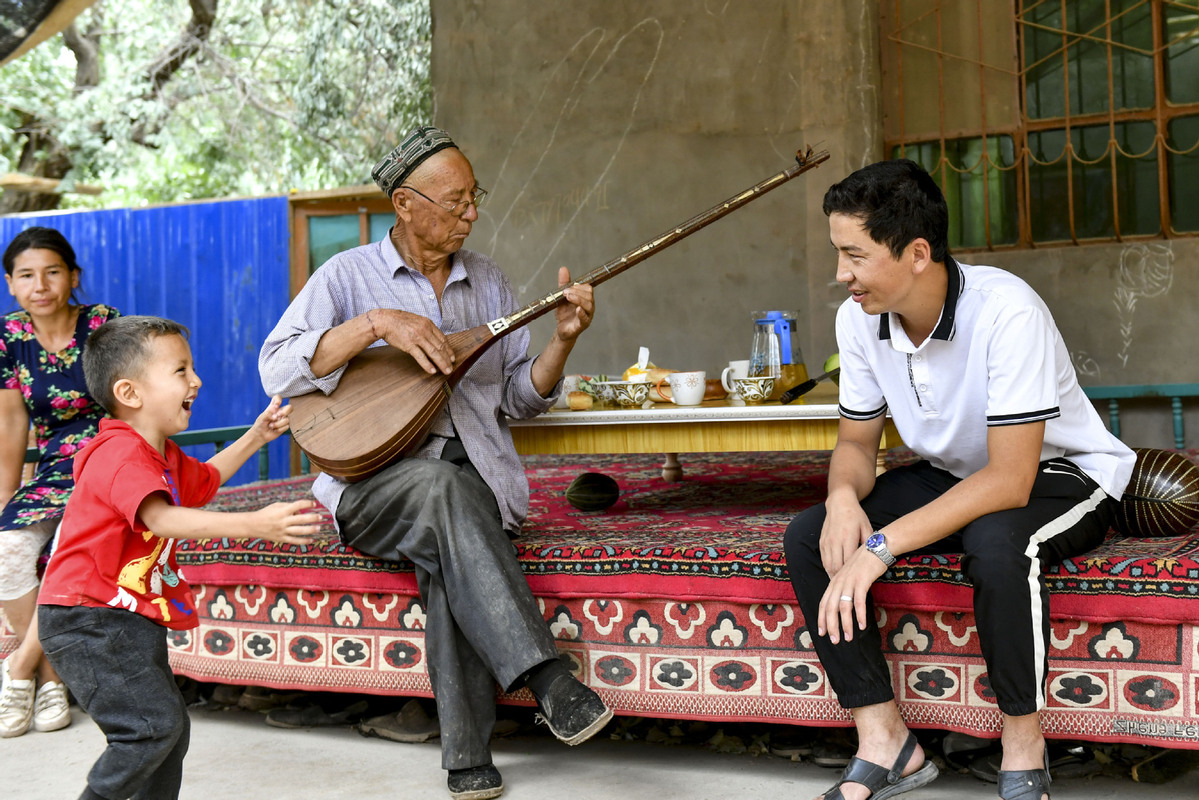
The common feeling of those who have visited southern Xinjiang recently is that after graduating from the centers, the trainees get a job or start a business with the government's help, and exhibit a lively and positive spirit.
Yet despite making strenuous efforts to protect human rights in Xinjiang, China has been criticized by some Western countries. These countries have called the vocational education and training centers "concentration camps", claiming they help persecute "ethnic minorities" and infringe "on religious freedom and human rights".
Such criticisms are partly the result of the East-West ideological confrontation. The West, led by the US, has always believed its political and social system and values are the best in the world and, worse, uses them to measure other countries' institutions, policies and human rights. And if any country's political and social systems are different from its own, the West, the US in particular, begins slandering that country, even trying to trigger a "color revolution" causing enormous upheaval in some states and regions.
Xinjiang's vocational education and training centers are nothing different from the community correctional facilities in the US, the Desistance and Disengagement Programme in the United Kingdom and the de-radicalization centers in France, all of which aim to preempt terrorist activities.
By demonizing the centers, the US wants to take advantage of the West's condemnation of China's actions in Xinjiang to gain the upper hand in the Sino-US strategic competition and check China's rise, and thus continue its hegemony in the world. China has always followed the peaceful development path, and handled both domestic and global issues in accordance with laws and regulations with the aim of building a community with a shared future for mankind.
There is a global consensus on clamping down on terrorism and extremism. And the vocational education and training centers in Xinjiang are a positive form such a clampdown.
The views don't necessarily represent those of China Daily. The author is a researcher at the school of history, Xinjiang University.