Decoupling not good for China or US









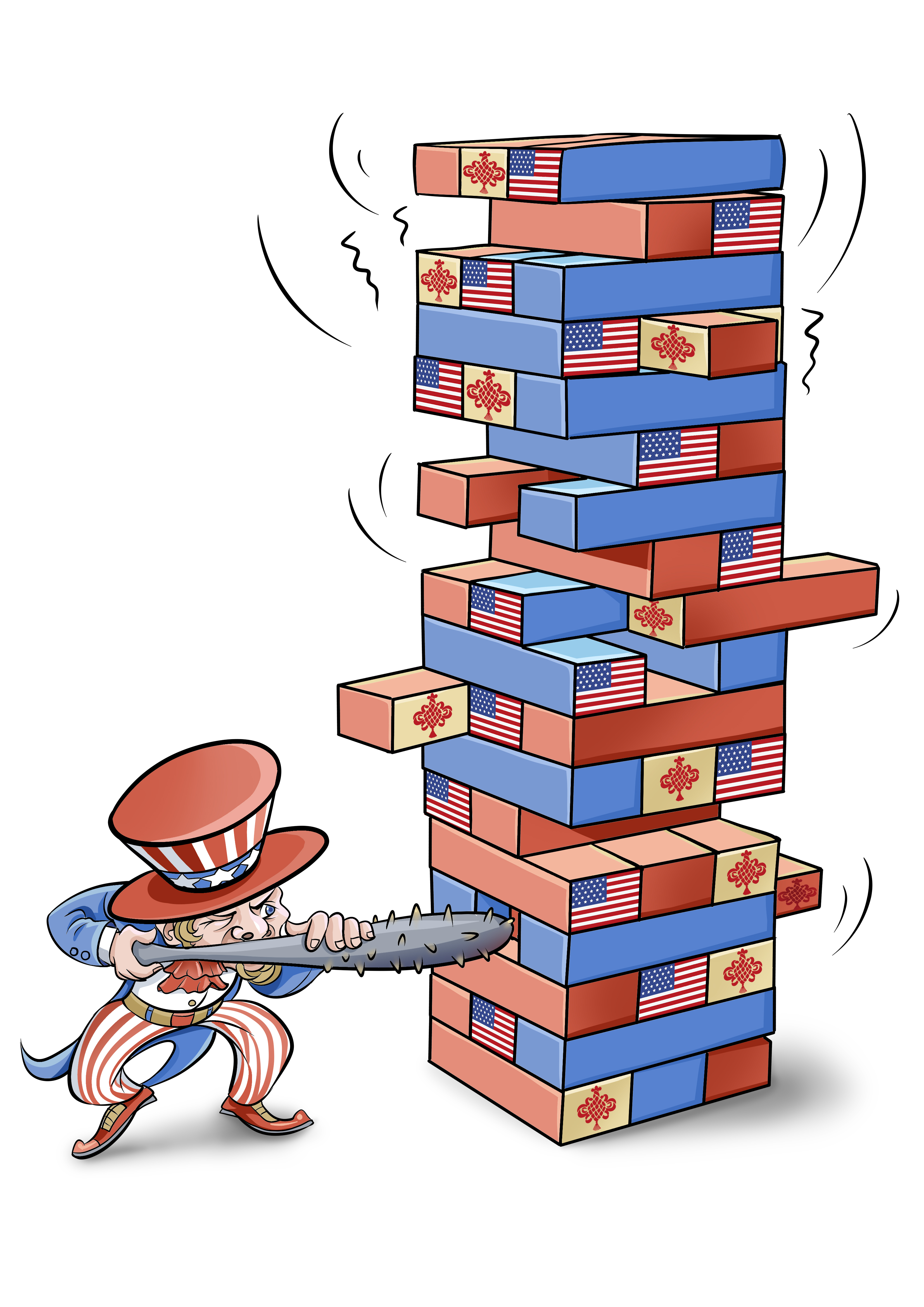
Sino-US relations have undergone drastic changes since the US administration launched a tariff war against China at the beginning of 2018.
Thanks to the China hawks in Washington who want to decouple the US and Chinese economies, Washington has taken a series of targeted measures against Beijing, including restricting Chinese investment in the US through the Committee of Foreign Investment in the United States' review process, trying to strangle Chinese high-tech enterprises, imposing visa restrictions on Chinese students who want to major in science or engineering in the US, and forcing American companies operating in China to return to the US, which have seriously affected economic and trade exchanges between the two sides.
The clampdown on TikTok, a short video-sharing app developed by Byte-Dance, and WeChat, a messaging app owned by Tencent, is the latest US move against Chinese companies on the pretext of safeguarding national security, economy and American people's private data.
Will the impact of all these US moves lead to the global supply chains expanding further out of China to more and more countries?
The fact is, the global supply chains were already widening as some industries, especially labor-intensive industries, had started shifting from China to other countries even before the outbreak of the COVID-19 pandemic or the US-triggered trade war. Such shifting of industries is determined by a variety of factors, including labor cost, changing consumer preferences and industrial upgrading.
Given the implementation of the Belt and Road Initiative across the world and the "go-global" drive of Chinese enterprises, it is only natural that some of China's production capacity will shift and supply chains will extend further to overseas countries and regions.
According to the "new economic geography" theory of Paul Krugman, Nobel Prize winner in Economics, the overlapping effects of industrial divergence and integration will lead to the "hump-shaped" distribution of industrial agglomeration and the geographical shift of manufacturing agglomeration, including the transfer of the textile industry from Europe to North America initially, followed by the transfer of the manufacturing industry from North America to Northeast Asia, mainly the Republic of Korea, Japan and Taiwan, and then to the Chinese mainland. So, it would be impractical to think that the industries that shifted to the mainland would remain there forever.
Also, the supply chains always keep moving, which is not a bad thing. What really matters is the innovation ability of a country and its enterprises, and the position its domestic enterprises occupy in the global supply chains and global markets. In addition, large economies such as China, which now mainly rely on domestic market circulation, have developed strong resilience.
As for the export-GDP ratio, Germany's is 47 percent, the highest among the world's major economies, and those of France, the United Kingdom and Russia are 31 percent, 30 percent and 26 percent respectively. China's exports account for only 18 percent of its GDP now, more than only Japan's 16 percent, and the US' 12 percent.
Assuming that 50 percent of the added value of China's exports can be calculated into its GDP, the value added of China's exports to the US would actually account for only 1.5 percent of GDP. As such, the US' so-called decoupling cannot shake the basic structure of China's economy, not to mention such a decoupling is unlikely to happen.
Besides, economic decoupling with the Chinese economy will also seriously hurt the US economy, especially those US companies operating in China and reaping profits of $300-$400 billion every year. Economic interdependence between China and the US also plays an important role in maintaining low prices, high fiscal deficit and savings in the US.
In an op-ed on CNN's website on Aug 4, Stephen Roach, a professor at Yale University, said the root cause of the US trade deficit with China lies in its low savings rate. If the US restricts trade with China, a similar trade deficit with a third country will soon occur, which will only make US consumers pay for more expensive imports, which is equivalent to raising taxes on them, Roach warned.
A Sino-US economic decoupling will not only affect US companies and capital, but also the entire US society, including ordinary consumers. This is also the fundamental reason why State Councilor and Foreign Minister Wang Yi said:"If China and the US work together, they will benefit both, but if they fight each other, they (both) will be hurt".
It would be a pity if the US administration still refuses to accept these basic economic facts. With the 2020 US presidential election approaching, the error-correcting function of the US political system will hopefully bring Sino-US relations back to the right track.
The author is a professor at and doctoral supervisor in the Department of Economics at the University of International Business and Economics.
The views don't necessarily reflect those of China Daily.