A Silk Road pearl shines










Uzbekistan offers much more than a distinct blend of East and West
The modern cities of Uzbekistan, a country steeped in history, sparkle under the bright sun like pearls scattered along the ancient Silk Road thousands of years ago.
Braving the blistering sun and sandblasting winds, Chinese traders began arriving in the city of Bukhara during the Han Dynasty (206 BC-AD 220). Some stayed, while others carried on along the Silk Road to explore new markets.
Known as a "shining pearl of the Silk Road", Uzbekistan's fifth-largest city is more than 2,500 years old.
Back when the ancient trading route was well trodden, long caravans traveled to the city from across the globe, lured by the legend of a magical oasis hidden between two deserts.
According to some records, the first caravans appeared on the Silk Road in 138 BC, when China opened its borders for trade. One of the first Chinese envoys to cross what later became Uzbek territory from north to south was Zhang Qian, an envoy of Han Dynasty Emperor Wu (156-87 BC).
Zhang and his companions wrote about three prosperous kingdoms: Bukhara, Fergana and Samarkand. All are now territories of Uzbekistan.
So, if you're intrigued by the ancient Silk Road but don't have the time to travel its length from China to Turkey, you'll find three of the route's most important cities in Uzbekistan-Khiva, Bukhara and Samark were key stop-offs for traders and have all been painstakingly restored to their former glory.
Think glittering minarets, voluptuous domes and mesmerizing mosaics.
With a little planning, you can squeeze them all into a week. But of course, most tourists start their Silk Road adventure from the Uzbek capital, Tashkent.
Genghis Khan destroyed the city for the first time in 1219. It was rebuilt and profited from the Silk Road.
An earthquake ruined Tashkent again in 1966, but it was reborn again as a model Soviet city. Actually, Tashkent became the fourth-largest city in the Soviet Union at the time, after Moscow, Leningrad and Kiev.
Consequently, you'll find a charming mishmash of restored 12th-century mosques and classical Soviet architecture alongside blocky Brutalist buildings and statues of workers with bulging biceps.
The city's heritage sites include the Oq-Tepa District, the Mausoleum of Abubakr Mukhammed Kaffal Chachi, and such museums as the Museum of Applied Arts and the Museum of Fine Arts, which take you back in time.
There's also the World War II Memorial Park and the Defender of the Motherland Cenotaph.
The city is lined with a grid of straight, wide streets and avenues. Its emerald-green parks, gardens and fountains infused with crystal strands are spectacular.
In the sleepy part of the town, one can still spot traditionally clad farmers carting their commodities through a maze of earthen houses, all the way through the bazaar's grinding crowds.
It's impossible to fully comprehend the Silk Road's incredible size and history without understanding its farthest-reaching and most-successful empire-Amir Timur (1336-1405), sometimes known as Tamerlane.
Timur was considered one of the greatest military leaders and tacticians in history. He was an undefeated commander and founded the Timurid Empire (from the 1400s-1600s) in and around modern-day Afghanistan, Iran and Central Asia.
It is worth mentioning that Timur is also the great-great-great-grandfather of Babur, founder of the Mughal Empire, which then ruled almost all the Indian subcontinent.
When you talk with any Uzbek about the undoubted hero of their nation, you will feel the honor and respect in their hearts. You'll see his face on everything from hotel-lobby paintings and banknotes to candy packages.
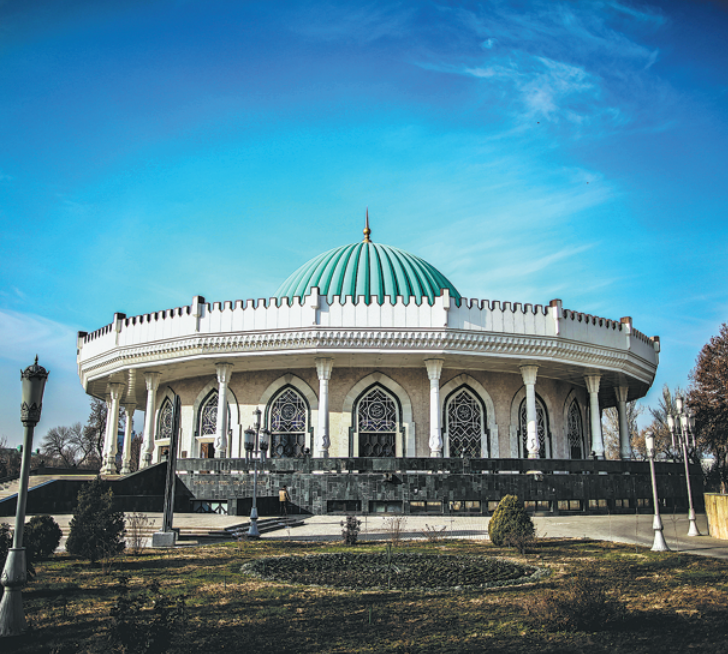
A 30-minute walk in the Amir Timur Museum in the capital's downtown helps you learn more about the country.
Late Paleolithic Era
Samarkand is another city of wonder. Located in southeastern Uzbekistan, it's one of the oldest continuously inhabited cities in Central Asia. And there is evidence of human activity in the area from the late Paleolithic Era.
Some theories suggest the city was founded between the eighth and seventh centuries BC.
Prospering from its location on the Silk Road between China and the Mediterranean, Samarkand remained one of Central Asia's largest cities.
Modern Samarkand is divided into two parts-the old city and the new city, which was built during the days of the Russian Empire and Soviet Union.
The old city includes historical monuments, shops and old private houses.
Its counterpart includes administrative buildings, cultural centers and educational institutions.
For most inbound travelers, the most awe-inspiring and must-see sight in Central Asia is Samarkand's Registan-a central square flanked by the most ornately tiled, mosaic-clad medressas (historical Islamic schools) that glitter at dawn and dusk in shades of the Silk Road-azure, lapis lazuli, indigo and gold.
The larger-than-life architectural gems were built during the Timurid Dynasty. Before that, this area served as a medieval bazaar that was, quite literally, a crossroads at the center of the world.
Legend has it that, when Genghis Khan's troops rampaged across Central Asia during his exploits toward Europe, the towering minaret that keeps watch over the Kalon Mosque complex in Bukhara was the only structure he didn't destroy.
The moving mosque and medressa complex in the ancient Silk Road city is one of the world's most-spectacular examples of Islamic art and architecture, with fine tiling and mosaics, and two facades facing each other accompanied by the spectacular earthen minaret.
All of Uzbekistan's cities have incredible bazaars, but none transport you to the old Silk Road quite like those in Bukhara. A network of interlinked domed market spaces still dominates Bukhara's old town. The most evocative are the Taki-Sarrafon (Money changers Bazaar), the Taki-Telpak Furushon (Capmakers Bazaar) and the Taki-Zargaron (Jewelers Bazaar).
One of Uzbekistan's oldest structures is the fifth-century, walled fortress town right in the center of Bukhara.
It was the residence of the emirs of Bukhara when it was an emirate state (from 1785–1920), and walking through the archway today offers glimpses into the ancient lives of people who made their homes along the ancient Silk Road during its earliest times of trade.
You can start your Silk Road journey by arriving at Islam Karimov Tashkent International Airport, which is Central Asia's third-busiest.
To travel between the cities, you can try the high-speed train, which connects Tashkent, Sirdaryo, Jizzakh and Samarkand.
Or you can take Uzbekistan Airlines if you want to visit some border cities, such as Bukhara or Khiva.