Milestone RCEP to energize Asia-Pacific cooperation, facilitate global economy









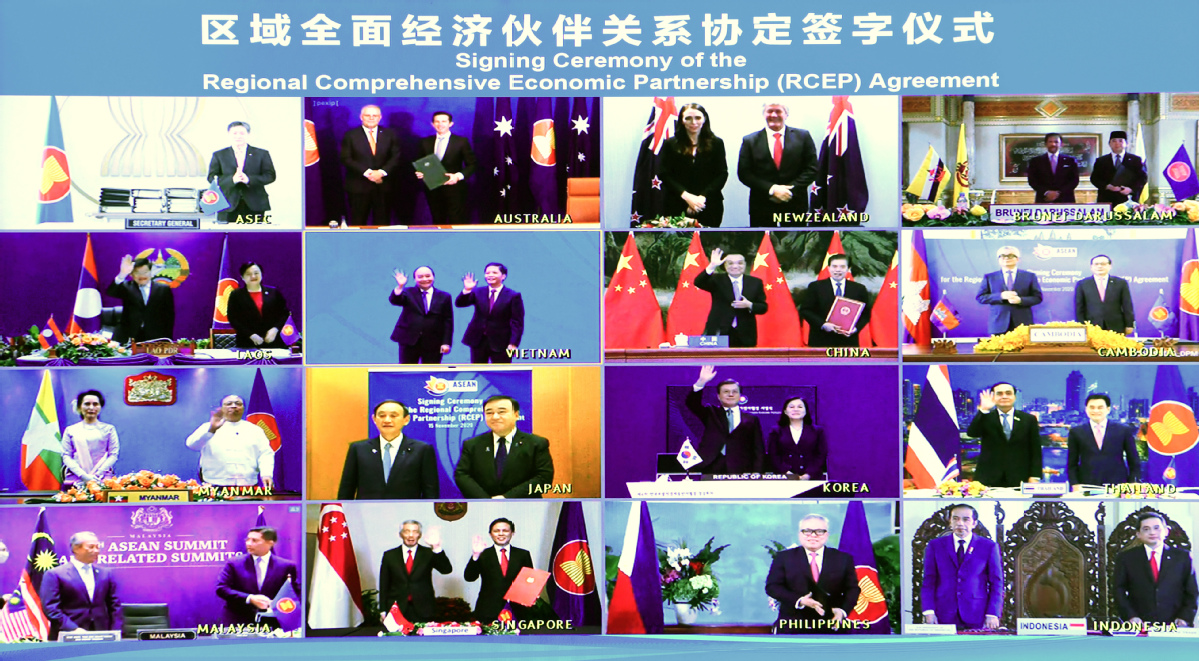
Eight years after its inception, a mega free trade agreement involving 15 countries in the Asia-Pacific region was formally signed on Sunday, a timely and inspiring move that will not only create new momentum for regional cooperation but facilitate global post-pandemic economic recovery.
The 10-member Association of Southeast Asian Nations (ASEAN) and its five free trade partners -- namely China, Japan, South Korea, Australia and New Zealand, inked the Regional Comprehensive Economic Partnership (RCEP) respectively via video link, pledging to lower trade barriers and promote relations within the region.
The milestone RCEP, by far the world's largest free trade deal, came at a critical moment full of uncertainties. The world sees rising protectionism and unilateralism, while trade and economic bullying from certain countries is posing a grave threat to international cooperation as well as the global drive to build an open world economy.
Worse still, the world economy, because of the COVID-19 pandemic, is struggling to pull through what might be the biggest recession since the Great Depression of the 1930s. Last month the International Monetary Fund envisioned a sharp 4.4 percent drop in global growth for 2020, and warned that "the ascent out of this calamity is likely to be long, uneven, and highly uncertain."
Under such volatile circumstances, sealing the mega trade deal is a reconfirmation of the 15 signatories' strong support for and commitment to multilateralism and free trade.
Since the negotiation was launched in 2012, the RCEP members have been stepping up efforts to build up consensus and bridge differences, trying to forge a comprehensive, high-quality and mutually beneficial economic and trade partnership among the region's fast-growing economies. Even the sudden outbreak of the coronavirus has not stopped the course.
China has all along been playing an active and important role in the negotiation process, and is ready to continue working with all sides to implement the trade deal so as to further unleash the potential in a further integrated Asian market and better benefit local industries and populations.
According to the trade pact, the RCEP will progressively phase out 90 percent of the tariffs on imports between signatories, and set up common rules for e-commerce, trade and intellectual property, which will largely boost investment, further integrate industrial and supply chains, better protect investors, and facilitate the movement of goods, funds and people across the region.
The RCEP is also a powerful demonstration of collective willingness of the 15 countries to reject trade protectionism, bolster multilateral cooperation, strengthen their already-close trade ties and speed up regional economic integration and development.
The decisiveness of the RCEP countries offers a ray of hope amid an agonizing winter for the global economy. With joint efforts, they have largely put the pandemic under control and have been on the way to recovery through an orderly resumption of work and production.
Meanwhile, China, a strong booster for regional trade and economy, is also doing everything it can to mitigate the impact of the coronavirus pandemic on economies in the region. In the first 10 months, China's trade with the ASEAN partners stood at 3.79 trillion yuan (574 billion U.S. dollars), up by 7 percent year on year. As some international agencies have projected, East Asia is expected to be the only region to post positive growth in 2020.
While Beijing is seeking to promote a high-quality development in China, it is also determined to further open up its market to the world, and share its development opportunities with the rest of the globe. Such offline events as the international import expo and the international fair for trade in services held by China have renewed investors' confidence in a rebounding Chinese economy and the country's sincerity to fulfill its opening-up promises.
The timely arrival of the pact now stands as a new starting point for deepening economic cooperation in Asia Pacific. All signatories need to ride on the refreshed momentum and expand their practical cooperation in various areas. As the world is cushioning the impact of the pandemic, a more open and developed Asia Pacific region will greatly help the stagnated global economy get out of the woods.