Japanese look back on what could have been










Year's lost chances need not hold nation back, with push for revitalized China ties
It should have been a perfect year for Japan. There was the reinvigoration promised by the Tokyo Olympics in the summer and the prospects for the country to forge a new path in its relationship with China.
The sakura season-when cherry blossoms float like pale pink clouds on the trees that line Tokyo's streets and rivers-was to have provided a colorful backdrop for the scheduled visit of Chinese President Xi Jinping and the start of celebrations leading up to the Summer Games.
But the coronavirus had other ideas for Japan, and the rest of the world, in 2020.
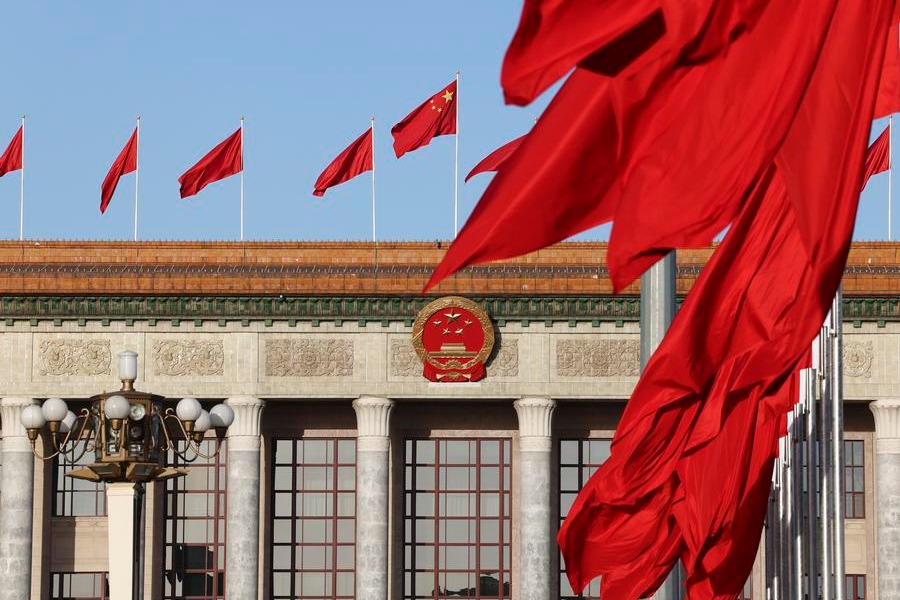
As for the much-anticipated visit of the Chinese leader, the practical implications were great. Even greater, was the symbolism bound up in Xi's arrival. That's because more than a decade has passed since the last Chinese president was received by Japan as a state guest-Hu Jintao in May 2008.
In recent years, long-standing Japanese prime minister Shinzo Abe had worked to rebuild his country's badly damaged relations with China. The state visit by Xi would serve to consolidate an improvement in bilateral ties. In the end, 2020 is closing without that landmark visit, and Abe stepped down in August because of poor health.
"The relations with Beijing had improved greatly during Abe's term. From my perspective, it would be a shame if the state visit were not to happen in the future and see all of Abe's work thrown out," said Kiyoyuki Seguchi, research director at the Canon Institute for Global Studies.
Abe, who had become Japan's longest-serving prime minister by the time he resigned after two stints in power, ended his second term of almost eight years in the nation's highest office with mixed results.
But an improvement in Japan's ties with China, after years of often-chilly interactions, can be added to his legacy on the diplomatic front.
"Abe implemented a steady strategy that can be described as following the United States firmly in politics and national security issues while deepening cooperation with China on economic matters," said Erbiao Dai, vice-president of the Asian Growth Research Institute in Fukuoka, Japan.
"In the past eight years, that strategy was relatively successful in balancing the relations between Japan, China and the US. That enabled Japan to enjoy stable economic growth under the Abe regime."
It falls to Yoshihide Suga, as Abe's successor, to build on the foundations laid by him.
Dai said Sino-Japanese ties underwent a severe test in 2020. However, with the joint efforts of the two countries, the overall relationship has achieved stability. And, in a troubled year, there were many instances of mutual support and solidarity in the face of the coronavirus pandemic.
At the beginning of the COVID-19 outbreak, the Japanese government and civil society provided "timely aid for China's prevention", and the mainstream media also offered warm support, Dai said.
"This was in sharp contrast to the attitude of a few other developed countries, which took the opportunity to try to suppress China.
"In turn, after having rapidly controlled the epidemic situation, the Chinese government and society also tried their best to help Japan after March, when Japan began to face a worsening epidemic situation, and gave more than double the rewards back to Japan for its early help.
"When facing common difficulties, the two neighboring countries showed to the world a spirit of interdependence and expressed kind wishes toward each other."
For many observers, the "friends in need" aspect of the relationship is seen turning into a long-lasting theme.
However, as the COVID-19 crisis progresses in Japan, there will be difficulties. And one effect of the pandemic has been the near-shutdown in interactions between the business people and civil society groups of the two countries.
An area of uncertainty could arise from a decision in July by the Japanese government to promulgate subsidies aimed at encouraging Japanese enterprises to invest in factories in Japan and Southeast Asia as part of efforts to reduce their reliance on China as a manufacturing base.
In making the decision, the government was believed to have come under pressure from abroad as well as from some Japanese politicians.
The result, however, has been characterized by Dai as amounting to "a lot of thunder but little rain".
After a contraction early in the year under the effects of lockdowns, the Chinese economy returned to growth. For the July to September quarter, it expanded 4.9 percent. The year-on-year expansion, while slightly lower than analysts' expectations, represents a dramatic reversal from the 6.8 percent shrinkage logged in the first quarter.
The Japanese business community was quick to take notice of the recovery. Japan's Ministry of Finance said Japanese companies invested more than $9.2 billion in China in the first three quarters of 2020.
Japanese enterprises' direct investments in China in 2020 are estimated to come close to-and possibly exceed-the $12.4 billion in flows recorded for 2019.
For the first 10 months of this year, Japan's direct investments in China accounted for 26.9 percent of the total outlay for Japanese foreign direct investment in Asia, rising by more than 5 percentage points from the 21.8 percent posted in the same period of 2019, the ministry said.