Rural revitalization can prevent poverty relapse









The Government Work Report Premier Li Keqiang presented on the opening day of the annual session of the National People's Congress is especially significant in that it not only reviews the government's work in 2020 and lays out the main tasks for 2021, but also provides an account of the achievements during the 13th Five-Year Plan (2016-20) period and an outline of the main targets and tasks for the 14th Five-Year Plan (2021-25) period.
The 14th Five-Year Plan covers the first five years after the eradication of extreme poverty across the country. Among the objectives and priorities of the 14th Five-Year Plan is advancing "rural revitalization", a concept coined by President Xi Jinping during the 19th National Congress of the Communist Party of China in 2017.
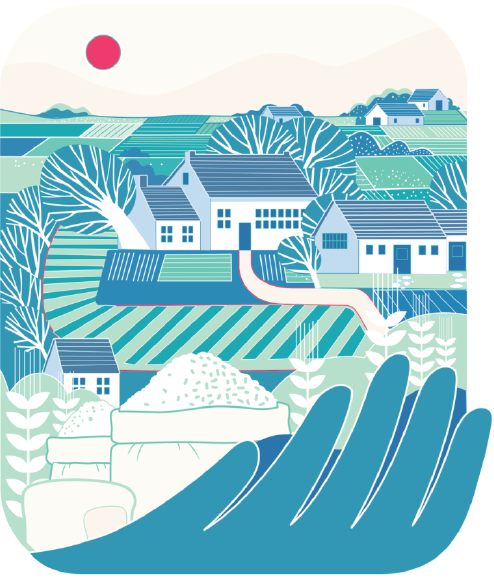
The idea is to have a long-term, comprehensive framework to close the development gap between urban and rural areas, by accelerating the development of rural areas and making them more attractive for living. Rural revitalization aims to consolidate the achievements of poverty eradication through rural economic development, rural governance improvement and ecological civilization construction.
As a representative of an organization mandated to promote poverty reduction, food security, and inclusive rural development-the International Fund for Agricultural Development-I share some ideas about rural revitalization.
China's focus on rural revitalization reflects the importance rural development plays in the pursuit of a "strong, democratic, civilized, harmonious and modern socialist society", which is the country's long-term goal. The pursuit of rural revitalization shows China recognizes the existing imbalance in urban and rural development, and the need to rectify it. The average income in rural areas is almost three times less than that in urban areas, and only about 40 percent of the active population in rural areas can find an employment opportunity for a period of more than six months locally.
The rest of the active population-most of which is represented by youths-is forced to migrate to urban areas in search of better-paying jobs. The massive migration from rural to urban areas that China has experienced over the past 40 years was a natural consequence of the industrialization process that underpinned China's rapid economic growth-and, in that context, it was justified.
However, under the current conditions, such a process challenges the supporting capacity and social stability of urban centers, entails high social costs, and is not sustainable in the long run. Only by investing in and developing rural areas can the imbalance between urban and rural areas be addressed, and the goal of a harmonious society pursued. Hence, the importance of revitalizing rural areas.
The pursuit of rural revitalization also means China's leadership recognizes the importance of consolidating the poverty-eradication achievements, which, incidentally, is an important agenda of the rural revitalization program. It stems from the recognition that, despite the eradication of absolute poverty, a significant percentage of the population still lives "above" but "close" to the poverty line.
These people remain vulnerable to shocks and risk slipping back into poverty, particularly in case of an unforeseen emergency: a serious disease in the family, the loss of job, drastic increase in commodity prices, a climate change-induced harvest failure, or-as the COVID-19 outbreak has shown-a pandemic. The COVID-19 pandemic has shown that the most vulnerable are also the worst affected by a crisis. That's why it is important to continue monitoring and supporting vulnerable groups.
Above all, rural revitalization is a comprehensive and holistic approach to rural development, where the objectives of economic development and employment creation, consolidating poverty-elimination achievements, reducing vulnerabilities, safeguarding food security, providing good governance, and better protecting the environment are not dealt with separately. Only by dealing with these dimensions of rural development in an integrated manner can rural revitalization be achieved.
The challenge ahead is to implement the rural revitalization program. The program will be as successful as China's battle against poverty provided it is carried out with the same level of political commitment and same amount of support as the campaign to fighting poverty.
This year, the IFAD and China celebrate the 40th anniversary of the IFAD's first loan to China, reflecting the strong and decades-old ties between the IFAD and China. The IFAD is ready to support China in pursuing its rural revitalization agenda as it has supported China, over the past 40 years, in its efforts to eradicate absolute poverty.
The views don't necessarily reflect those of China Daily.
The author is country director and representative for China and head of East Asia Regional Hub, International Fund for Agricultural Development.