Lower growth target means higher-quality development









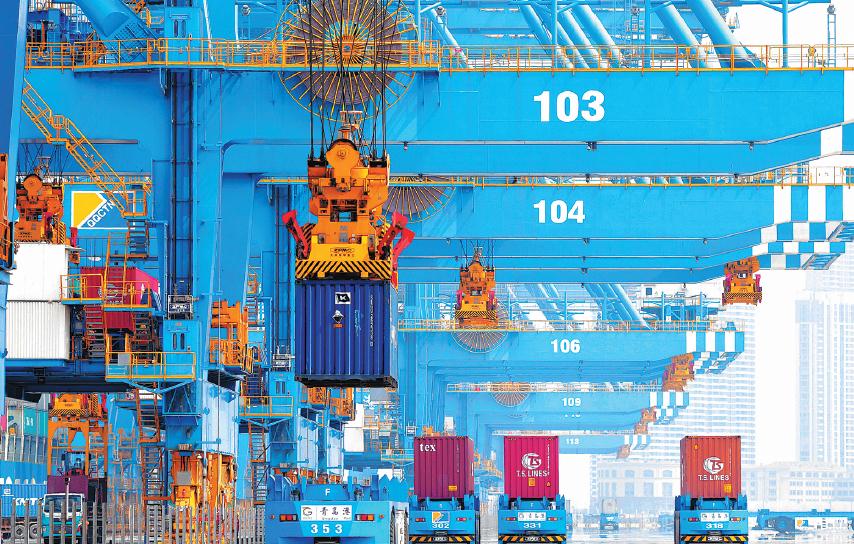
Premier Li Keqiang reiterated China's need to achieve high-quality economic growth at a news conference on Thursday, the concluding day of the annual session of the National People's Congress. And although economists and market analysts, in general, have forecast 8-10 percent for China's economy for 2021, Premier Li once again emphasized a target of "above 6 percent" will better help China's economy grow more steadily.
By setting a target below the market consensus, the government has sent a clear message that, for China, the quality of growth outweighs the magnitude and speed of growth, as long as it remains within a reasonable range.
Incidentally, the proposed macro policy mix points to a gradual policy normalization, and we (at Standard Chartered Bank) see substantial room for growth to beat the targeted floor of 6 percent.
Recent economic indicators suggest China's economy is already running at above-potential level. In the fourth quarter of 2020, GDP growth reached 6.5 percent year-on-year and industrial production increased by more than 7 percent year-on-year, both exceeding the pre-pandemic pace.
In addition, the extraordinary policy stimulus introduced after the COVID-19 outbreak, including reduction in taxes and fees, increase in infrastructure and social spending, and substantial credit support to the real economy, is expected to sustain the growth momentum in the first few months of this year.
Externally, the vaccination progress and expected fiscal stimulus in major economies have fuelled optimism over the global recovery outlook.
It is therefore no surprise that China has shifted focus toward containing further rise in the macro leverage ratio. Indeed, the government recognizes the need to consolidate the foundation of economic recovery and has pledged to provide necessary support for the economy and avoid sharp policy turns. Yet we believe the priority is no longer faster growth but rather tackling uneven recovery through targeted support in the broader context of fostering super-sized domestic market and boosting consumption.
The initiation of policy exit sets China apart from the other major economies that are expected to maintain accommodative macro policies throughout 2021 at least. China's 2021 budget envisages a reduction in the official budget deficit to 3.2 percent of GDP from 3.6 percent in 2020, signalling fiscal consolidation. The country's central bank has made no secret that it wants to keep normal monetary policy for as long as possible, and has committed to guiding money supply and total social financing growth basically in line with nominal GDP growth.
Reflecting the broad guidelines in the Government Work Report, we think total social financing growth is likely to be brought down to 10-11 percent (the pre-pandemic level) by the end of this year from 13-14 percent last year. This translates to broad money growth of 8-9 percent based on the relationship between money and credit growth in recent years.
Also, the central bank will likely keep liquidity reasonably adequate by lending to commercial banks through open market operations, medium-term lending facility and re-lending/re-discounting. And since the government aims to press the lending rates lower, we don't expect a hike in the policy rates this year.
We believe the relatively generous fiscal stance is intended to mitigate the impact of tighter credit policy and other contingencies. And if growth recovery remains on track during the year, the government may very well choose to under-implement the spending program to save policy space for the future.
Supported by policies and a low base last year, we still expect China's GDP to grow by 8 percent in 2021, so the official target will be easier to achieve. Interestingly, the official budget, with deficit set at 3.57 trillion yuan ($548.93 billion) or 3.2 percent of GDP, implies a nominal GDP assumption of 111.6 trillion yuan. This is equivalent to 10 percent nominal GDP growth and about 8 percent real growth assuming a deflator of 2 percent.
Our forecast is based on a broad deficit of 6 percent of GDP, assuming there is no need to fully utilize the room built in the budget, but a more aggressive budget implementation could generate upside risk to our forecast.
The views don't necessarily reflect those of China Daily.
The author is chief economist, Greater China and North Asia, Standard Chartered Bank.