Look north, SE Asia urged for climate goals









China's green shift can serve as carbon model for nations in region, experts say
China's commitment to reduce emissions could encourage countries in Southeast Asia to become more ambitious in their own responses to climate change, analysts said.
As Asia's largest economy pursues low-carbon growth, a key goal emphasized under the nation's 14th Five-Year Plan (2021-25), that transition will nudge governments in the region to rethink their development path and embrace green technologies, they said.
"China's outsized global role means its influence in Southeast Asia looms larger," said Renato Redentor Constantino, executive director of the Institute for Climate and Sustainable Cities, a think tank in Manila.
With China's close diplomatic and trade connections to the region, Constantino said Beijing's latest energy and emissions targets can "trigger a revaluation of investment strategies and prospects" in Southeast Asia.
"Southeast Asian governments need to decide whether they will chase the agenda of modernity China seems determined to pursue, or stay stuck with the past (that) China is eager to leave behind," he said.
China is aiming to reduce energy consumption per unit of GDP and carbon dioxide emissions per unit of GDP by 13.5 percent and 18 percent, respectively, in the 14th Five-Year Plan.
Ruben Carlo Asuncion, chief economist at the Union Bank of the Philippines, said pursuing low-carbon growth in the region is like walking on a tightrope. But "it is still worth going after", he said, adding:"Everybody should win with being green."
Cutting emissions
China and the 10-member Association of Southeast Asian Nations are among the 195 signatories of the international climate change accord that was adopted in Paris in 2015. The signatories pledged to cut carbon emissions to help keep the global temperature rise well below 2 C. For ASEAN, achieving the goals of the treaty is crucial as the region is among the world's most vulnerable to extreme weather events, given the long coastlines and a huge agricultural sector that provides livelihoods for millions of people. Additionally, large segments of populations across the region live below the poverty line.
According to the Global Climate Risk Index 2020, four ASEAN members are among the top 10 of nations most affected by climate change.
Sujata Gupta, director of the energy division at the Asian Development Bank's East Asia Regional Department, said China's carbon neutrality target (by 2060) "is very laudable".
But, more than just setting an example to its neighbors, China with its low-carbon path can accelerate the development and usage of renewable energy in the region, she said.
"China has demonstrated that renewable energy can work," said Gupta, noting how renewable energy consumption is growing in China.
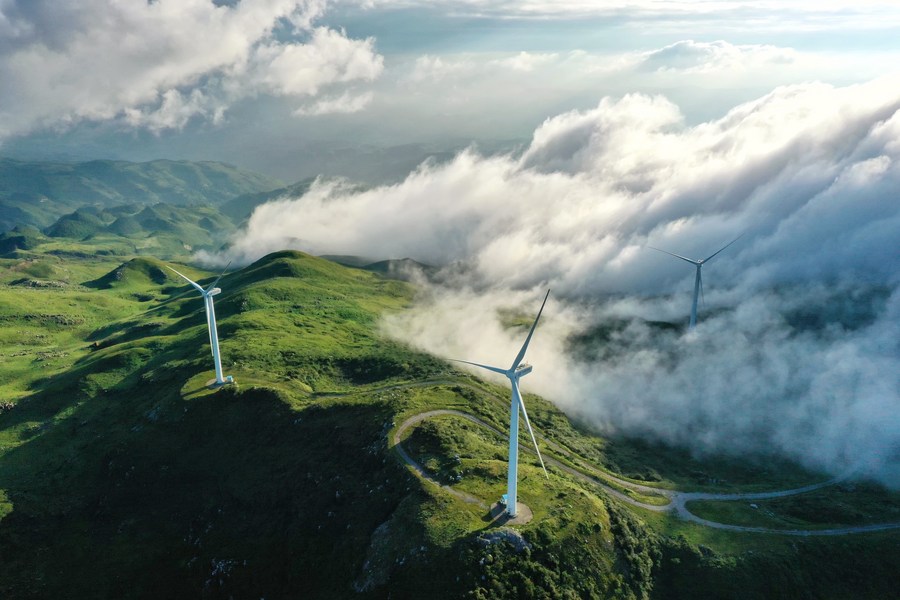
China's expertise, combined with its large manufacturing base, has helped the nation to bring down the cost of renewable energy machinery, including wind turbines and solar panels, Gupta said. This will benefit everyone that wishes to use renewable energy resources, she said.
China is the world's largest manufacturer of wind turbines and dominates global solar module production, according to energy consultancy firm Wood Mackenzie. The country is also the biggest producer of global lithium-ion batteries, electric vehicles and solar panels.
"If China can replicate its current global market share in battery and solar-panel production across the entire future value chain of clean energy, it would transform global energy supply, trade and industry,"Zhou Yanting, senior economist at energy and resources consultancy Wood Mackenzie, said in a report.
Constantino said that China, as the biggest developer of renewable energy, can play a more active part in enabling Southeast Asia to adopt clean-energy technology.
"It is in rolling out more deliberate, predictable programs that share resources and technology that China can truly, actively enable ASEAN countries to accelerate the energy transition taking place in the region," he said.