Wastewater case a test of global nuclear governance









While Japan is adding a new invisible scar to nature and its own probity by blatantly deciding to release nuclear wastewater into the Pacific Ocean, the rare voices of support by US Secretary of State Antony Blinken and International Atomic Energy Agency Director General Rafael Mariano Grossi look perplexing, if not immoral.
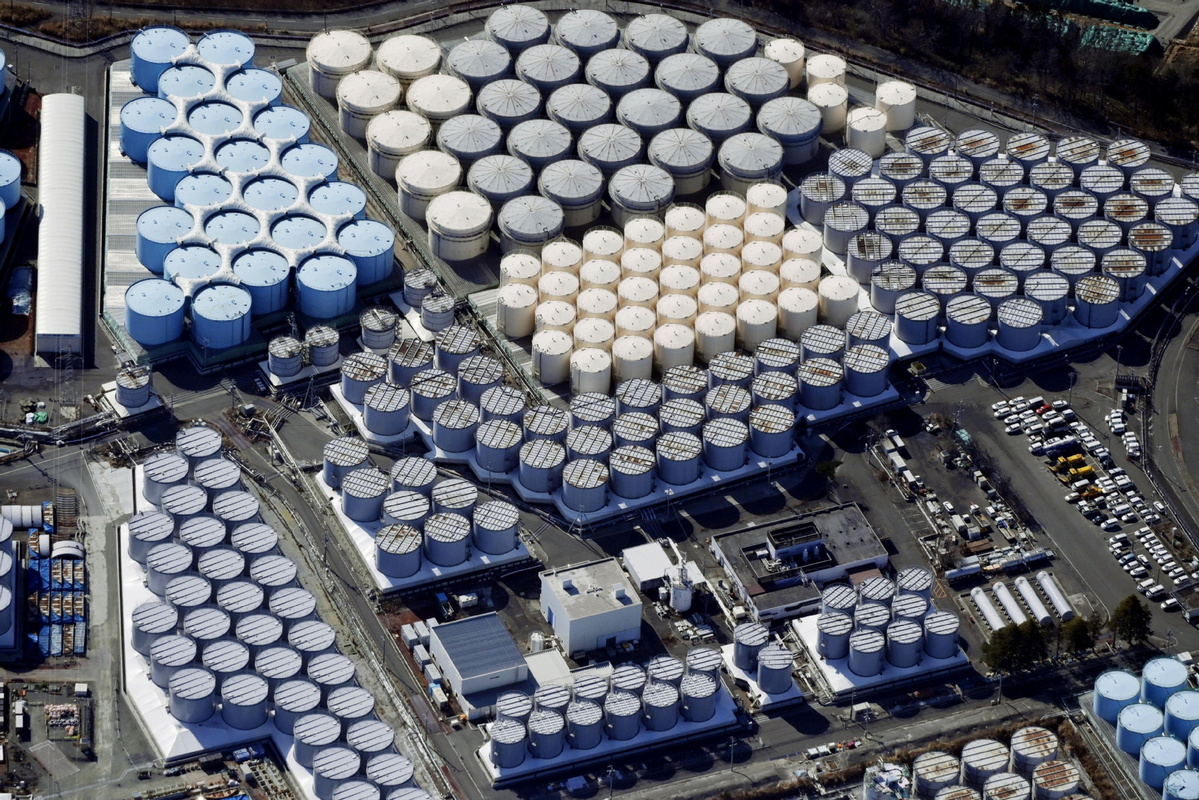
Despite widespread criticism, the Japanese government seems determined to dump into the ocean huge amounts of radioactive water from the earthquake-crippled Fukushima Daiichi nuclear power plant, a decade after revealing its inadequacy in handling the crisis in 2011.
The money-above-all choice of convenience among five options available exposes the selfish nature of capital-minded officials who dare to sacrifice the livelihood of its millions of people in the fisheries industry, apart from ocean life and people in neighboring lands.
People including the Japanese have reason to question the wording of Tokyo officials in "ensuring "the harmlessness of the radionuclides set for release. Their method of diluting the radioactive isotopes in wastewater does not mean eliminating the radioactive substance from the water.
Moreover, experts have revealed what Japanese government and company officials did not: The Fukushima wastewater contains not only tritium after treatment, but several other radionuclides as well. Although scientists pointed out some of these elements in 2018, Tokyo Electric Power Co managers, who were criticized for withholding information in 2011, acknowledged the presence of carbon-14 for the first time in August.
By trusting these TEPCO officials, the Japanese government is rousing distrust. By forcing its neighbors and the rest of the world to shoulder the potential radiation risks, Japan establishes itself again as an irresponsible member of the global community. And by costing the livelihood and possible health of its own people and other peoples, apart from causing uncertain disruption to marine ecology, the Japanese administration is wasting its own morality.
Yet Blinken was eager to "thank Japan for its transparent efforts in its decision", telling the world he knew Japan's move beforehand, though many other countries, including its neighbors, did not.
His gratitude to Japan and unwillingness to oppose the move may be knotty, but as a major nuclear power that used the first nuclear bomb, against a Japanese city, the US has its own nuclear problems.
Writing about forcing a path forward on US nuclear waste management, US research scholar Matt Bowen said in January in a Columbia University blog, "A new report, part of wider work on nuclear energy at Columbia University's Center on Global Energy Policy, explains how the United States reached its current stalemate over nuclear waste disposal."
A CNN report in 2019 said radiation levels across parts of the Marshall Islands in the Pacific Ocean, where the US tested nuclear bombs during the Cold War, are 10 to 1,000 times higher than areas contaminated by the Chernobyl and Fukushima nuclear disasters.
Whatever difficulty Blinken has on nuclear waste, he seems glad to see Japan testing the issue of disposal. And he kept his words vague possibly to escape from injury once Japan's decision, however immoral or irresponsible, eventually backfires.
Grossi, the IAEA chief, sounds less diplomatic in his tense, somber announcement and has even called Japan's decision "a milestone".While the US Department of State suggested Japan "appears to have adopted an approach in accordance with globally accepted nuclear safety standards", Grossi said "the Japanese government's decision is in line with practice globally, even though the large amount of water at the Fukushima plant makes it a unique and complex case".
Grossi's words are of great concern, since he admits the gravity of Japan's case but somehow remains convinced and complacent with reference to global practice.
While the IAEA chief was expected to use his decade-old expertise in inquiring where such a practice may lead, his citing of such a practice seems an unlikely excuse. A global practice cannot always be justified as good, as for a bad routine or habit like smoking.
Our world is changing fast. The practice of dumping nuclear wastewater into the ocean may appear acceptable before and now, because it takes time for most people to grasp the real danger in an invisible world, and nuclear industrialists lobby hard. Nowadays more people, including scientists, regard the low-standard but widespread practice as bad and potentially injurious, and the more technology advances, the clearer it will be.
As the carrier of the best hope for nuclear safety today in our fragile world, the IAEA should do its utmost to ensure nuclear energy that is safe beyond doubt. Instead, it has long ignored criticism of Japan building a series of nuclear power plants in earthquake-prone zones, which its own politicians describe as "Japan's curse".
However, Grossi reached his own decision within the IAEA to jump onto Japan's wagon. His appreciation of Japan's "transparency", in contrast to neighboring countries' criticism of Japan not engaging in adequate consultations, reminds people that an institution of integrity should not serve the privileged few at the cost of common heritage.
Allowing such a controversial dumping practice to be extended to an extreme limit, as in Japan's case, indicates the IAEA's indolence and unaccountability, which amounts to poor governance.
As the top global organization on a top issue of protection of workers, the public and the environment from undue radiation hazards, the IAEA should reflect the will of at least a majority of members, demand high and exacting standards for nuclear waste treatment, be accountable and make parties involved accountable.
A failure to live up to these expectations will call for change to achieve better nuclear governance.
The author is a current affairs commentator based in Hong Kong.