Europe must read between the lines of Biden's sweet talk









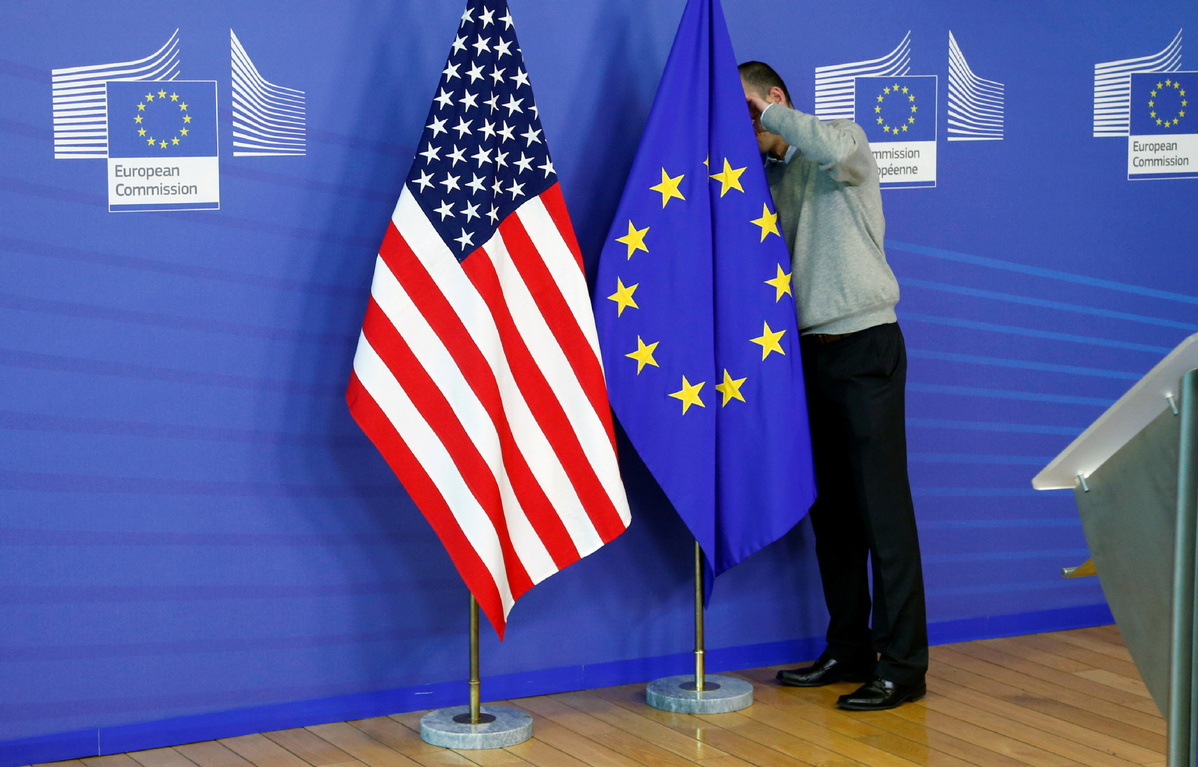
Back in 2003, then German foreign minister Joschka Fischer advised former chancellor Gerhard Schroder to not join the US invasion of Iraq. Fischer questioned former US defense secretary Donald Rumsfeld at the Munich Security Conference that year about the so-called evidence against Saddam Hussein possessing weapons of mass destruction, famously telling him: "Excuse me, I am not convinced."
It was brave of a European leader to question the authenticity of the United States' claim, especially because it was much later that the world came to know the sheer US lies on the WMDs.
On Monday, Fischer warned that a new Cold War waged by the US on China is the last thing the world needs in the 21st century. In an op-ed piece published in Project Syndicate, he said the idea of such a Cold War has quickly evolved from a misleading analogy into a self-fulfilling prophecy. He argued that "contemporary China is nothing like the Soviet Union, and in today's world, we simply cannot afford another clash of mutually exclusive systems".
The comment came just after Joe Biden concluded his first trip to Europe as US president to rally Washington's allies against China by claiming the Sino-US conflict is a clash of exclusive systems.
Fischer said such rhetoric has made a military confrontation, or a new arms race, a distinct possibility. According to Fischer, given the scale of the Chinese market and the economic interdependency it engenders, the idea that China can be isolated is simply absurd.
Fischer was again blunt, saying the issue is more about power than economics. "By uniting with the rest of the West, can the US really change the historical trajectory of China's rise and the West's relative decline? I doubt it," he wrote.
Fischer emphasized that great powers like China and the US should cooperate to tackle major challenges such as the COVID-19 pandemic and climate change regardless of which country is "Number One".
In March, Harvard University scholar Joseph Nye, too, warned of another Cold War, or hot war, arguing the US and China must avoid exaggerated fears and misperceptions about changing power relations. It was a message directed more at Biden, who, like his predecessor Donald Trump, is altering the China engagement policy pursued by every US president since Richard Nixon.
Like Trump, Biden claimed in March that China won't surpass the US under his watch, an indication that the US will resort to all means possible to sabotage China's development, including taking measures to destroy China's solar energy industry that is vital to the global fight against climate change.
It is true that European leaders have welcomed Biden's election as US president after four years of Trump, but Fischer's remarks show that Europeans are not blind to his confrontationist policies.
Former NATO secretary-general Javier Solana argued earlier this week that despite the highlights of Biden's tour, disagreements among democratic countries will not vanish overnight, nor will the West recover its former global standing anytime soon, and questioned Biden's ability to engineer a kind of global democratic renaissance.
Also in an op-ed piece in Project Syndicate, Solana criticized the rhetoric against China in NATO's communiqué, saying that NATO "should avoid overreaching". While welcoming "America is back", Solana also said:"Like it or not, the US-led unipolar world is gone for good."
And former Swedish prime minister Carl Bildt pointed out this week that in terms of trade, the US is not back yet. He cited Biden's lack of interest in reviving the free trade agreements whether with trans-Pacific partners or Europeans, and bemoaned that the Biden administration's trade approach looks more like the Trump administration's than Barack Obama's.
There is no doubt that Europeans are cool-headed and will continue to seek "strategic autonomy" from Washington despite all the fanfare regarding Biden's recent European trip.
The author is chief of China Daily EU Bureau based in Brussels. chenweihua@chinadaily.com.cn