Mess-making muscling in
Mess-making muscling in









US-led Western countries' continual interference in the affairs of other countries comes at great cost
On June 19, Iran's Chief Justice Ebrahim Raisi won the presidential election. Incumbent President Hassan Rouhani congratulated him on being "the choice" of the people. His challenger Abdul Nasser Hemmati tweeted his congratulations, while the leaders of China, Russia, Turkey and Iraq sent congratulatory messages. The United States, however, claimed Iranians were denied a "free and fair electoral process". The same happened after the Syrian elections in May in which incumbent President Bashar Assad won 95.1 percent of the vote, with Western countries "ruling" his landslide victory invalid.
The US-led Western countries' denial of the election results of Iran and Syria is blatant interventionism. History tells us that such behavior brings nothing but disasters and sufferings to the Middle East, not "democracy and freedom". Although they play "savior" and "teacher", these Western countries engage in "small interest group politics", creating antagonism and division by drawing ideological lines.
In the last few years, they have repeatedly and maliciously spread lies and disinformation on issues related to Xinjiang and Hong Kong, deliberately slandering China and interfering in China's internal affairs in an attempt to contain China's development. Their sinister intentions have long been known to all, and have been rejected by well-informed people of the international community.
In October 2020 envoys and the diplomats of 20 Arab countries as well as the League of Arab States in China visited the Xinjiang Uygur autonomous region and acknowledged its economic and social development, achievements in poverty eradication and its ethnic and religious policies. At successive sessions of the UN Human Rights Council, the majority of developing countries, represented by Egypt, Saudi Arabia, Algeria and other Arab countries, have firmly supported China by co-signing joint statements related to Xinjiang and Hong Kong, resolutely defended the purposes and principles of the UN Charter, and opposed the use of issues related to Xinjiang and Hong Kong to interfere in China's internal affairs.
Similarly, at the 47th session of the Human Rights Council in Geneva, the Middle East countries were not compelled by the Western-led anti-China joint statement, as evidenced by the joint declaration of 16 countries in support of China, the letter of six Gulf Cooperation Council countries to the Chinese representative in Geneva expressing support, and the individual statements of Jordan in support of China's just position.
The Middle East has experienced the turmoil of the Arab Spring and witnessed the failure of Western governance in many ways. Western values and governance models are losing their appeal in the region. If the US is trying to stage the old drama based on the old playbook of interfering in the internal affairs of other countries under the pretext of human rights, it will lose its audience.
Some Western countries are keen on seeing regime changes in the region, but always ending up with running away or hastily trying to patch up the mess they have caused. The US used a bottle of laundry detergent as "proof" that Iraq possessed weapons of mass destruction, and thus brazenly launched a war against Iraq, leaving the local population devastated, the economy collapsed and society in tatters. Recently, the US suddenly announced the complete withdrawal of its troops from Afghanistan. The domestic conflicts in Afghanistan immediately intensified. The local security situation took a sharp turn for the worse. The war the US launched 20 years ago in the name of anti-terrorism brought nothing but calamity to the Afghan people. Today, its irresponsible "escape "leaves the Afghan people facing a future fraught with danger and crises.
The US is one of the biggest external factors determining the direction of many regional issues. It is good at helping the side that it regards as best supporting its own interests and then fanning the flames of unrest to try and get them into a position where they can be of most use.
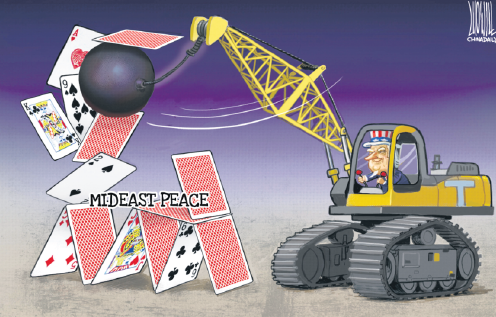
In the Middle East, the US' staunch support of Israel is an obstacle to resolving the Palestinian issue. In May, a serious conflict broke out between Israelis and Palestinians. Facing the rising calls for a ceasefire, the US used its veto four times to prevent the UN Security Council from issuing a statement. Senior US officials, who went to Palestine and Israel on a mission to promote reconciliation after a ceasefire was agreed, avoided talking about practical solutions and road maps to advance the Middle East peace process.
In contrast, China's support to the Middle East has been widely welcomed by the region.
In May 2020, President Xi Jinping announced at the World Health Assembly that once developed and put into use, China would provide its COVID-19 vaccines as a global public good to help ensure vaccine accessibility and affordability for developing countries. To date, China has provided more than 500 million doses of vaccines to the international community. In West Asia and North Africa, Chinese vaccines have become a powerful weapon for regional countries to fight the pandemic. China has cooperated with many countries, including the UAE, Bahrain, Egypt, Turkey and Morocco, to conduct phase III clinical trials of its vaccines. People in 17 countries in the region have been vaccinated with Chinese vaccines and are gradually returning to normal economic and social life. Egyptian Health Minister Hala Zayed exclaimed that the Chinese vaccine was a life-saving gift in times of crisis.
The Middle East is for the people of the Middle East. It is not the territory of any other country. It should not be a victim of the geopolitical games of great powers and should not be left behind as the whole world moves ahead together. The region desires and needs development, security and stability. It is to be hoped that the international community, especially the major powers, will abandon the inertia of looking at the Middle East from the perspective of geopolitical rivalry and political self-interest, play a responsible role on the basis of full respect for the wishes of the Middle East countries, and inject positive energy in the region for exploring a development path with Middle Eastern characteristics and building a security architecture that takes into account the legitimate concerns of all parties.
The author is a commentator on Middle East affairs based in Beijing. The author contributed this article to China Watch, a think tank powered by China Daily. The views do not necessarily reflect those of China Daily.