Building back the ladder









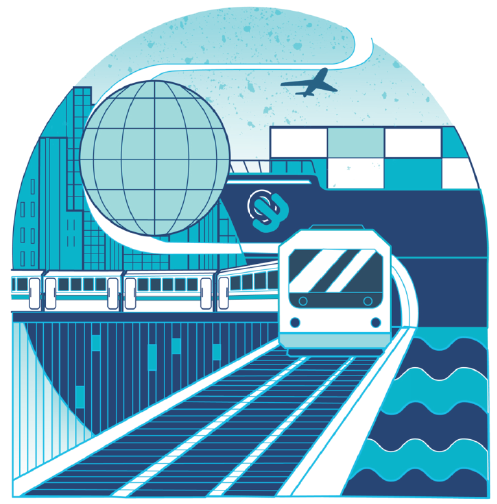
The Belt and Road Initiative is helping the poverty alleviation and development endeavors of countries
The historical development mentality of the Western world toward developing countries is well described in the thought-provoking book Kicking Away the Ladder, written by Ha-Joon Chang, a development economist at the University of Cambridge. The gist of the book is that once the Western countries achieved advanced economic status, they have tried their utmost to prevent developing countries from becoming developed. To complicate the story, many areas concerning international development, such as poverty alleviation, have witnessed capacity constraints from established international organizations, such as the World Bank, making the development path of the developing countries harder.
The Belt and Road Initiative has rapidly opened up new avenues for the developing countries to boost their infrastructure, resulting in gradual poverty alleviation. As the linchpin of the initiative, infrastructure development allows prosperity and the fruits of globalization to be shared by many countries and regions that were not considered to be economically viable under the post-World War II economic framework of the Bretton Woods System.
The Belt and Road Initiative was initiated after President Xi Jinping proposed building a Silk Road Economic Belt and a 21st-Century Maritime Silk Road during his visits to Kazakhstan and Indonesia in, respectively, September and October in 2013. According to the World Bank, the 71 economies of the Belt and Road Initiative "transport corridors" (including China), received 35 percent of the global foreign direct investment and accounted for 40 percent of global merchandise exports in 2017. Other than those in China, the cost of the planned and implemented infrastructure projects has amounted to $575 billion since the initiative was conceived. According to the projections of the Organization for Economic Cooperation and Development, the Belt and Road investment projects are expected to add over $1 trillion of outward funds for infrastructure construction over the 10 years from 2017.
China's story of lifting nearly 800 million people out of extreme poverty has already been praised by the United Nations. Siddharth Chatterjee, the United Nations resident coordinator in China, recently said that China's experience in poverty alleviation should be shared among developing economies and the Global South, of which many are along the Belt and Road routes.
From a global standpoint, the Belt and Road Initiative has already been included in the United Nations 2030 Agenda for Sustainable Development (formalized in 2015). In addition, the BRI-Sustainable Development Goals Project has been overseen by the UN's Department of Economic and Social Affairs and UN Economic and Social Commission for Asia and the Pacific. The capacity constraints the UN faces in its efforts to realize the 17 Sustainable Development Goals are enormous. The Belt and Road Initiative can help realize Goal 1(No Poverty), Goal 2(Zero Hunger) and Goal 9(Industry, Innovation and Infrastructure), which are aligned with the concepts underlying the initiative. For example, at the Second Belt and Road Forum for International Cooperation in 2019, President Xi stated that Beijing needed to prioritize poverty alleviation and job creation in the Belt and Road Initiative partner countries. The synergy between the initiative and the UN Agenda are mutually reinforcing.
Capacity building can be improved from the ground up in countries along the Belt and Road routes with additional basic vocational training for the locals who can unleash further human capital potential for various infrastructure projects with different focuses. This has been demonstrated by the Luban Workshops. The initial Luban Workshop was launched by the Municipality of Tianjin as a vocational training center for in-demand skills. There is now a Luban Workshop in Djibouti for communication infrastructure, one in Kenya for internet facilities and one in Thailand for the chemical industry.
The overarching focus of the Belt and Road Initiative and SDG collaboration and the bottom-up training workshops certainly help the poverty alleviation efforts of the developing economies. Yet, implementation of the projects needs more regional organizations to act as go-betweens to help resolve some regional differences and ensure the smooth implementation of projects.
To build back the development ladder with countries along the Belt and Road routes is a Herculean task because the existing development framework has been established by the West for a long time and they are trying their best to safeguard the "secrets" of their success. The Belt and Road Initiative is an attempt to turn the tide and gradually build back the development ladder with the previously neglected countries. There is nothing glamorous in the process of building back the development ladder. But it should be affordable and practical for those countries in need of finding suitable ways for development.
The author is director of the Centre for Contemporary Chinese Studies at Durham University and an associate professor in International Relations of China at Durham University. The author contributed this article to China Watch, a think tank powered by China Daily. The views do not necessarily reflect those of China Daily.