Favorable policies set off inbound tourism boom










Thanks to favorable policies and innovation-oriented supply channels, China's inbound tourism sector is on an upward trajectory. During the first six months of this year, foreigners made more than 38 million trips to and from China, up 30.2 percent year-on-year.
The 240-hour visa-free transit policy for the nationals of a number of countries has yielded great benefits. To make payments more convenient, a multi-layered system of "bank card for large payments, QR (quick response) code for small payments and cash as backup" has been introduced. All 4A-level and above scenic areas and three-star and higher hotels now accept bank cards issued by both domestic and overseas financial institutions.
Targeted facilitation measures, too, have been introduced for scenic spot reservations, transportation ticketing and accommodation payments. For example, overseas visitors' travel documents have been integrated into the reservation system, and multilingual booking channels launched. Payment convenience and departure tax refund policies are also expanding beyond core cultural and tourism fields to cover other areas.
While favorable policies are reshaping the behavior pattern of inbound travelers, the 240-hour visa-free transit policy has significantly lowered decision-making barriers for tourists planning their first or subsequent visits to China, and convenient payment and tax refund services have enhanced tourists' overall experience.
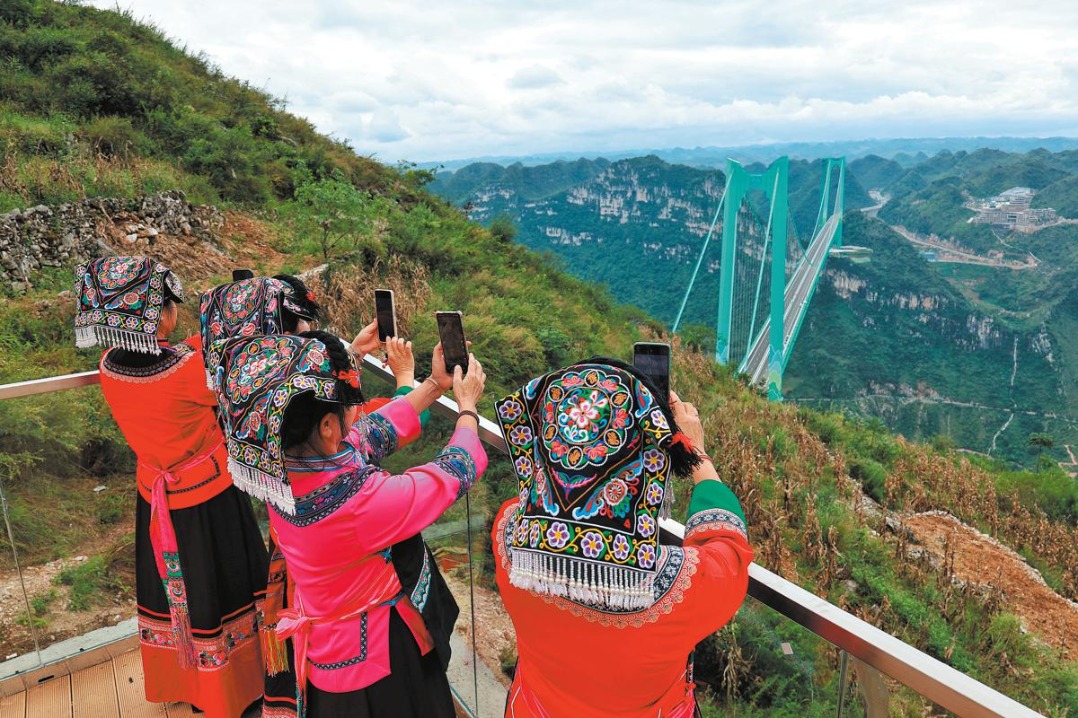
First-time visitors often follow a pattern shaped largely by secondhand information from social media. Hence, their itineraries usually comprise China's iconic landmarks such as the Great Wall in Beijing, the Terracotta Warriors in Xi'an, Shaanxi province, and the Bund in Shanghai. Returning visitors, however, tend to behave differently, as they explore local cultural venues, intangible cultural heritage sites and even traditional food markets.
A closer look at the itineraries of returning visitors shows a clear trajectory. Their first trip is often focused on the classic "Beijing-Xi'an-Guilin-Shanghai golden route". On their second visit, they may choose destinations such as Chengdu or Chongqing. With further trips, they are more likely to pursue themed experiences such as cycling around Qinghai Lake or trying pottery-making in Jingdezhen, Jiangxi province. This shift from "sightseeing" to "thematic exploration" underscores how China is establishing a more diverse and multidimensional image in the minds of overseas tourists.
For many, the first visit represents the beginning of understanding tourism opportunities in China, while returning visitors generate deeper value and engage in positive word-of-mouth promotion, strengthening the destinations' appeal. Together, they form a dynamic system of mutual reinforcement, advancing not only inbound tourism but also deeper mutual understanding between China and the world.
The consumption behaviors and psychological needs of both frequent and infrequent visitors are not only fostering a more dynamic market ecosystem but also reshaping China's inbound tourism service system and business models. Infrequent visitors tend to follow compact, goal-oriented itineraries, often opting for "classic packages" that include Beijing's Great Wall, the Palace Museum (Forbidden City) and the Summer Palace. Although they may yearn for more in-depth experiences, they often lack proper guidance to realize them.
Frequent visitors, in contrast, pursue more fragmented travel patterns with highly personalized service demands. With easier access to China and the rapid increase in inbound tourists, the potential for resonance between these two groups is becoming more apparent. For example, frequent visitors quickly share their personalized route experience with others via social media, and recommend them to infrequent visitors. While first-time visitors bring fresh perspectives and raise common questions, frequent visitors come up with deeper observations and expert insights.
This interplay and fusion of perspectives means travel experience in China is no longer a one-way output defined by either-or choices. Instead, it has evolved into a multilayered and multidimensional dialogue in which every inbound traveler can find his or her own understanding. In this process, the allure of Chinese tourism is presented in its fullest and most vivid form. For destinations and market players, it also signals greater opportunities for market development.
It is thus essential to adapt to the evolving behavior patterns of inbound tourists.
For first-time visitors, their standardized experiences can be provided with personalized designs. Returning visitors, on the other hand, need more exploration space, allowing their deepening interests to find professional outlets.
The customization of returning visits calls for differentiated product portfolios. Hence, greater access to professional institutions and study tours should be offered to cultural explorers, services that help build industry-specific social networks to frequent business travelers, and comprehensive community integration support to those who prefer lifestyle-oriented long stay.
One innovative approach could be to invite long-term foreign residents in China to serve as cultural interpreters. They can explain China in ways that resonate with visitors in their native language, while also channeling newcomers' questions and feedback to improve their overall tourism experience.
Besides, tourist attractions need to evolve from mere "showcases" into "dialogue spaces", and services must integrate standardization with personalization in a seamless way, while technology should progress from being a tool of convenience to becoming a bridge of understanding. Only when first-time visitors get a profound impression and returning visitors find abundant nourishment for continued exploration can China's inbound tourism develop steadily.
There is also a need to develop different services and products for all kinds of overseas visitors. The true measure of quality is whether first-time visitors feel comfortable, returning visitors can continue to find fresh impetus to visit again, and whether there is a natural transition across different levels of visits.
More products and services should be designed to not only meet the needs of frequent travelers but also improve the first-time experience of visitors. In this way, as overseas tourists visit China more frequently, they can continue to savor new experiences.
The author is a researcher at the China Tourism Academy.
The views don't necessarily reflect those of China Daily.
If you have a specific expertise, or would like to share your thought about our stories, then send us your writings at opinion@chinadaily.com.cn, and comment@chinadaily.com.cn.