China's Epic Journey from Poverty to Prosperity









4. Improving People's Wellbeing
A moderately prosperous society in all respects puts people first and places their wellbeing above anything else. The people are at the center of the philosophy of the CPC. Improving people's lives and wellbeing is the Party's goal as it continues to address their issues of major and immediate concern, and raise their sense of fulfillment, happiness and security. The Chinese people are now leading the decent life to which this nation has aspired for several thousand years. Their rights to subsistence and development are well protected. They have access to childcare, education, employment, medical services, elderly care, housing and social assistance.
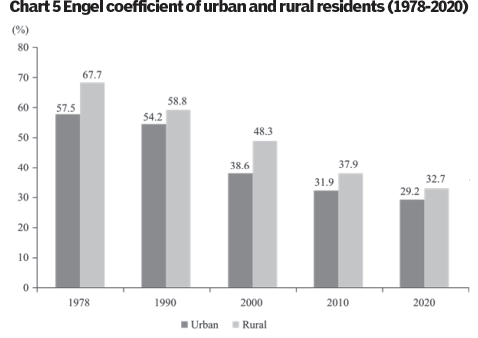
People's lives have been notably improved. Personal incomes have grown steadily, with the average per capita disposable income up from RMB171 in 1978 to RMB32,189 in 2020 (Chart 4). Quality of life has improved, with the Engel coefficient of urban residents down from 57.5 percent in 1978 to 29.2 percent in 2020, and that of rural residents down from 67.7 percent to 32.7 percent (Chart 5). Once their basic need for food and other daily necessities has been satisfied, people want a better life, including better food, clothes, housing, and travel facilities. Subsistence-based consumption is gradually giving way to a model directed towards greater fulfillment and comfort. People regard clothes not only as something that can protect them from the elements, but also as something that can make them look more attractive. Food serves not only to fill an empty stomach, but also to provide better nutrition and good health. People also aspire to live in bigger homes and better neighborhoods, and have faster and more comfortable transport. They are fully supplied with daily necessities and own a range of home appliances; car ownership is increasing rapidly. Consumption of services such as catering, health care, education, tourism, culture and entertainment has continued to surge, and now represents approximately half of China's per capita consumer spending. More people have sufficient time and money to explore their dreams away from the hustle and bustle of daily life. Traveling no longer requires lengthy preparation and has added to the pleasures of life. China has entered the era of mass tourism.

The job market remains stable and the quality of employment is rising. China's employed population rose from 180 million in 1949 to 750 million in 2020. In the past, most working people were farmers. The employment structure has improved to the extent that 47.7 percent of the workforce are now employed in the tertiary sector (Chart 6), and 61.6 percent are working in cities (Chart 7). The working-age population, once mostly illiterate and semi-literate, now has an average of 10.8 years of schooling, and a higher-quality workforce is reflected in the fact that the number of skilled workers has reached about 200 million. Millions of people have found work they enjoy and work that can bring greater happiness to their lives. In the past, people were assigned to jobs. Now they can choose their career freely, based on market needs, or even start their own business. New forms of employment have emerged alongside traditional ones. This has brought a profound change to the mindset of the workforce, broadened their choices, and expanded the forms of employment available. Individuals can tie their interests, hobbies, skills and talents more closely to their job expectations, and to social demand and national needs. This has helped people to realize their personal values and further raised their initiative and their passion for creativity. The employed have seen their lawful rights and interests protected, their pay increased, and their incomes secured. More and more people can find work from which they can draw happiness and dignity. They are creating a better life with their own hands.





- China successfully launches new test satellites
- China launches Lijian 1 Y9 carrier rocket
- First cross-border event debuts at the National Games
- China Focus: National Games enhances coordination under 'one country, two systems'
- China's Fujian aircraft carrier to make regular appearances on high seas: spokesperson
- A decade of dialogues