China's Epic Journey from Poverty to Prosperity









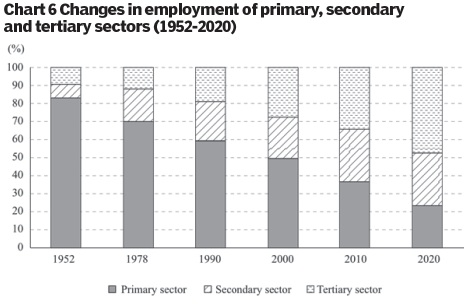
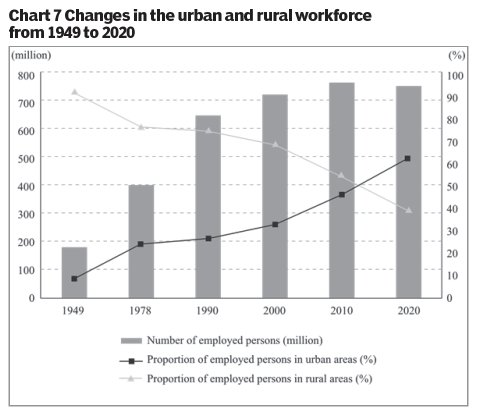
China's policy has progressed from one day off to two days off per week and from the "golden week holidays" to paid annual leave. The rights of working people to rest and leisure are better protected, to help them balance work and life. The idea that work is a most honorable and noble activity has been welcomed, and is practiced by the great majority of the people, who believe that hard work is essential to success in life. The prevailing trend is to advocate, respect and value work.
Education is thriving. China has evolved from a populous country where a vast majority of people were illiterate or semi-illiterate, through one with significant education resources and a huge workforce, to one with high-quality education and human resources. It has established the world's largest education system that spans preschool, primary, secondary, and higher education, ranking in the upper-middle category worldwide in terms of modern education (Panel 5 and Table 1). The enrollment rate in preschool education and the coverage rate of affordable preschool education have surpassed 84 percent, the completion rate of nine-year compulsory education has exceeded 95 percent, and senior secondary education is universally available across the country. Gaps in education between different regions, urban and rural areas, and different schools have all diminished. China's basic education has progressed from providing access to schools and teachers to ensuring the quality of both, and a good and equitable education for all children is becoming a reality.
China's universities and colleges have trained nearly 100 million high-caliber professionals. Enrollment in higher education is surging and the education level now ranks in the upper-middle category worldwide. Its vocational education institutions have trained a large number of highly skilled personnel and craftspeople. In the past, there was no provision of special education; now people with disabilities are guaranteed equal rights to education. A system for lifelong learning is under construction, augmented by internet and digital technologies and offering wide personal choices, and as self-improvement comes to be an everyday activity, a learning society for all is taking shape. Education in China has opened up paths for people to pursue a better life, changed their destiny, turned their dreams into reality, and presented them with more possibilities in life.
Social security covers all people. China has established the world's largest social security system, comprising social insurance, social assistance, social welfare, and support for entitled groups-components of an inclusive, multi-tiered, and sustainable system that guarantees basic living needs. By the end of June 2021, the number of people covered by basic old-age insurance was 1 billion; unemployment insurance, 222 million; work-related injury insurance, 274 million; basic medical insurance, more than 1.3 billion. The law provides that maternity insurance covers all employers and employees.
Panel 5 Achievements in Education
In 2020, China had 537,100 schools at all levels and of various types, with 289 million students and 17.9 million full-time teachers. The gross enrollment rate in preschool education reached 85.2 percent, and the completion rate of nine-year compulsory education 95.2 percent. The net enrollment rate in primary education was just under 100 percent, the gross enrollment rate in junior secondary education 102.5 percent, and compulsory education realized balanced development in 96.8 percent of the counties nationwide. The gross enrollment rate in senior secondary education reached 91.2 percent, and that in higher education 54.4 percent. All primary and secondary schools in China had access to the internet, and 98.4 percent already had multimedia classrooms.

- Exhibition commemorating the epic relocation of universities opens in Fujian
- Twelve punished for scaffold collapse that killed 7 in Shandong
- Slovenian official visits whole-process people's democracy practice site of CPPCC committees
- China's commercial rocket maker puts two satellites into orbit
- People in Taiwan commemorate victims of White Terror period
- China successfully launches new test satellites