Another act in Washington's South China Sea farce
Sanctions have become the US' favorite tool for reinforcing its global hegemony









On Oct 19, the US Senate Foreign Relations Committee discussed the so-called South China Sea and East China Sea Sanctions Act 2021, which was proposed by certain US senators in May 2021.
From the perspective of the domestic legislative procedures in the United States, this act is still at its early stage. There is a long way to go for the bill come into force, and there are many uncertainties about when this process may be completed and even whether it will become law.
The bill reflects the inherent prejudice of some politicians in the US. It is intended to impose sanctions on Chinese persons and entities that participate in certain activities related to China's territorial disputes in the South China Sea and the East China Sea and also to address other related issues. Behind the sanctions proposal is the disregard and ignorance of some people in the US toward China's territorial sovereignty and maritime rights.
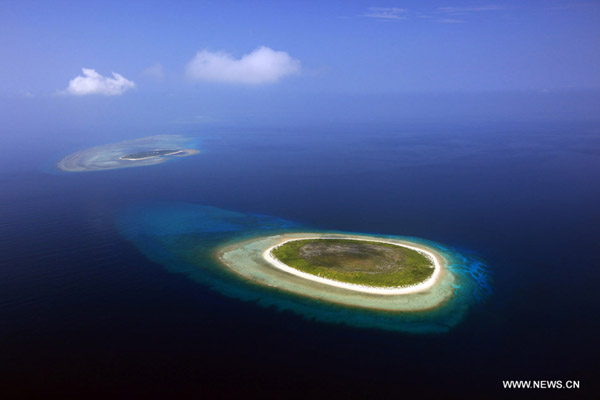
China's territorial sovereignty and maritime rights in the South China Sea have sound historical and legal grounds. China's land reclamation on its own islands and reefs in the South China Sea is an exercise of its sovereignty. The bill seeking to impose unilateral sanctions, initiated by certain politicians in the US, undermines international law and the basic norms of international relations.
Any activity or policy that China adopts to safeguard its territorial sovereignty and maritime rights is an activity of the State. The US approach of invoking domestic laws to impose unilateral sanctions on such activities of China has no basis in international law. Out of consideration for repairing Sino-US relations, Washington should not proceed with the review of the bill to avoid presenting new obstacles to the relationship.
In international practice, it is reasonable for entities and individuals to safeguard their own country's territorial sovereignty and integrity in different ways. It is an extremely absurd scene in international relations that individuals of one country suffer unilateral sanctions from another country for patriotic acts. The US is not a party to any of the disputes and should remain neutral on the disputed issues.
The bill reflects a policy shift by the US on the South China Sea issues in recent years. According to the bill summary published by the US Congress, certain types of foreign aid of the US may not be provided to the countries that recognize China's claims to the disputed territories. This can be seen as a deviation from the US' long-standing policy of not taking a position on the territorial disputes. It may also reflect the US' attempts to sour relations between China and neighboring countries.
Washington's use of sanctions on the South China Sea issue is not surprising. There have always been such voices in the US Congress, and they have been brewing trouble for a long time. It can be seen in the diplomatic practices of the US on the South China Sea issue that starting to use the tool of sanctions is an important change in Washington's tactics to put pressure on China. During the Trump administration, there were similar measures introduced, such as sanctions on "Chinese companies that help China carry out the construction of South China Sea islands and reefs". The initiative of South China Sea and East China Sea Sanctions Act 2021 indicates that some US politicians are trying to consolidate and expand the practice.
In fact, neither the ploys of US politicians on the imposition of unilateral sanctions against China nor Washington's attempts to put pressure on China will have any material impact on China's territorial sovereignty and maritime rights in the South China Sea.
In the past few years, the US has imposed unilateral compulsory sanctions on individuals, corporate entities, and even government departments in many countries around the world based on its domestic laws and policies. The frequency of the use of sanctions by the US during the Trump administration has far exceeded the imagination of observers and commentators. Sanctions have become a handy tool of Washington to reinforce its global hegemony under the pretext of implementing domestic laws. For the US, it seems that the political appeal of other foreign policy tools has greatly diminished.
However, the US, which always uses sanctions as a diplomatic tool, is still experiencing diplomatic failures. None of the unilateral sanctions on Iran, the Democratic People's Republic of Korea, or on Russia or China have achieved the expected results, nor have they played any active or constructive role in the resolution of related issues. This fact will undoubtedly lead the international community to increasingly question the value of sanctions.
The US, troubled by issues such as its debt crisis and the Covid-19 pandemic, seems to desperately need a target to shift the attention of its people away from domestic problems. In this atmosphere, some US politicians that still have a Cold War mentality, are always thinking about how to contain China and how to intensify confrontation with China. Recently, there have been some relaxations in Sino-US relations, such as Meng Wanzhou's return to China and the US trade representative's proposal to adjust US trade policy toward China. Some US politicians believe that the Biden administration is about to repair the relationship with China to some extent, a notion that they fiercely reject. For them, opposing China is not a rational consideration, but more like a business, with the goal of seeking greater benefits within the US.
The author is deputy director and associate research fellow of the Research Center for Ocean Law and Policy at the National Institute for South China Sea Studies.
The opinions expressed here are those of the writer and do not represent the views of China Daily and China Daily website.
If you have a specific expertise and would like to contribute to China Daily, please contact us at opinion@chinadaily.com.cn , and comment@chinadaily.com.cn