Green Belt and Road vision aims high









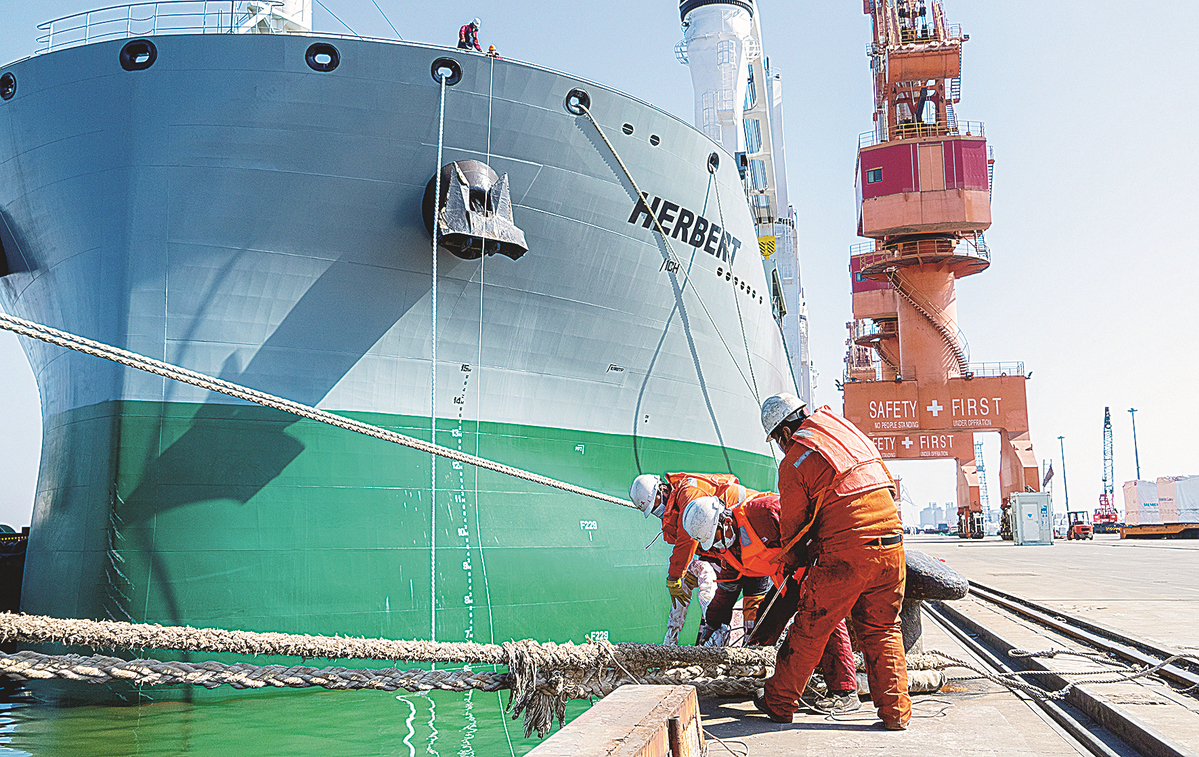
On March 28, four Chinese ministries published a key policy document on the further greening of the Belt and Road Initiative, titled "Guidelines on the Joint Implementation of Green Development in the Belt and Road Initiative".
Greening the BRI means reducing climate emissions, reducing pollution and protecting biodiversity, while providing improved economic opportunities for the countries involved.
The guidelines reaffirm the pledge by President Xi Jinping to the United Nations General Assembly in September last year that no new coal-fired power plants would be built abroad-a key commitment to global action on climate change. The guidelines go further than that, saying that China "will facilitate the full implementation of the Paris Agreement among all parties". In our understanding, that means BRI projects should be selected and designed so that they must not allow the planet to warm by more than 2 C by the end of this century.
This is of great importance to humanity. The UN has just released a scientific report that shows the world must step up climate action "now or never", or temperatures will soar by more than 3 C, with catastrophic consequences.
The guidelines go beyond climate and address many other important issues, covering the development of "green" infrastructure projects in power and transportation, industry and manufacturing, green finance and cooperation on standards.
The guidelines include time-bound targets. In essence, by 2025 we should see clear progress toward a green BRI, and by 2030 the green development of the BRI will be basically formed.
Apart from not building new coal-fired power plants overseas, the guidelines call for "prudently" proceeding with "existing ones that are under construction". There may be an ongoing debate about exactly how to deal with existing projects, and exactly where to draw the line on "new projects". The text suggests that projects that haven't started construction should not proceed.
The guidelines also call for promoting "the green and low-carbon development of overseas coal-fired plants that have already been built". This refers to the retrofitting of existing coal-fired plants, for example to make them less polluting or more efficient, or to install carbon capture, utilization and storage technology. While that could be an improvement in some cases, there might be the risk of an increase in the lifetime emissions of such projects, which would be bad for the climate.
More positively, the guidelines spell out that the priority for energy projects will be everything needed to decarbonize a national power grid, including renewables, smart grids, storage, interconnectivity and carbon capture, utilization and storage. Their deployment is a real win-win, helping developing countries leapfrog to low-carbon energy systems, and allowing them to achieve economic development, sustainability and energy security.
The guidelines draw on the technical studies conducted by the BRI International Green Development Coalition, which has worked since its establishment in 2019 by China's Ministry of Ecology and Environment and international partners to advance environmental protection and low-carbon development in the BRI.
We have worked with the coalition to develop a "traffic light system" for greening the BRI, to help avoid and mitigate environmental impacts throughout a project's life. Projects with a significant environmental or climate impact that isn't mitigated are classified as "red", whereas projects that are neutral or make a positive contribution are classified as "yellow" or "green".
It is crucial for the guidelines to be fully implemented. Although the guidelines are not a legal document, we believe that they will be carefully read, and implemented, by all key stakeholders, including government departments, project developers and financial institutions. Further implementation policies and regulations are likely to follow.
Given the turbulent geopolitical environment we face today, it is very promising to see that China isn't backsliding on its efforts to green the BRI. Rather, the guidelines further clarify China's green BRI ambitions and provide comprehensive policy directions for future areas of "green" overseas engagement.
With the world facing increasing pressure from climate change, biodiversity loss and fossil fuel supply shocks, it is critical for this work to proceed with great urgency. China, as the main finance and trade partner in most of the developing countries in the BRI, can play a key role in their green transition.
Dimitri de Boer is chief representative for China of ClientEarth and team leader of the EU-China Environment Project. Christoph Nedopil Wang is an associate professor at Fudan University and director of the university's Green Finance & Development Center.