Not left old and alone
The government is doing more to improve fundamental elderly care and medical insurance systems in rural areas









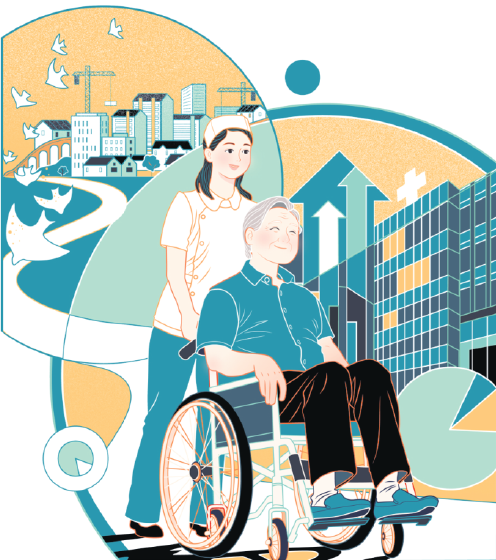
China has an aging population, with the rural elderly population growing faster than the urban one. Data from the seventh national census in 2021 show that the proportion of people aged 60 and 65 and above in rural areas has reached 23.81 percent and 17.72 percent, respectively, which are 7.99 and 6.61 percentage points higher than the corresponding figure in urban areas. In 2010, the urban-rural gap in the proportion of people aged 60 and 65 and above was 3.19 and 2.26 percentage points, respectively.
Although China's urbanization rate has reached 63.89 percent, 47.4 percent of the population aged 65 and over and 48.08 percent of the population aged 70 and over live in rural areas, accounting for nearly half of the total. As urbanization advances, rural areas will face the challenges of an aging population earlier than urban areas, which will have a severe impact on their socioeconomic development.
The gaps of economic development and residents' incomes between urban and rural areas are prominent. In 2021, the per capita disposable income of rural residents was 18,931 yuan ($2,973), only 40 percent of that of urban residents. Rural care services for the elderly are insufficient as infrastructure and public services in rural areas are less full-fledged than in urban areas.
China's elderly care service system has improved since 2013, with major suppliers of elderly care services shifting from institutions to at-home caregivers and communities. The rural elderly care service has also transformed from an assistance policy for the elderly with financial difficulties to the inclusive benefits aiming to cover all the rural elderly people. However, the demands of the elderly in rural areas are different from those of their counterparts in urban areas, for there are many left-behind rural elderly people, as young rural residents migrate to urban areas.
In 2020, in the 376 million floating population, about 70 percent is rural-urban floating population. As a result, the left-behind elderly people in rural areas are living alone, lacking care and bearing the heavy burden of agricultural work. Because of social conventions, elderly people living in rural areas prefer to stay at home than live in elderly-care institutions. Also, they live in secluded areas, making it difficult for public services to reach them. While demands for daily care, healthcare and comfort have been growing, services of communities and at-home care are insufficient. As private investors lack enthusiasm to invest in elderly care services due to low consumption capacity of rural residents and a weak social and economic foundation, public services rely heavily on financial subsidies and central transfer payments. The potential of the elderly care industry in rural areas, therefore, remains weak.
The government has issued a plan for the development of the elderly care services system during the 14th Five-Year Plan period (2021-25), aiming at ensuring the provision of care services for the elderly, and creating a livable environment for them. It focuses on building inclusive and diverse elderly care service systems. The key is to build a rural elderly care service system, and improve service supplies for rural vitalization.
The Chinese government should improve fundamental elderly care and medical insurance systems in rural areas, develop standards for pension insurance for urban and rural residents and adjustment mechanisms for basic pensions, improve the medical system in rural areas, and promote basic medical insurance, major disease insurance and medical assistance for urban and rural residents.
The authorities also need to enhance rural medical and healthcare services. The role of the national public health service programs should be given full play, and financial support and preferential supplies need to be offered. The government needs to improve medical facilities, enhance the level of medical staff and institutions, expand healthcare services for elderly people, and promote disease prevention, health lectures and examinations in rural areas.
Besides boosting elderly care institutions, at-home elderly care and services in communities should be improved. Efforts are needed to improve existing facilities for the elderly, build new facilities for those who need nursing care, boost medical treatment and healthcare industries, and improve the service system and database for left-behind elderly people in rural areas. Pilot programs can be introduced for the development of mutual-aid centers, rural care homes and public dining halls for the elderly in line with the situation in rural areas.
The mutual-aid elderly care model will have strong growth potential. Led by local governments, rural community services, cultural and health centers and reading rooms can provide public services for the elderly with the assistance of village residents, volunteers and private investment participation.
Mutual-aid elderly care models that are cost-effective, practicable, sustainable and flexible can meet rural demands and have been launched in many regions. As early as 2012, Feixiang district of Handan city in Hebei province established a care home, which later led to the evolution of the rural mutual-aid elderly care model.
Data from the Ministry of Civil Affairs in 2020 show that the number of elderly care service facilities in rural mutual-aid communities increased from 40,000 in 2014 to 133,000 in 2020, with the coverage rate reaching 65.7 percent. There have been many referable cases on reforming home-based and community-based elderly care service in many provinces, but problems remain, including lack of funds, low public trust and insufficient service standardization. The services need to be improved to supplement the role of family members, as China is experiencing a critical period of demographic transformation.
Efforts are needed to consolidate the achievements of poverty alleviation and drive rural vitalization to allow the elderly in urban and rural areas to share the benefits of development and enjoy their old age.
The author is an associate researcher of the Institute of Population and Labor Economics at the Chinese Academy of Social Sciences. The author contributed this article to China Watch, a think tank powered by China Daily. The views do not necessarily reflect those of China Daily.
Contact the editor at editor@chinawatch.cn