Sustainable, inclusive and connected
Focus should be on where and how aid for trade can deliver the most fruitful development results









Focus should be on where and how aid for trade can deliver the most fruitful development results
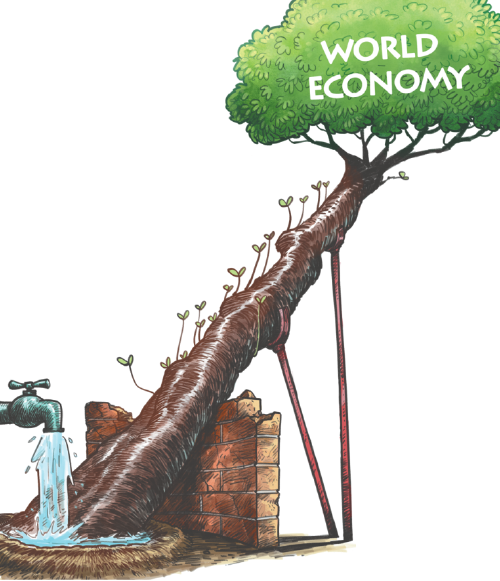
We are in the toughest period the world economy has faced since the creation of the multilateral system more than three-quarters of a century ago. The quadruple shocks of the COVID-19 pandemic, climate change, conflict and cost-of-living have undone years of hard-fought development gains. As financial conditions tighten, even countries that had seemed on track to prosperity and stability now stare into the abyss of debt distress, fragility and uncertainty about the future.
Coordinated, multilateral action is necessary to tackle the crises we face. Both aid and trade have key roles to play in reversing the impacts of this quadruple shock and putting the world back on track to achieve the Sustainable Development Goals.
We head the three international agencies that comprise the Geneva trade hub-the World Trade Organization, the United Nations Conference on Trade and Development and the International Trade Centre. The WTO makes and monitors the rules for global trade. UNCTAD delivers research and consensus-building to guide governments. The ITC helps small business go global, especially firms led by women and young entrepreneurs. We work together so that trade works better for development.
All three of us share a deep commitment to trade-led prosperity. All three of us understand that a world in crisis means no more business as usual. And all three of us want our organizations to "walk the talk" on making aid and trade deliver for real people.
To guide aid and trade toward a better world, policymakers need to pivot in three fundamental ways.
First, make trade greener. Global trade can play an important role in a transition to a low-carbon economy. Preliminary research at the WTO suggests that removing tariffs and regulatory trade barriers for a set of energy-related environmental goods would reduce global carbon dioxide emissions by 0.6 percent in 2030 just from improved energy efficiency, with additional potential gains from innovation spillovers and as lower prices accelerate the shift toward renewable energy and less carbon-intensive products.
Second, make trade more inclusive. Promoting greater trade by small businesses and greater participation by women and youth makes companies and countries more competitive, drives economic transformation and reduces poverty. Yet the ITC business surveys found that one only out of every five exporting companies is women-led. WTO data show that micro, small and medium-sized firms represent around 95 percent of all companies globally but only one-third of total exports.
Third, make trade more connected. In our networked world, the future of trade is through digital channels and platforms, especially for small businesses. During the pandemic, we saw how doing business online went from being useful to critical for survival. UNCTAD data shows that digitally delivered services reached almost two-thirds the level of global services exports.
These themes will be discussed at the upcoming Global Review of Aid for Trade, which will be held on July 27-29 in Geneva.
The event comes one month after the WTO's successful 12th Ministerial Conference, which put trade multilateralism back on track and delivered a landmark agreement on fisheries subsidies, and two months before the COP 27 meeting in Egypt that could determine the world's chances to keep the 1.5 C target alive.
The data shows promising signs that aid for trade is tilting toward greater sustainability, inclusivity and connectivity. The OECD and WTO data reveal a record high of nearly $50 billion in aid for trade disbursements in 2020, of which half were either climate or gender related, and one-third supported the digital economy. Despite growing budgetary pressures at home, it is critically important to continue and increase these aid for trade flows.
Apart from a stronger thematic focus on sustainability, inclusivity and connectivity, maximizing the contribution of aid for trade to achieve the Sustainable Development Goals requires a resolute focus on the "where" and "how" of delivering development results.
This means a focus on those countries whose trade and development needs are highest-particularly the Least Developed Countries and fragile/conflict-affected countries-and regional initiatives such as the African Continental Free Trade Area, to ensure they become stepping-stones to wider and more inclusive regional value chains and trade-led growth.
It means partnership across international organizations. The WTO, UNCTAD and the ITC already collaborate on initiatives like the Global Trade Help desk, which simplifies market research by bringing key trade and business information into a single portal, as well as on support to cotton-exporting countries in Africa.
Last but certainly not least, it means mobilizing public and private finance. The IFC estimates a worldwide $300 billion financing gap for women-and the global trade finance gap has nearly doubled from an already-staggering $1.5 trillion. Without access to finance, firms cannot grow, diversify or formalize.
We want to end with a call to action. Creating a more sustainable, inclusive and connected future is the moon shot of our times. Aid, trade and multilateralism-working together-are part of the solution. It is normal and understandable that governments act to shore up their own economies in troubled times. But we must act now to ensure that the world's poorest and most vulnerable can still see a pathway to prosperity through global trade.

Ngozi Okonjo-Iweala is the director-general of the World Trade Organization. Rebeca Grynspan is the secretary-general of the United Nations Conference on Trade and Development. Pamela Coke-Hamilton is the executive director of the International Trade Centre.
The authors contributed this article to China Watch, a think tank powered by China Daily. The views do not necessarily reflect those of China Daily.
Contact the editor at editor@chinawatch.cn.