Marine tech serves Belt and Road for common good









Sampling device
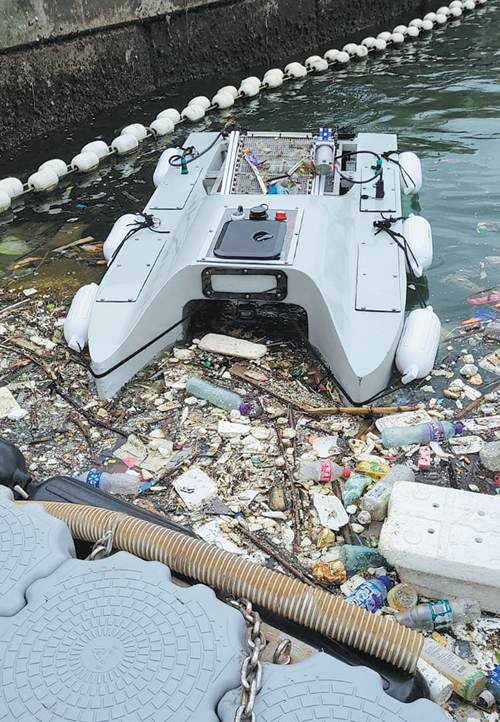
Long before technology driven by artificial intelligence helped monitor water quality in Hong Kong, Rudolf Wu Shiu-sun, adviser to the department of science and environmental studies at Education University of Hong Kong, came up with his own answer to this issue.
In 2006, Wu, then a professor at the University of Hong Kong, developed a novel sampling device to monitor heavy metals in seawater. He described the device as an "artificial mussel", as it has similar features to mussels, which can accumulate certain metals.
Wu's device comprises a plastic tube and chemicals that can detect metals. The tube is sealed with permeable gel at both ends, and its simple design means that a single tube can be made in just a few minutes for a cost of about HK$5, Wu said.
All scientists need do is place these tubes in the sea and retrieve them a month later. The information collected is used to calculate the amount of heavy metals such as copper and zinc in the water.
Wu, who began researching marine pollution in the late 1970s, said traditional methods for sampling seawater require large volumes of water to be collected. The quantity of metals in the water also varies from place to place and time to time, so scientists must take a number of samples to gain accurate data, which is time — and labor-consuming.
Excessive amounts of heavy metals in the sea are hazardous to marine life and humans via the food chain, according to the UN Environmental Programme. As a result, scientists need to monitor the content of heavy metals in seawater and make appropriate decisions. This could lead to Wu's creation being used more widely.
He and his colleagues have held many training courses in recent years to share news about the device with global scientists, including representatives from the UN and the International Atomic Energy Agency.
More than 20 countries and regions now use these devices for marine environmental protection, including those taking part in the BRI such as Thailand and the Philippines.
China founded its first key state laboratory for marine pollution at City University of Hong Kong in 2010. Eight years later, a branch of this laboratory was set up at Education University of Hong Kong, and Wu became the lab's first director.
He said international cooperation is needed to address marine pollution. This should be considered a global challenge, as seawater transfers pollution from one place to another, he added.
Peng Bo, a research fellow at the Institute of Belt and Road Initiative and the GBA at Jinan University in Guangzhou, the Guangdong provincial capital, said that by enhancing international cooperation, the marine industry in the GBA can further exert its influence globally.
Funding plans for developing marine technology in the GBA could consider applicants from outside the region, allowing more overseas research institutions and scientists to tap the GBA's scientific resources and achieve joint development, Peng suggested.
Hong Kong has already taken the first steps in this regard.
In the 2016-17 academic year, the city set up Belt and Road Scholarships for students from designated countries and regions taking part in the BRI. This plan was extended to students from all BRI economies in the 2019-20 academic year, including those arriving in Hong Kong for postgraduate education.
In the future, more overseas students may travel to Hong Kong to start their careers, as Gupta and Goel once did.
The city has been offered a new perspective of how it can capitalize on the BRI to address its brain drain and goal of becoming the word's innovative technology hub.
williamxu@chinadailyhk.com

- First-ever footage of wild Amur tigress taking care of five cubs caught on camera
- China's Genhe city witnesses extremely cold weather
- Beijing courts handled 15,000 patent cases involving bottleneck technologies
- Beijing gives big boost to IP protection over the past five years
- Man sentenced to death for killing his children
- Hemodialysis services cover all counties with over 100,000 permanent residents