Using science and tech to promote modernization









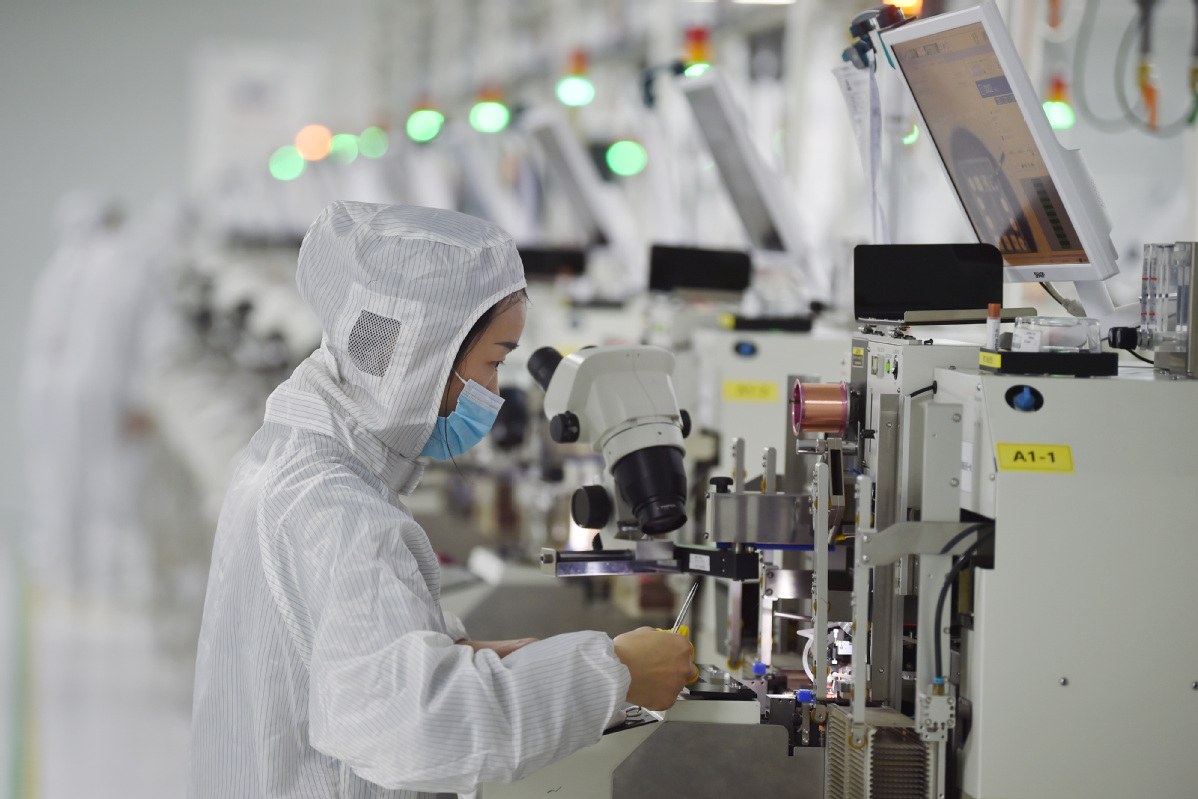
The Ministry of Science and Technology will be restructured according to the institutional reform plan, which is aimed at strengthening the centralized and unified leadership of the science and technology sector under the upcoming central science and technology commission.
The restructured ministry will focus on macro-management of strategic planning, resource allocation, coordination, policies, regulations, supervision and inspections. The restructuring will help establish a new national science and technology system, optimize the management of the entire technology innovation chain, and facilitate the transformation of scientific and technological achievements while integrating science and technology with economic and social development.
In recent years, the evaluations of technology plans, institutions, policies and other activities organized by the ministry have played an important role in optimizing technology resources, improving government management, and enhancing the level of technology management. Since the beginning of reform and opening-up in the late 1970s, China has been improving the technology evaluation system in a bid to provide clear guidance for scientific and technological activities, and promote innovations in the technology sector. This has played a crucial role in the rapid development of China's science and technology industry.
As China's scientific and technological level continues to improve, the depth and breadth of technology-related activities are constantly expanding, and the challenge of breaking the ceiling of "four onlys" (papers, titles, education and awards) has become one of the key and difficult-to-resolve issues in the reform of the technology evaluation system.
In July 2018, the General Office of the Communist Party of China Central Committee and the State Council highlighted the importance of moral character, ability and performance, and of overcoming the tendency to focus solely on papers, titles, education and awards. After five years, the process of breaking the "four-onlys" ceiling has entered a critical stage which requires an improved technology system, a more scientific and rational new technology evaluation system, and institutional reforms, as well as the use of technology evaluation as a "stethoscope" and "conductor" to promote closer integration of technology with socioeconomic development to facilitate high-quality development.
The emphasis of the "four onlys" is on papers, because advanced degrees, job titles and awards are mostly supported by academic publications. Therefore, to break the "four-onlys" barrier, one needs to first reduce the excessive emphasis on papers.
However, in the fields of basic science and cutting-edge scientific research, publishing papers in reputable academic journals and authoring highly cited papers are two of the best ways to demonstrate a researcher's ability and value. This is also the norm followed by the international academic community.
Overcoming the "four-onlys" hurdle does not mean paper metrics will no longer be considered for scientific and technological evaluations. Rather, it means breaking the simplistic and excessive emphasis on "only" papers. Modern science- and technology-related activities are a complex system, and many tasks cannot be measured by the number or "quality" of published papers alone.
For example, over the past 20 years, a large number of Chinese experts have researched and developed major equipment and materials for integrated circuits ranging from 90 nanometers to 28 nanometers, thus clearing a series of bottlenecks. Those experts have made significant contributions to the development of China's integrated circuit industry and better safeguard its economic security. However, these technologies have already been mastered and widely used in the United States, Japan, the Netherlands and other countries. And due to the need for secrecy, in many cases, the results in most cases cannot be published as papers.
The key to ending the obsession with papers is to establish a new evaluation system which would be guided by the quality and contributions to, and innovations in, the field of science and technology, with focus on meeting the major strategic needs of China's four key areas.
First, there is a need to improve the national scientific and technological evaluation management system. Also, a complete national scientific and technological evaluation management system should be established to optimize the feedback on the innovations in science and technology and better coordinate science and technology resources to intensify efforts to make China self-reliant in the field of advanced science and technology.
Second, it is necessary to strengthen theoretical and methodological research on scientific and technological evaluation, especially by using high-tech such as big data and artificial intelligence, to build a new system of scientific and technological evaluation.
Third, there is also a need to build a multi-level differentiated scientific and technological evaluation system to address the problems of an incomplete classification evaluation system, overly standardized quantitative evaluation criteria, and a utilitarian approach to evaluations.
And fourth, the authorities should take measures to optimize the system and environment for technological evaluation. To counter the trend of seeking quick success and instant benefits in scientific research, and eliminate the culture of weak integrity and low innovation capacity, efforts should be made to create a strong democratic academic atmosphere, and crack down on academic misconduct such as data falsification and plagiarism. This will help foster a positive social atmosphere that values knowledge and innovation.
The author is a researcher at the Institutes of Science and Development, Chinese Academy of Sciences.
The views don't necessarily represent those of China Daily.
If you have a specific expertise, or would like to share your thought about our stories, then send us your writings at opinion@chinadaily.com.cn, and comment@chinadaily.com.cn.