The EU still values pragmatic cooperation with China









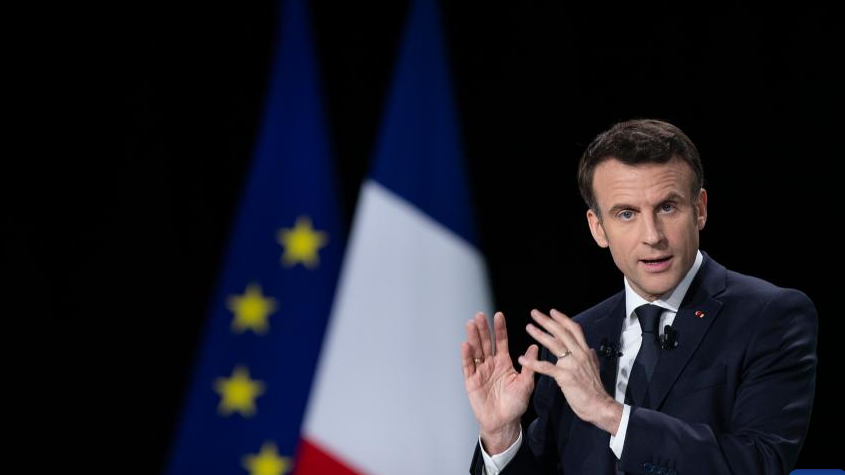
French President Emmanuel Macron speaks during a press conference in Aubervilliers, Seine Saint Denis, France, March 17, 2022. [Photo/Xinhua]
In recent days, French President Emmanuel Macron's state visit to China from April 5 to 7, accompanied by the President of European Commission Ursula von der Leyen, has become a hot topic. Last November, German Chancellor Olaf Scholz led a delegation of prominent enterprises to China, a month later the President of the European Council Charles Michel also visited China. In addition, last November Italian Prime Minister Giorgia Meloni, after meeting with Chinese President Xi Jinping during the G20 summit, announced that she too would visit China. From March 30 to 31, Spanish Prime Minister Pedro Sanchez also paid a state visit to China. The frequent visits of European leaders to China have attracted widespread attention from the international community to China-EU relations.
In the past three years, influenced by a series of factors, such as the U.S.'s all-around suppression of China, the COVID-19 pandemic that blocked personnel exchanges, and the Russia-Ukraine conflict that intensified geopolitical tensions, there have been more voices within the EU to "reduce dependence on China" and shrink cooperation with China due to divergent values and ideologies. However, there is no fundamental conflict of political interests between China and the EU, and there is still high economic compatibility, which is fully reflected in the continuous growth of bilateral trade and investment.
In addition, China and the EU share many common concerns and interests on global issues such as addressing climate change and safeguarding multilateralism. In this context, it is crucial for both China and the EU to continue high-level dialogue, strengthen communication on important issues, reduce misunderstanding and misjudgment and deepen practical cooperation. The current frequent visits of European leaders to China mean that China-EU relations are turning warmer after experiencing a trough and indicate that the EU is adopting a different policy towards China from the U.S.
Firstly, the EU attaches great importance to China's sincerity in peacefully solving the Russia-Ukraine conflict. At present, the EU is deeply involved in serious consequences brought about by the Russia-Ukraine conflict, including energy crisis, high inflation, intensified de-industrialization, and large-scale social protests. Besides, the Russia-Ukraine conflict has made Europe more dependent on the U.S. for security, further highlighting the inequality of the trans-Atlantic partnership.
The U.S. has almost completely ignored the interests of Europe when issuing industrial policies such as the Inflation Reduction Act. The continuation of the Russia-Ukraine conflict is not in the interests of Europe. Against this background, as an important power that can engage in dialogue with Russia, Ukraine and the West at the same time, China is expected to play an important role in ending the conflict.
Especially, the fact that China mediated Iran and Saudi Arabia agreeing to resume ties after years of hostility has made European leaders more aware of China's diplomatic clout. After China released the 12-point peace position on Ukraine, the feedback from both Russia and Ukraine was positive, which gives Europe hope of politically ending the conflict. It is expected that during their visit to China, Macron and Ursula von der Leyen will have in-depth discussions with Chinese leaders on politically resolving the Russia-Ukraine conflict and restoring peace to Europe as soon as possible.
Secondly, Europe still values economic cooperation with China. Economic cooperation has been the ballast of China-EU relations, while providing impetus and vitality for the economic development of both sides. In 2022, the total bilateral trade in goods between China and the EU reached $847.3 billion, with an increase of 2.4 percent year-on-year. China and the EU are each other's second largest trading partners. In 2022, Chinese enterprises invested $7 billion in the EU, and their investment stock in the EU reached $102.9 billion till the year end.
Currently, the EU economy is in a difficult situation where high inflation and low growth co-exist. Against the backdrop of significant downward pressure on the global economy, Europe cannot ignore the boosting role of China as a large-scale market and an important manufacturing base. Last December, the President of the European Council Michel stated during his visit to China that the EU is willing to work with China to continue to push forward the Comprehensive Agreement on Investment, boost stability and mutual trust on supply chain issues and deepen cooperation in areas where mutual benefits exist. Chinese President Xi Jinping, during his talks with Italian Prime Minister Meloni and Spanish Prime Minister Sanchez, also said China will increase imports of high-quality products from Italy and Spain. Therefore, strengthening economic cooperation will also be an important topic between the two sides during the visit of Macron and von der Leyen to China.
The world landscape is undergoing drastic changes. Both China and the EU should fully be aware of the significance of healthy development of China-EU relations for world peace and development, insist on not drawing lines based on ideologies and values, find the largest consensus in bilateral relations and addressing global challenges, and achieve mutual benefits and win-win results through practical cooperation. Von der Leyen stated during her speech on European strategy towards China on March 30, that "we do not want to cut economic, societal, political or scientific ties (with China)," which largely shows the autonomy of the EU. In the future, the EU's China Policy could be an important indicator for observing whether it adheres to promoting its strategic autonomy.
The author Sun Yanhong is a senior research fellow and the head of Division of European Economic Studies at the Institute of European Studies, Chinese Academy of Social Sciences (CASS).