US must stop playing Taiwan card









In August 2022, then US House speaker Nancy Pelosi's visit to Taiwan dealt a serious blow to the already deteriorating Sino-US relations. And although the meeting between the two countries' leaders on the sidelines of the G20 Summit in Bali, Indonesia, in November 2022 raised some hopes of bilateral ties returning to the normal track, Sino-US relations continue to deteriorate with the level of official exchanges falling to a historical low.
The deterioration in bilateral ties is neither in the interest of China nor the United States. China has said that, despite improving Sino-US relations being of great importance, it will not make any compromise on the Taiwan question, as it is of China's core interest.
Hence, for bilateral ties to be back on track, the US needs to adhere to the principles the two sides agreed to on the Taiwan question. But the US administration's actions related to the Taiwan question have been downright provocative, which is not what President Joe Biden meant when he said that Washington seeks to put "guardrails" on the Sino-US relationship, meaning taking measures to prevent conflict.
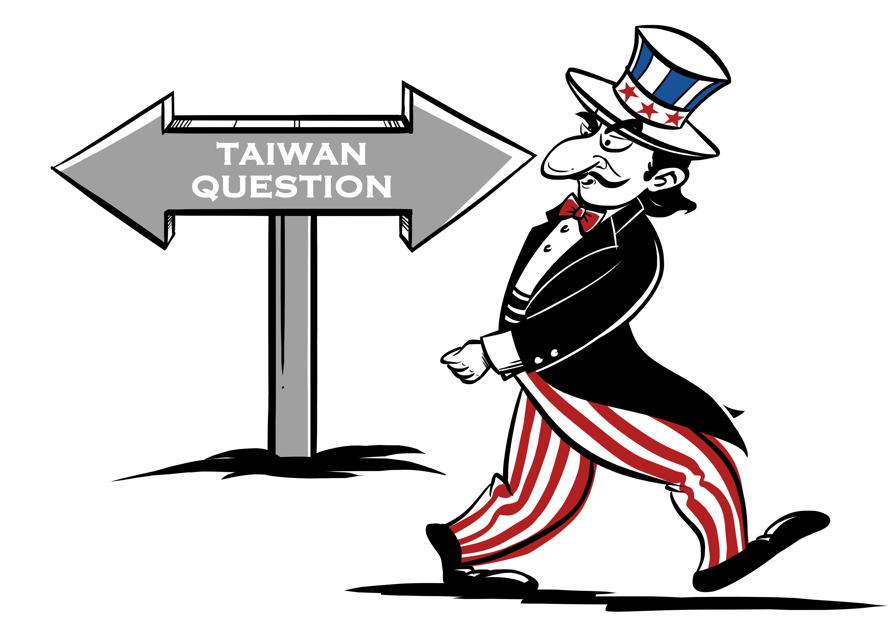
By interfering in the Taiwan question, the US is interfering not only in China's internal affairs but also trying to prevent the reunification of Taiwan with the motherland. In fact, the US is trying to draw maximum geopolitical leverage by raising tensions across the Taiwan Strait.
However, the Biden administration must realize that stabilizing, rather than worsening, the situation across the Strait is in the best interest of the US. And the first thing it should do in this regard is to stop supporting and encouraging separatist forces in Taiwan to seek "independence".
Yet the US has been doing the opposite, apparently trying to hollow out the political foundation of Sino-US relations set by the three joint communiques. This could force China to take extreme measures if the situation spirals out of control. Some US politicians are willing to take such risks, but there still are some rational people in the US who realize the consequences of a conflict, and therefore don't support the US' moves.
It is in the best interest of the two sides to take steps to resume strategic communication and dialogue, and build mutual understanding and trust. For that, of course, the US needs to change its diplomatic posture and build an atmosphere conducive to resuming normal bilateral exchanges.
Stabilizing the situation across the Strait will help maintain peace and development in the Asia-Pacific region, and is in the long-term interest of the US. And despite competition between major powers being inevitable, the competition should be fair and limited to trade. The consequences of unfair competition could be ugly.
As the two largest economies in the world, the US and China should act responsibly. To do that, the two sides need to manage their differences on the Taiwan question. For example, the US shouldn't intensify tensions by making provocative moves.
The Chinese side has learned valuable lessons from war, and its foreign policy decisions are now deeply influenced by the ancient idea of "caution against war" and the strategic principle of being reasonable, disciplined and mutually beneficial.
It's time the two sides brought together all countries in the Asia-Pacific region and beyond to end the geopolitical game of confrontation. In this regard, the Shangri-La Dialogue in Singapore from Friday to Sunday can provide some guidance to the US, because the defense ministers of Asia Pacific countries have come together for the dialogue to discuss ways to prevent confrontations and conflicts.
The US should understand that by destabilizing the cross-Strait situation, it will increase the risk of conflict.
Also, there is huge difference between China and the US on the Taiwan question. China emphasizes that cross-Strait relations are China's internal affairs and no external power has the right to interfere in it. China's position is recognized by not only international documents such as the Potsdam Declaration, but also by the United Nations and all the countries that have diplomatic ties with China, including the US.
Yet some US politicians have been trying to interfere in the Taiwan question, forcing China to draw a redline and warn them that it is not to be crossed under any circumstances. These US politicians should learn from the American people, most of whom either don't care about the Taiwan question or don't know where Taiwan is, because they have to deal with pressing individual and domestic issues which the US administration doesn't seem interested in addressing.
So if the US politicians really confront China on the Taiwan question, they will be despised by the American people for creating another big problem which will eat up more US resources and leave people back home to pay the cost. The US politicians should learn from the American public's lack of interest in geopolitical confrontations, and attend to their domestic woes.
The author is a senior researcher at the Chinese Academy of Social Sciences.
The views don't necessarily reflect those of China Daily.