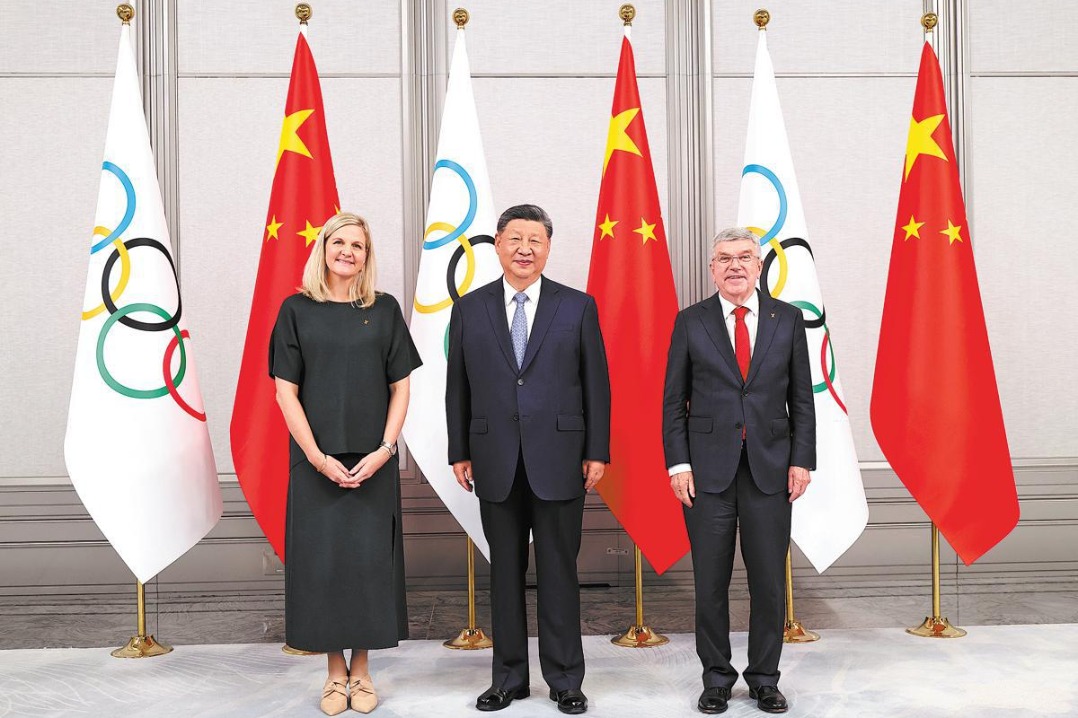
Experts share views on China-US relations









Editor's note: The heads of state meeting between China and the US in San Francisco is widely believed to have added stability to China-US relations, brought new impetus to the Asia-Pacific cooperation and injected positive energy into the international and regional landscape. Three experts offer their insights to China Daily.

A new stage for positive measurable action
By Edward Lehman
The recent meeting between US President Joe Biden and Chinese President Xi Jinping, before the Asia-Pacific Economic Cooperation (APEC) Economic Leaders' Meeting in San Francisco, provides a strong basis for action by the parties. Against the backdrop of the forum's theme "Creating a Resilient and Sustainable Future for All", the forum brought attention to the crucial power dynamics in the Asia-Pacific region, which represents a substantial 62 percent of global GDP and nearly half of global trade.
The face-to-face interaction marked the leaders' first meeting in a year, following high-level visits by US officials, including the treasury and commerce secretaries, a senior US Congressional delegation, and the governor of California. These visits were seen as positive steps for alleviating tensions that had escalated during the former Trump administration, marked by the imposition of tariffs on Chinese imports, which the present administration has continued. This has been the lowest point in Sino-US relations since 1979.
During their hours of discussion, Biden and Xi addressed key issues, including cooperation on trade, agriculture, climate change, artificial intelligence, the flow of illegal substances, and agreed to restart direct military-to-military talks. While joint commitments were not made, both leaders stressed the importance of continued dialogue.
The meeting signifies both countries' willingness to collaborate, building upon a relationship that began 12 years ago when the leaders first met as vice-presidents. President Biden described the discussions as "constructive and productive," underlining the significance of such high-level dialogues.
President Xi emphasized the China-US relationship as "the most important bilateral relationship in the world," advocating its nurturing for mutual benefit. He envisioned setting an example for other nations through collaboration on trade, agriculture, climate change, and artificial intelligence.
The productive meeting at Filoli is the beginning of a dialogue at the highest level, boosting confidence in the stability of relations between the two nations and contributing to a reduction of tensions. This stability sends a positive signal to businesses on both sides of the Pacific, ensuring stable business and commerce between the two nations.
It's crucial to send the message that immediate, cost-free steps can significantly improve the situation for both countries. US Treasury Secretary Janet Yellen's suggestion to remove reciprocal tariffs imposed on imports, if implemented, can address a significant trade dispute and contribute to reducing inflation.
The divide between the two nations, however, is not as large as people might have been led to believe by reports in the media. Since 2002, when China joined the World Trade Organization, the two countries have brought less than 40 cases against each other. This is less than 20 percent of all WTO cases. It's a remarkably low number considering the amount of trade carried out between the two countries.
Similarly, the Committee on Foreign Investment in the United States, an inter-agency committee of the US government which reviews the national security implications of foreign investments in US companies or operations, which dates back to a 1975 Presidential Executive Order, affects a very narrow category of investment technology companies. The reality is that only a very small fraction of all Chinese investments have been impacted. While trade has decreased between the two countries, this is due in large part to the trade tariffs and the strong headwinds the global economy is facing. The two countries still remain two of the largest trading partners with a significant interdependence in many areas including trade.
China's 24-point policy to attract foreign investment is another noteworthy aspect, aiming to improve investment opportunities for foreign companies and eliminate perceived barriers and restrictions, fostering economic growth and further mutual cooperation between the world's two largest economies.
Viewing competition positively has the potential to prompt innovation, fostering economic growth for both nations. The focus should shift toward innovation, cooperation, and healthy competition. Established US giants could draw valuable lessons from the agility and growth of Chinese counterparts like Alibaba, Tencent and Xiaomi.
The recent meeting serves as a significant foundation for future exchanges post-APEC. The business community would welcome immediate steps, including the removal of tariffs and addressing barriers. It would be in the best interest of both nations to take positive steps toward future cooperation in other areas of mutual interest, such as data security, environmental protection, international health cooperation, and regional stability.
According to the IMF, the forecast for global growth is estimated to slow down to about 3 percent this year and 2.9 percent next year.
Expanding US-China trade can help to influence growth globally.
The summit increases optimism for future dialogues, setting the stage for more exchanges, but concrete steps are essential for the benefit of both sides. It's time to translate words into comprehensive and actionable policies that benefit the interest of all parties.
The author is AmCham General Counsel, long time China-based expat, and chairman of LehmanBush. The views don't necessarily represent those of China Daily.