Food of 'dripping sweat and hard toil' should be cherished









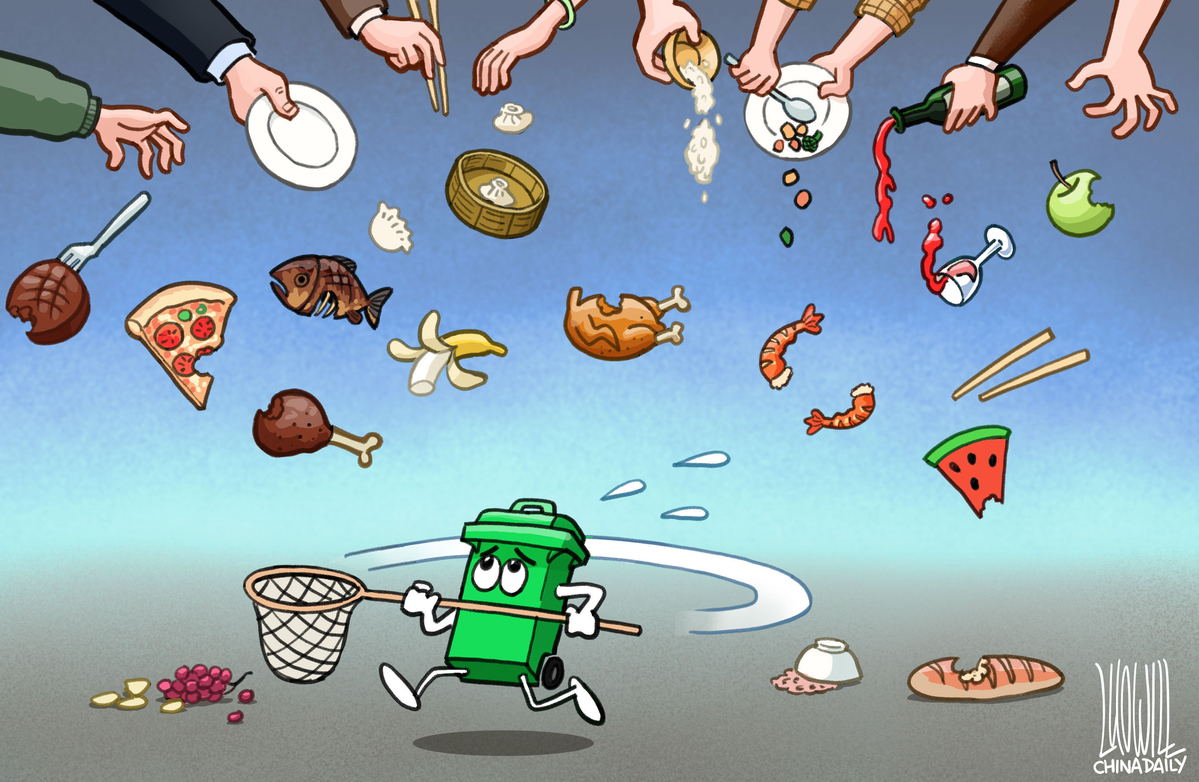
The Chinese people have developed the habit of ordering more dishes than they can eat when inviting friends or relatives for dinner in a restaurant, because if all the plates are empty at the end of the dinner, it would be considered a matter of shame to the host.
To ensure that some (if not lots of) food is left on the table when the guests get up to leave is considered good hospitality even though the host's heart might be bleeding over the waste of delicacies he/she paid for. This practice causes a huge waste of food each day in millions of restaurants.
Surveys show that, on average, 93 grams of food is wasted by each person having dinner in a restaurant, making up about 12 percent of the food he/she had ordered. Leftovers from banquets and parties reached a high of 38 percent of the total dishes ordered. Statistics show that as much as 35 million tons of grain — 6 percent of the total grain output — is wasted in China every year.
"At noon they weed with hoes; their sweat drips on the soil. Each bowl of rice, who knows is the fruit of hard toil." Although almost all Chinese people can recite this ancient poem from the Tang Dynasty (618-907) and boast of being diligent and frugal, they seem to contradict themselves when it comes to preventing food waste.
For generations, we have been taught by parents and teachers, and advised by officials, to be thrifty and not waste food. But a decade ago a group of volunteers found that to effectively curtail food waste it is necessary to impose restrictions on restaurants, which are believed to contribute to half of the grain wasted in China.
The "Clean Your Plate" campaign was launched in 2013 and got a positive response from restaurant owners, food associations, the public, and governments at different levels. Small leaflets, seen on an increasing number of restaurant tables, remind diners to order as much as they can eat. And more and more waiters and waitresses are now reminding diners to stop ordering more if they have ordered enough to satiate their hunger.
Also, most restaurant owners nowadays provide free boxes in which the diners can carry the leftovers home. And some restaurant owners are offering vouchers to those who finish the food they have ordered.
The "Clean Your Plate" campaign has become popular along with the "save water", "go green" and "eradicate poverty" canvassing. In fact the "Clean Your Plate" is taking up a lot of TV and radio time and newspaper space, impacting people's mindset.
Slowly but steadily, the pride associated with ordering excess food in restaurants is becoming an out-dated practice. Although, occasionally, we can still see people wasting a lot of food in restaurants, they draw sneers from other diners and the restaurant staff, rather than admiration for their fat wallets.
However, since it takes generations for people to change their bad habits, it's too early to blow the horn of success. Instead, more attention should be paid to preventing food waste at home.
As it is true worldwide, almost every Chinese family has a "trash can" — I mean the member who eats all the leftovers to ensure no food is wasted. Unfortunately, I happen to be the "trash can" of my family.
I used to enjoy my status until I heard an expert on TV saying that eating leftovers cause cancer. Many doctors say the same thing. But later, I saw other experts doing on-the-spot experiments and concluding that food cooked hours ago or even a day ago shows no obvious increase in carcinogenic particles if stored properly.
Their contradictory arguments have left me confused. I have no idea who is right, but I am clear that if all the leftovers are thrown away as suggested by some experts, it would be a big waste of food.
To clear the confusion, healthcare authorities should conduct an in-depth study on the issue and give the public an authoritative answer. This is necessary because it concerns the health of millions of "trash cans" like me, and would decide the fate of millions of tons of food produced through dripping sweat and hard toil.
The author is former deputy editor-in-chief of China Daily.
kangbing@chinadaily.com.cn