


Paradise found
Over the course of centuries, China's literati were drawn to Jiangnan, viewing it as a spiritual sanctuary, Zhao Xu reports.









Ask Tao Yuanming, Chinese history's much-celebrated recluse best remembered for his fable, The Story of the Peach Blossom Spring, written in 421, during a time of great political instability and national disunity.
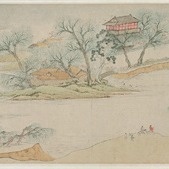
The story is about a chance discovery by a fisherman of an ethereal utopia, where people lived in complete harmony with nature, unaware for centuries of the outside world. The fisherman, having haphazardly sailed into a river which carried him to the beginning of secret passage, emerged to "look into a landscape that must have looked like a Wen Zhengming painting", to use the words of Von Spee.
"On one hand, you have Tao Yuanming's peach blossom which is indicative of the springtime; on the other, you have these paintings of the Jiangnan spring which, complete with unspoiled nature and rice paddies, constitute an earthly paradise," she says.
The curator points to a Ming-era hand-scroll with a blue-green color scheme titled The Peach Blossom Spring, as well as a Qing Dynasty porcelain dish whose design illustrates the tale.
"Jiangnan is to China what Arcadia is to the West," she reflects. Derived from the ancient Greek province of the same name, the term Arcadia represents a vision of pastoralism and, as such, has long inspired Western art and literature.
According to Von Spee, the Peach Blossom theme saw its popularity soar during the Ming-Qing transition in the 17th century, another chaotic time that had persuaded more than a few to withdraw into the beauty and repose of Jiangnan. And when they did so, they had something — some people — in mind.
In 1652, a group portrait was painted to commemorate what some believe to be an imaginary gathering of six Jiangnan literati in 1636. While the figures were painted by a professional portraitist, the landscape was added on by Xiang Shengmo, who himself appears in the painting sitting at the back, to the right of the piece. The center of attention, not surprisingly, belongs to the red-clad Dong Qichang, the most prominent artist-cum-art theorist of the Ming Dynasty. Dong passed away in the autumn of that year.