Decoding Trump's 10% tariff plan









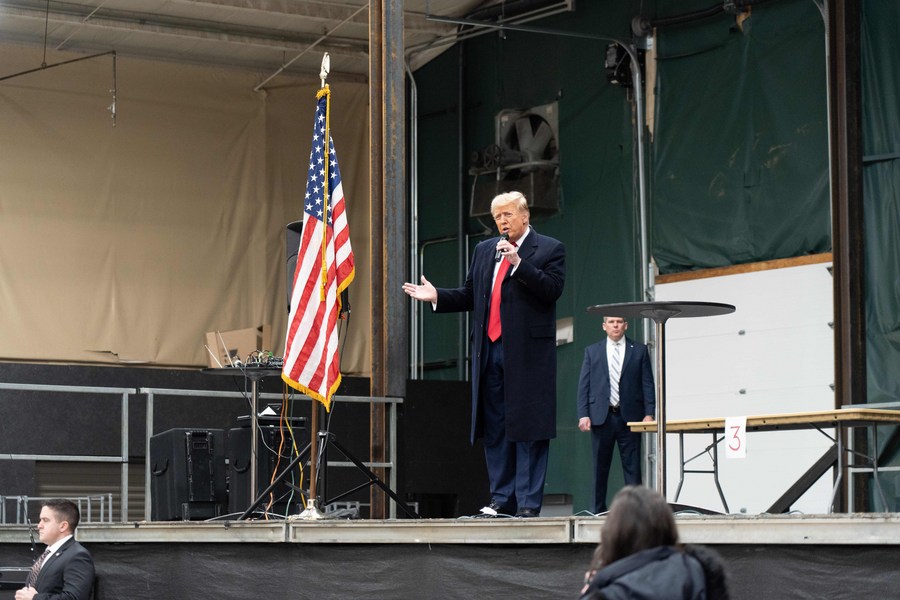
Former US president Donald Trump speaks at a caucus site in Clive, Iowa, the United States, Jan 15, 2024. [Photo/Xinhua]
It seems as though Donald Trump has secured his position as the GOP nominee with a recent victory in New Hampshire; leaving Nikki Haley, Trump's last remaining Republican contender, with no real path to the party's nomination for president. With the ever-increasing chances of Trump returning to the White House, his proposed 10 percent tariff on all imported goods deserves a much closer look. This bold, protectionist move, aiming to boost American manufacturing, could have profound implications for the US economy, disrupt global trade, and add a new dimension to the already complex and tense US-China relationship.
At its heart, Trump's tariff plan aims to reinvigorate American manufacturing by imposing a blanket tariff, attempting to encourage local production and reduce reliance on foreign goods. However, what this plan would do is shift income from net importers to net exporters, weakening demand for foreign-made goods and giving the Treasury an influx of new revenues. This could potentially narrow the US' trade and budget deficits and might spur employment in certain sectors, offering a glimmer of hope to the industries long overshadowed by global competition.
However, this approach is not without its pitfalls. Increased tariffs mean higher prices for imported finished consumer goods and intermediate goods, which could stoke the fires of inflation at a time when the economy is still recovering from pandemic-induced upheavals. Additionally, this policy could exacerbate income inequality. The increased costs of imports would disproportionately affect lower-income households, widening the economic divide. Thus, while some sectors may flourish, the broader picture could be one of rising prices and deepening inequality.
As the world's largest economy running the world's largest trade deficit, Trump's tariff plan for the US could send shockwaves through an already unsettled global economy. The US consumer, a cornerstone of global economic growth due to the country's substantial trade deficit, plays a crucial role in driving demand worldwide. By curtailing US demand for foreign goods, thus dampening global demand, the plan would negatively impact the global economy, namely for countries with large trade surpluses such as Germany, China, and Japan. Tariffs often provoke retaliatory measures from trade partners, which could complicate global supply chains, and encourage countries such as China to seek alternative markets or impose their tariffs, affecting American consumers and exporters. This could initiate a shift in global trade norms, leading to an era where protectionist policies become the new standard, further destabilizing an already fragile global economy, exacerbating deglobalization, and decreasing international cooperation.
The potential implications for US-China trade relations are particularly significant. The US is China's largest export market, and any disruption in this trade flow could have far-reaching effects on the Chinese economy. This might entice Chinese firms to look for economic partners elsewhere, further hurting the bilateral economic relationship. More importantly, such a policy shift by the US would likely be viewed in Beijing as a move toward increasing unpredictability and antagonism, potentially leading to reciprocal trade barriers and derailing the recent progress made in the bilateral relationship.
Unbeknownst to Trump and whoever helped him form this plan, it's essential to recognize that trade imbalances are not solely a function of trade policies but are deeply intertwined with domestic economic policies and economic imbalances. Trade imbalances are caused by domestic imbalances of savings and investment, which are in turn caused by imbalances in domestic distributions of income. Trump's plan overlooks the complexity of the modern global economy and attempts to solve a 21st-century problem with a 17th-century solution. The US' focus should be on the complex task of fostering a balanced global trading environment and crafting international institutions, by consensus building among nations, that encourage the balancing of domestic savings and investments, rather than resorting to tariffs, which are merely symptomatic treatments of deeper economic issues. In an era where products are "Made in the World" rather than in single countries, tariffs could negatively impact American businesses and workers who are part of these global value chains, hurting the folks this plan was made to help.
In light of Trump's victory in New Hampshire, his large lead in the polls of the remaining states in the GOP primary contest, and the increasing likelihood of his return to the White House, his proposed 10 percent tariff plan requires a careful look at its potential global impact. Much like as we saw in his first stint in the White House, Trump's trade policies seem to be out of step with the complexity of the current global trading system. As Americans and the world watch the unfolding horse race between Trump and Biden, we should all hope for a more balanced approach to international trade from whoever occupies the White House in 2025.
The author is an American PhD candidate at the School of Politics and International Relations at East China Normal University.
The views don't necessarily reflect those of China Daily.
If you have a specific expertise, or would like to share your thought about our stories, then send us your writings at opinion@chinadaily.com.cn, and comment@chinadaily.com.cn.