Narrative arc set in stone










Spiritual evolution
The Nanjing Museum exhibition, which ended last month, included a rather special piece believed to have belonged to an early stage of the Liangzhu culture. Featuring on one end a bird perching atop a beast held up high by a kneeling man, the piece tapers down toward the other end to form a pointy finish, which probably had been once inserted into a wooden pole to form a scepter-like wand wielded by an officiant during ritual ceremonies.
"Seeing birds piercing through clouds or beasts roaming the boundless earth aroused in the people of Liangzhu a sense of devotion they had always harbored toward the heaven and the earth, the holy spirits of which they believed these animals embodied," says Zuo Jun, curator of the exhibition.
Reflecting on the symbolism of the iconic Liangzhu jade cong, Fang believes that they amount to an enunciation of "the Liangzhu people's view of the universe".
"From the top to bottom, the cylinder — if it can be called one — has a very slight taper. If you have the experience of standing in an open field surveying your surroundings, with an unobstructed view, you would know that the earth is a circle — or at least appears so to you — with its border defined by where it meets the heaven. The heaven, of course, is also a circle, albeit a bigger one encompassing you," he says.
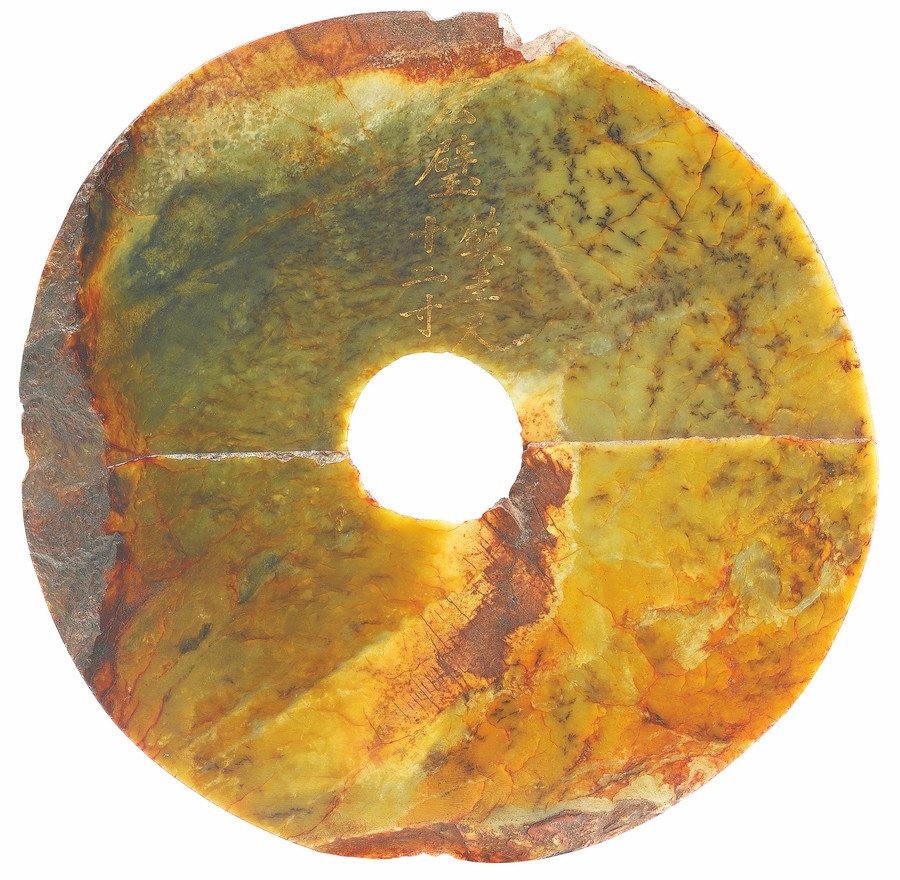
Teng would have said almost exactly the same thing about the jade cong from both Miaodigou and Qijia. Only that she believes the elevated terrains of western China, the prehistoric jade tradition of which is exemplified by the two cultures, is where the jade cong had originated, not the low-lying delta home of the Liangzhu culture.
"The Liangzhu jade cong — if they could be called so — were derived from a type of wide jade bracelet known today as cong-style bracelets, that have been unearthed in large numbers from the sites. Therefore, although the Liangzhu cong did bear a striking resemblance to the jade cong from western China, they are better examined within their own cultural framework," she says.
"While the cong-style bracelets continued to exist toward the end of the Liangzhu culture, the Liangzhu jade cong gradually stopped being pieces of ornamental art to take on other, more significant duties, including functioning as a cultural emblem and a communicative tool between the terrestrial and the celestial." (The Liangzhu cong believed to have fallen into the latter category are often too chunky or feature an opening that's too small for a hand to be put through, ruling out the possibility of them being wrist accessories.)
To better perform that function, the jade cong that appeared during the later stages of the Liangzhu culture tended to grow higher and "be closer to the heaven", to use Zuo's words.
"One of the ways ancient people performed sacrificial ceremonies using ritual jades was to burn them, believing that the smoke generated in the process would help accomplish the mission," says Zuo. "We know this thanks to what was recorded on the oracle bones during China's Shang Dynasty between the 16th and 11th centuries BC."
According to similar recordings, ritual jades had also been buried or sunk in water in honor of the earth and the rivers. At Shimao, a late Neolithic to early Bronze Age site in Shenmu, Shaanxi province, northwestern China, ceremonial jade axes and shovels have also been found inside the stonewalled platforms of a palatial complex, dated to around 2000 BC.