All aboard the coffee plantation express
Area renowned for tea growing prowess is making waves with another beverage










Fancy a cup of China's finest coffee? Well, hop on a train and head for Pu'er.
Sorry, did you say coffee?
That's right. Although tea has long been the calling card of Pu'er, in Southwest China's Yunnan province, the coffee industry is making giant strides in the region.
That's because Pu'er, due to its climate and geography, is blessed with a unique combination of factors that make it conducive to growing tea leaves as well as coffee beans.
Pu'er, in the remote frontier of Yunnan, bordering Myanmar, Vietnam and Laos, is renowned for its fermented dark tea and has been a tea distribution and trade center since the Tang Dynasty (618-907).
The tea was carried by local horse caravans to Lhasa to be exchanged for things such as horses, furs and medicines. The caravans would also travel to Nepal, Burma and India, which is how the Tea Horse Road came about.
Today Pu'er is China's largest coffee growing area, with the highest output and best quality, according to Yunnan's agriculture and rural affairs department.
"Pu'er is indeed a unique place, where both coffee and tea cultivation thrive," said Wang Changjiang, a former agronomist for the Starbucks coffee farmer support center in Pu'er.
Pu'er, it so happens, "lies at the juncture of tropical and subtropical zones", he said.
More than 98 percent of domestic coffee is produced in the province, half of that from Pu'er, Xinhua News Agency has reported.
The rise of coffee in Pu'er didn't happen overnight, but began in 1892 when a French missionary planted the first coffee seed in a village there. After that, coffee was planted on a small scale, Wang said.
By last year, Pu'er had 250,000 coffee farmers and 45,000 hectares of coffee plantations, generating income of 6.3 billion yuan ($945 million), and it is a supplier to the likes of Nestle and Starbucks.
"Coffee is a unique agricultural product," said Zheng Hongwei, founder of Gushan Cultural-Tourism Technology. "It's grown in rural areas, whereas most coffee drinkers live in cities." Because of this geographical disparity of production and consumption, coffee and tea attract many visitors, Zheng said.
Among them is Luo Xiaoshu, a coffee connoisseur who works in Beijing, Shanghai and Shenzhen. Luo, in her 40s, works as a volunteer at Aini coffee plantation, honing her skills in the delicate art of coffee brewing.
Pu'er, drawing on its rich heritage in both tea and coffee, has become a magnet for travelers.
Coffee plantation tourists, from the very young to the very old, are eager to immerse themselves in the entire coffee cultivation process, from beans to brew, Luo says.
For Luo and her fellow coffee lovers, Pu'er stands as a top destination with its accessibility. Luo described her journey, during which she boarded a high-speed train to Kunming, the provincial capital, and then transferred to the China-Laos Railway.
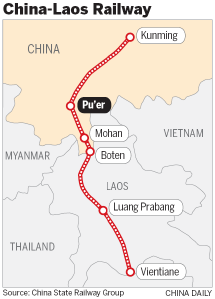
The inauguration of the China-Laos Railway in December 2021 has made traveling to Pu'er a lot easier. The railway connects Pu'er to Kunming and the capital of Laos, Vientiane, putting an end to Pu'er's history of isolation from rail transportation.
Previously, reaching Pu'er required an arduous journey. Visitors would first go to Kunming, followed by a six-hour bus ride to Pu'er. The China-Laos Railway cuts travel time from Kunming to Pu'er to a little more than two hours.
In ancient times horse bells resounded throughout the rugged terrain as the prized Pu'er tea embarked on the long trip along the Tea Horse Road. Today the shrill whistle of high-speed trains announces the arrival of global coffee merchants and tourists, who travel to the burgeoning coffee havens using the China-Laos Railway.
"With the railway in operation, the number of merchants and visitors exploring Pu'er's coffee origins has surged," said He Yuejun, manager of Pu'er Aini plantation.