Experts' take on Asian economic development









Editor's note: Facing the complex and uncertain international situation, countries in Asia have played and will continue to play a vital role in promoting free trade, multilateralism and globalization, which are essential to building a just, equitable, open and inclusive world. Three experts share their views on the issue with China Daily.

Climate goals need trade collaboration
By Cyn-Young Park
The countries responsible for 88 percent of global carbon emissions, including large emitters in Asia, have pledged net-zero emissions by 2050(with some realizing the goal between 2060 and 2070), yet current efforts are insufficient to achieve that target. Integrating trade policies with climate initiatives could break the gridlock and bring us closer to achieving this crucial goal.
A growing number of countries have pledged to achieve the time-bound net-zero emissions. More than 140 countries, which account for about 88 percent of global emissions, including the biggest emitters — China, the United States, India and the European Union — have now signed up. Their net-zero targets are translated into climate action plans, or Nationally Determined Contributions, to reduce emissions and slow the pace of global warming.
However, the current NDCs are not enough to achieve the climate goal set in the Paris Agreement to keep global temperature rise to below 1.5 degrees Celsius above the average preindustrial level.
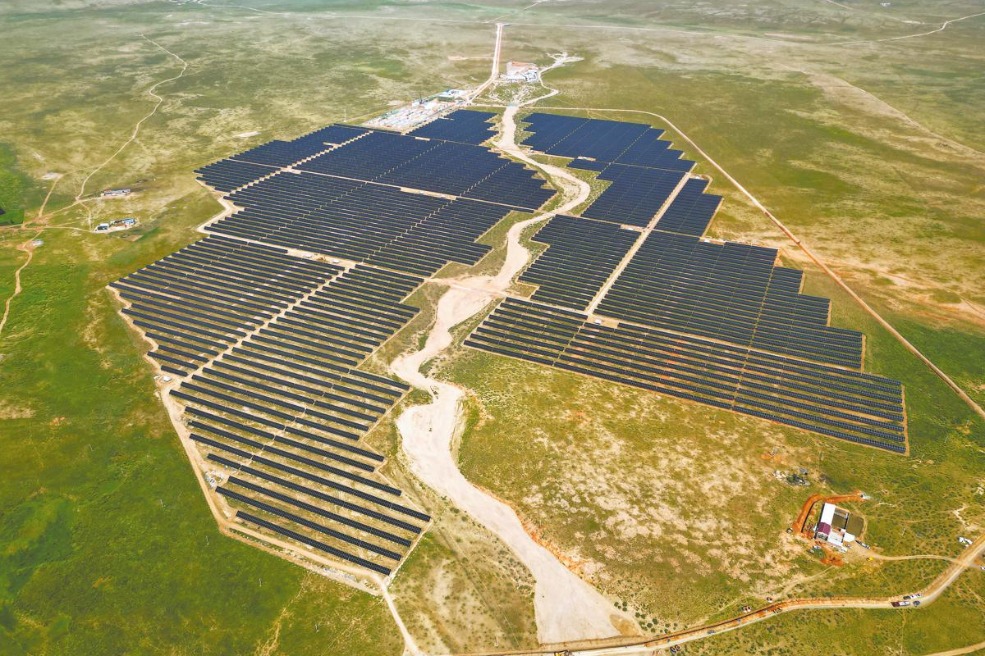
Trade policies need to become more integrated with the NDCs to cover the shortfall. Unfortunately, the nexus between trade policy and climate actions continues to be overlooked in formulating the NDCs. The economic rationales for improving the interface between trade policy and climate actions are compelling. For example, green trade can offer many solutions to climate change by expediting the transition to renewable energy, promoting technology transfer, and encouraging investment in green sectors and low-carbon technologies among others.
Leveraging green trade and investment is also key to successfully facilitating the energy transition and the NDCs' implementation in developing countries which face difficulties in gaining access to finance and technologies.
Policy frameworks under the NDCs, which help create new trade and investment opportunities in renewable energy for example, can support just transitions in developing countries and increase their NDC ambitions.
But geoeconomic fragmentation is a growing threat to the transition to clean energy and developing a net-zero economy. Conflicting national interests in the name of energy security have led many countries to undertake unilateral actions and restrict trade in materials critical for energy transition. And as enterprises compete in the global race to secure the supplies of critical minerals for new business opportunities, governments lend their support to domestic companies and promote domestic energy transition through additional protectionist measures.
With many governments leaning toward protectionism, businesses and investors retreat further from overseas activities. Protectionist policies could persist despite their adverse consequences on the reliability of global supply chains and national long-term energy security, if the lack of collective global actions continues to create uncertainties over trade and supply chains.
Given the complex workings of deeply interconnected global value chains, protectionist measures such as export bans, tariffs and subsidies create uncertainty, which in turn will discourage investments. They can also distort business incentives, create supply chain bottlenecks, and disrupt the flow of essential inputs that could be detrimental to the successful transition to clean energy technologies.
Trade policies need to become more integrated with the NDCs to address the shortfall the current NDCs represent in delivering on the global climate goal. It would be more sensible therefore to implement proactive policies such as encouraging investment in infrastructure and human capital development, and implementing reforms to improve the overall business environment while preserving open trade and investment regimes.
As global energy transitions gather pace, developing reliable, diversified and responsible supply chains for critical mineral and clean energy manufacturing is becoming strategically important in Asia and the Pacific. The region boasts rich natural resources, well-established manufacturing and industrial bases for clean energy technologies, as well as a high-quality and skilled workforce.
To unlock the massive economic potential from the global energy transition, the region's policymakers must take coordinated measures to reduce business uncertainties, help manage environmental, social and governance risks, and support reforms to address supply-side constraints. Governments, for their part, can encourage private and foreign investors to input capital into projects by "de-risking" investments, leveraging government funding and tax incentives, and forging strategic partnerships to reduce policy uncertainties and political instability.
A united front on green trade and investment can exert significant influence on national climate pledges. For example, trade agreements with strong environmental provisions can help increase the NDC ambitions and make their implementation more efficient by aligning private sector incentives with climate goals and creating an environment conducive to green trade and investment.
More importantly, coherent policies and coordinated actions across countries will help strengthen their NDC targets and expedite their implementation. The current trade tensions and geoeconomic fragmentation harm our chances of capitalizing on these opportunities and reaching the global climate goals in time to avert the climate crisis.
The collective ambition to achieve net-zero emissions underscores the urgent need to leverage trade policies for climate action. Trade policy reforms focusing on transparent trade rules and regulations can reduce market uncertainties that hamper investment in green projects, boost confidence and trust by increasing market access for private and foreign investors, and facilitate cross-border investment and technical transfers.
The author is director for Regional Cooperation and Integration and Trade, Asian Development Bank. The views expressed are those of the authors and do not necessarily reflect the views of the Asian Development Bank, its management, its Board of Directors, or its members. The views don't necessarily reflect those of China Daily.