Visits showcase good examples of international relations










A week-long visit to Hungary was like a breath of fresh air to me, not only because Hungary, notably its capital Budapest, is beautiful but also because the officials, businesspeople, academics, teachers and students I talked with in the country made so much more sense than those ideologues in Washington and Brussels, where I have been based for the past decade.
That's why I'm not surprised to see China-Hungary relations getting better by the day. And that's what I heard from multiple people including Balazs Orban, political director for Prime Minister Viktor Orban, and Gyorgy Matolcsy, governor of the Magyar Nemzeti Bank, Hungary's central bank.
They were not trying to please a Chinese journalist, because, as they said, improving relations with China is in Hungary's national interest. For example, Hungary's "Eastern Opening" policy has been described by several experts as being very similar to the China-proposed Belt and Road Initiative: both want to improve connectivity and expand cooperation, rather than building walls, forming political blocs and sowing discord as the United States has been doing.
The fact that Chinese enterprises and investors including the CATL, BYD and Huawei have been warmly welcomed in Hungary explains why China is the top source of foreign direct investment in the Central European country. The fearmongering about Chinese companies, a common phenomenon in Washington and Brussels, does not exist in Hungary.
Contrary to Western disinformation, about 80 percent of the staff, including senior executives, in the CATL and NIO Inc. offices I visited in Budapest comprised local people.
In fact, it was fun to talk to teachers and students at the Hungarian-Chinese Bilingual School, the only public school in Central and Eastern Europe where learning Chinese is mandatory; it's the same as learning one's mother language.
"Learning Chinese is hard", some students told me teasingly, stressing Chinese and Hungarian are the two most difficult languages to learn. But learning another language is also learning about another culture, another country's or region's history and traditions. Many of the global problems are caused by the lack of mutual understanding, and learning another language or about another country clears misunderstandings.
That's why it's shocking to see some US and European politicians claiming that they know China, even though they spent less than a week or, in many cases, just a couple of days in the country. It is in this context that China's short-stay visa-exemption policy for citizens of 12 countries, mostly European countries, which earlier this week was extended till the end of 2025, is good news. It will allow more people to visit China and see for themselves its achievements in different fields and the rapid transformation it is undergoing.
It's also good news for tourists and the tourism industry, for it will facilitate the return of Chinese tourists to Europe after the three-year-long COVID-19 pandemic. I overheard many people speaking Chinese on the streets of Budapest and Paris, which I visited last month, and Brussels, where I'm posted.
The China-Hungary relationship is an excellent example of how international relations should be conducted despite the differences in two countries' cultures, histories, territories and political systems. Sino-Hungarian ties are also about mutual respect, mutual exchanges, and practical and win-win cooperation which benefit both countries and their peoples.
The same is true for China-Serbia relations, as well as China-France relations. And the bonds between China and France, Serbia and Hungary will further strengthen after the Chinese leader's visit to the three European countries this week.
While China-Serbia relations are ironclad, China-France ties are strong given the $79 billion Sino-French trade last year and the strong people-to-people exchanges. Unlike some Western countries, France is known for its independent foreign policy since the days of General Charles de Gaulle, while incumbent President Emmanuel Macron is against the European Union becoming a US vassal and forming political blocs.
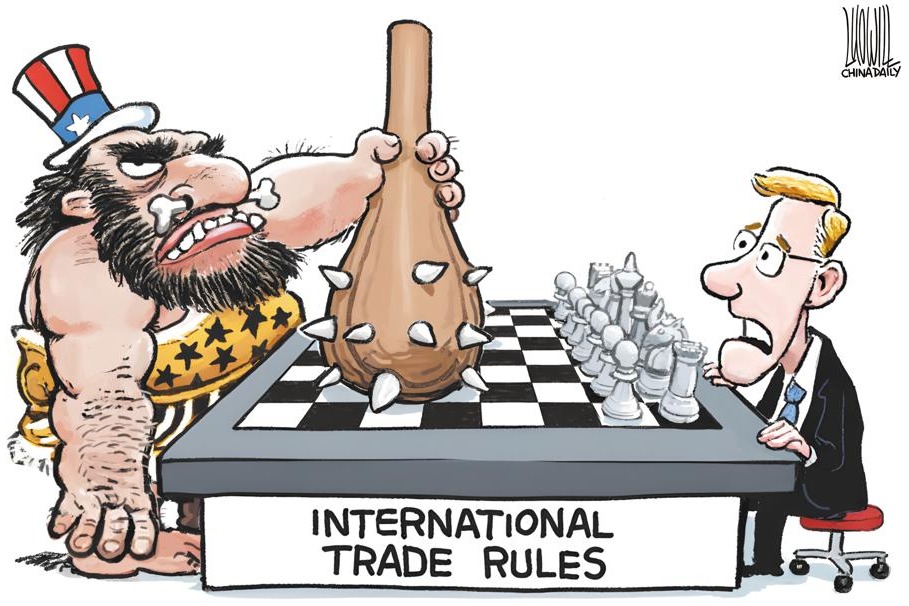
Macron is opposed to such geopolitical games because, he knows, they will lead to a brutal new Cold War, which would be a disaster for future generations considering what our generation and our parents' generation suffered during the Cold War.
The author is chief of China Daily EU Bureau based in Brussels.
If you have a specific expertise, or would like to share your thought about our stories, then send us your writings at opinion@chinadaily.com.cn, and comment@chinadaily.com.cn.