Tanks rather than thanks
Contrary to the claims of the US and the EU, China is not flooding the world with loss-making EVs









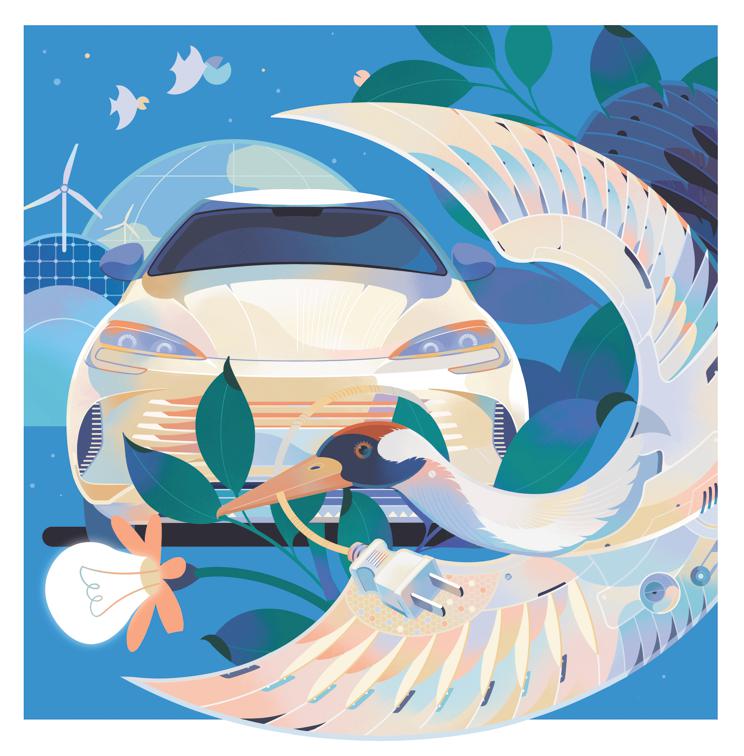
The United States and the European Union have been hyping up allegations that China's overcapacity is a cause of unfair trade. The Joe Biden administration has used this as an excuse to quadruple to 100 percent tariffs on China-made electric vehicles.
Economic competition in important forward-looking, save-the-planet sectors is a good thing. But the assertion often made is that the rivalry here is also strategic. Some months ago at an academic conference in the US, I asked why EVs are a matter of national security. Two US experts enlightened me: "Tanks. We make the best military attack vehicles when ours are the best automotive technologies."
In a related move, although less hardline, the EU is imposing tariffs of up to 38 percent on Chinese EVs. The reason is that it is what is required to level the playing field against China's "unfair economic practices".
Unlike concerns surrounding national security — where even magnets and rubber tires are suspect — economic reasoning can be publicly interrogated using empirical evidence.
What is overcapacity? If it were no more than what the English language says it is, then overcapacity is just capacity that arithmetically exceeds use. In economics, it is excess of supply over demand; it is how much is produced over how much is consumed. In international trade, overcapacity in this sense is exports minus imports, for that is how much more an economy produces than it consumes. This isn't very useful, however, as comparative advantage implies every economy will have overcapacity in some sector.
An alternative view is that overcapacity refers to an unlevel playing field, i.e., where one side doesn't play fair. That side is a nation that applies slave labor, practices economic coercion and uses illegally-sourced raw materials, operates low-standard engineering processes, thereby emitting excessive CO2 and pollution, and subsidizes industry or otherwise distorts markets in ways that violate international rules. Such a nation is then unfairly able to produce at cost lower than others who appropriately obey rules.
In June 2024 the World Trade Organization registered 49 dispute cases against China, with the US raising 23 of them and the EU 11. However, China is not alone in facing dispute action for not obeying rules. Indeed, at that same time the WTO recorded 171 cases against the US, with China raising just 18 and the EU 35. In other words, the dispute cases against the US are more than three times the number against China.
One of these complaints I've heard in other discussions, is that China might well be producing clean-energy machines, but it does so using dirty energy. This needs to be documented; I have seen no credible empirical evidence supporting it. And further questions should be asked: how are other nations making their clean-energy machines? Should dirty energy never be applied to invest in cleaner energy devices? Is it preferred to use dirty energy so that it has no obvious impact on future possibilities for clean energy?
A more appropriate and more immediate way to look at overcapacity is how many economists might do so, that is via the concept of dumping: Is the exporter selling in a foreign country at a price lower than it sells in its own, and hence is it running losses on its own account so as to harm that foreign country? It is easier to get evidence on this. That evidence, however, does not support the hypothesis of Chinese overcapacity. Many Chinese products — especially batteries and EVs — are cheaper in China than in the EU or the US. This is hardly surprising in light of the so-called Balassa-Samuelson effect, which says poorer countries are cheaper countries.
Are Chinese industries accused of overcapacity seen to be making losses? Market competition in China is fierce. But many Chinese industries, especially EVs, are profitable in the aggregate. Some individual businesses of course do fail, but that is evidence of creative destruction, not of dumping. The Chinese government does provide subsidies in the EV industry, but it does so for consumers to purchase EVs, not for producers to make them. Those consumer subsidies can be used to purchase Teslas just as easily as they can use to buy BYDs. Arguably, such consumer subsidies ought to be used more in all other economies to encourage the transition to clean-energy vehicles and away from fossil-fuel combustion.
Is China flooding Western markets with clean-energy products? China's total exports of EVs are only 14 percent of its aggregate production, a smaller fraction than that of cars exported by Japan and the Republic of Korea. Yes, that means more in absolute numbers — but penalizing a country for its size is a different economic argument than claiming it is breaking international trade rules. And, on the other side of the exchange: What fraction of total new car sales in the US are China-made EVs? Two percent.
While rightly looking out for their own industries and businesses, everyone needs to think a little also about the good of our planet. Simply put, the world needs clean cheap energy. To gain any reasonable measure of control over their own destiny, emerging economies will need massive sustained bursts of energy. The less-developed countries cannot afford costly technologies to replace fossil fuels and, as a result, unless things change, the Global South will be responsible for most of the world's impending carbon emissions. These countries are not agitating about clean-energy overcapacity: for the 70 percent of humanity that lives there, for a long while still, there is no state of the world where there are too many EVs, too much electric battery storage, or too many solar panels.
The author is Li Ka-shing professor in economics and dean of the Lee Kuan Yew School of Public Policy at National University of Singapore. The author contributed this article to China Watch, a think tank powered by China Daily. The views do not necessarily reflect those of China Daily.
Contact the editor at editor@chinawatch.cn.